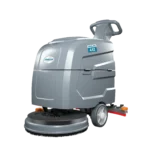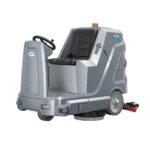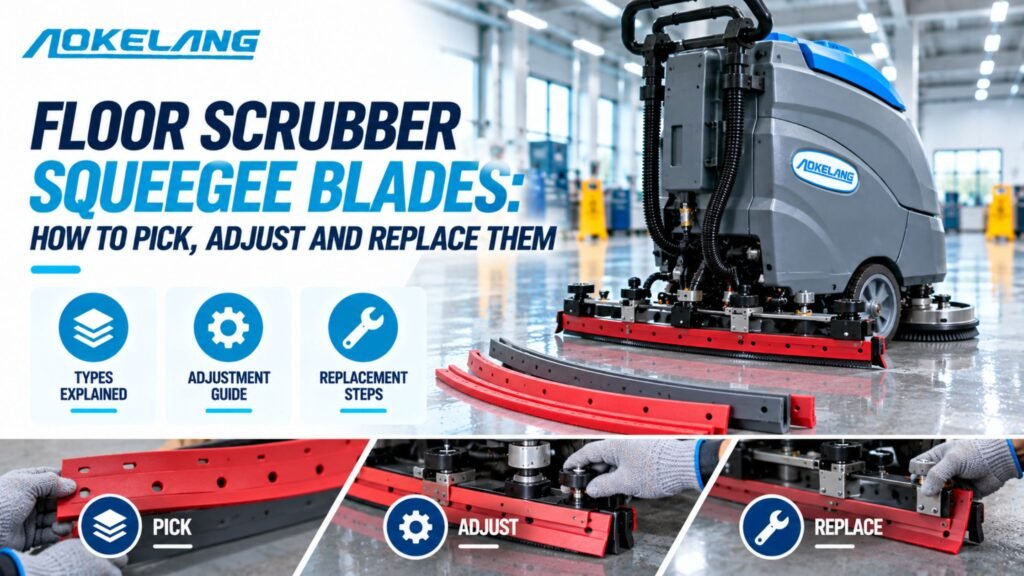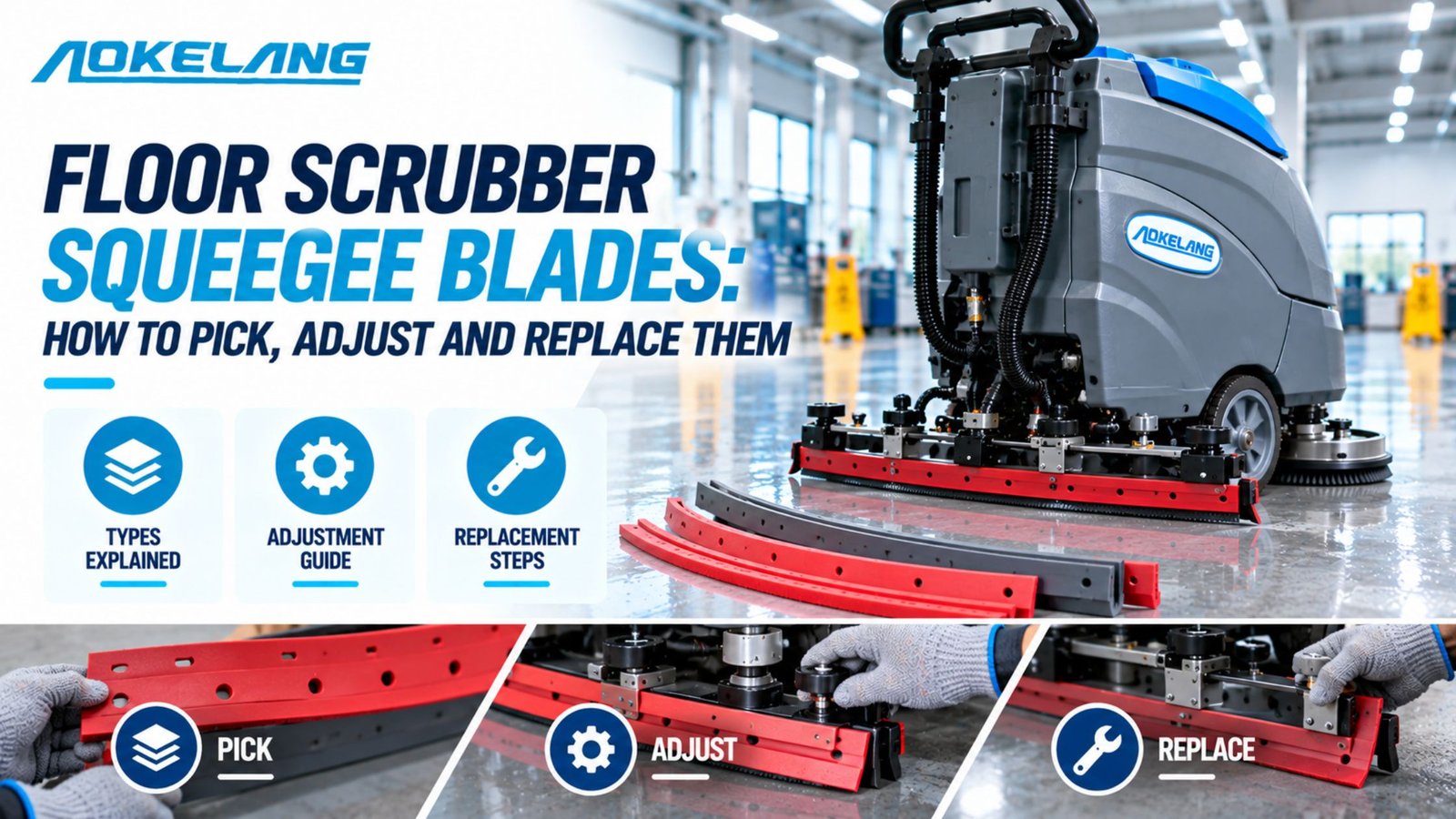
Floor scrubber squeegee blades are flexible rubber or polyurethane strips mounted on the machine’s rear assembly to channel water and cleaning solution toward the vacuum suction port. Front blades feature slotted notches for airflow, while solid rear blades perform the final scraping to dry the floor.
Key takeaways
- Pick the blade material for your floor and soil. Gum rubber is the budget option for smooth, clean floors. Linatex-type red rubber is the long-life option for most floors. Polyurethane is the choice for oil, grease and rough surfaces.
- Set the blade so it bends back evenly along its full length. Use the least bend that still wipes the floor dry.
- Wet in the middle or wet at the ends means the tilt (pitch) needs adjusting. Too much curl or too little means the height needs adjusting.
- Most rear blades have four usable edges. Rotate through all four before you replace the blade.
- Raise the squeegee whenever the machine is parked. A blade left pressed against the floor takes a permanent bend.
The squeegee blade is the part of a floor scrubber that wipes the floor dry, and it’s the part most often behind leftover water and streaks. Choose a blade material that suits your floor, set it to bend evenly across its full width, and rotate it to a fresh edge before it rounds off.
Table of Contents
What does each Floor scrubber squeegee blades do?
A scrubber squeegee usually has two blades with a gap between them, and the vacuum hose connects to that gap.
- The front blade faces the scrub deck. It has slots or notches cut along its edge, which let water flow through into the space between the blades.
- The rear blade is solid. It seals against the floor and wipes it dry as the machine moves forward.
Water passes through the front slots, is trapped by the rear blade, and is pulled up the hose by the vacuum. If either blade fails, the floor stays wet.
The two blades are not interchangeable. A slotted blade fitted in the rear position leaves a wet line at every slot.

Which squeegee blade material should you choose?
There are three common blade materials. Each suits a different kind of floor and soil.
| Material | Typical color | Best for | Weak point |
| Gum rubber | Tan or natural | Smooth floors, tile, retail and public areas on a budget | Swells and goes wavy in oil, and wears fastest |
| Linatex-type red rubber | Red | Most floors, including warehouses and rough concrete. Long life and tear-resistant. | Higher price, and still degrades with heavy oil |
| Polyurethane (urethane) | Clear, amber or other colors | Oily and greasy floors, workshops, kitchens, anti-slip and rubber floors | Higher price than gum rubber |
Gum rubber: the low-cost option
Gum rubber is soft and flexible, so it follows smooth floors and grout lines closely. It’s the cheapest blade to replace.
Its weakness is oil. Gum rubber absorbs oil and grease, swells, and turns wavy, and a wavy blade can no longer seal against the floor. It also wears faster on rough concrete.
Linatex-type red rubber: the long-life all-rounder
Linatex is a branded natural rubber with additives that make it more resistant to tearing and wear. Several major scrubber makers fit it as standard. It lasts longer than gum rubber on most floors, including rough warehouse concrete.
Not every red blade is Linatex, though. If you’re paying for the premium material, check the brand name.
Linatex handles mild chemicals better than gum rubber, but heavy oil will still shorten its life.
Polyurethane: the oil-resistant choice
Polyurethane resists oil, grease and many solvents without swelling. It suits machine shops, auto workshops, food production and commercial kitchens.
It’s also a good choice for anti-slip coatings and rubber floors, where softer rubber wears or grabs. One common setup on harsh floors pairs a slotted polyurethane front blade with a solid red rubber rear blade.
How do you match a blade to your floor?
Use the floor and soil together to decide:
- Smooth, clean floors like sealed concrete, vinyl tile and terrazzo: gum rubber works, and red rubber lasts longer.
- Grouted tile: red rubber or gum rubber, both of which flex into the joints.
- Rough or worn concrete: red rubber, for tear resistance.
- Any floor with oil, grease or coolant: polyurethane.
- Anti-slip epoxy or rubber flooring: polyurethane.
If your facility has mixed areas, choose for the worst one. A blade that swells after one pass through a greasy workshop won’t seal properly anywhere else.
How should a squeegee blade be adjusted?
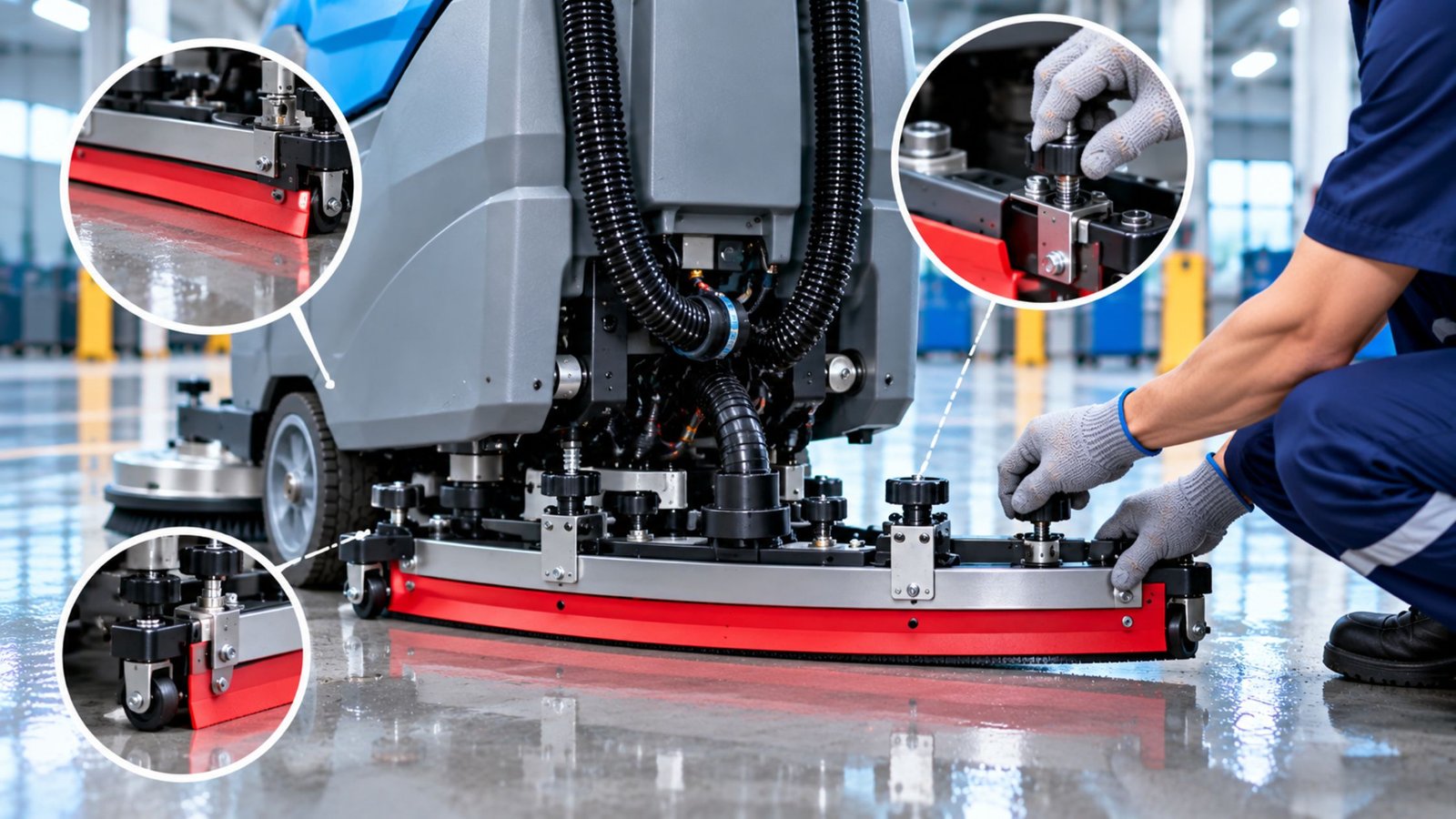
A correctly set rear blade bends back slightly, evenly along its whole length, while the machine moves forward. That bend is called deflection or roll-out.
The goal is the least deflection that still wipes the floor dry. Too much bend presses the blade’s flat face onto the floor instead of its edge, which wears it faster and can leave water. Too little bend lets the blade lift over low spots.
For reference, Tennant’s T7 operator manual specifies about 12 mm (0.5 in) of deflection on smooth floors and about 15 mm (0.62 in) on rough floors. Your machine’s manual may give different figures, so use them where they exist.
There are usually two adjustments.
- Height controls how much the whole blade bends. On many machines it’s set by the squeegee caster wheels, or by a height knob.
- Pitch or tilt controls whether the middle or the ends of the blade press harder. It’s usually a knob or bolt on the squeegee mount.
How to check and set the adjustment
- Park on a flat, level section of floor.
- Lower the squeegee and drive slowly forward a short distance, then stop.
- Look at the rear blade from behind. Check that the bend is even from one end to the other.
- Measure the deflection with a ruler, if your manual gives a target.
- Make small changes, one at a time, then drive forward and check again.
- Make a wet test pass and look at what’s left behind.
Use this table to choose which adjustment to make:
| What you see | What to adjust |
| Water left in the center of the path | Pitch: the ends are pressing harder than the middle |
| Water left at both ends of the path | Pitch: the middle is pressing harder than the ends |
| Water left along one side only | Level: check the caster heights and look for a bent frame |
| Blade curls over heavily and drags | Height: too much deflection |
| Blade barely bends and skips | Height: too little deflection |
Your manual shows which direction to turn each knob or bolt for your machine.
When the adjustment won’t hold
If you can’t get an even bend however you adjust it, check the squeegee casters. Worn or flat-spotted casters change the blade height and make proper adjustment impossible. Replace them as a set.
A frame bent by contact with racking, doorways or curbs causes the same problem. Lay a straight edge along the frame to check it.
How do you know a blade needs rotating or replacing?
Check the rear blade’s wiping edge weekly, and at any sign of water left behind.
- Rounded edge: a new edge has a sharp 90-degree corner. A worn one looks rounded, like an eraser. Rotate the blade.
- Nicks and tears: each nick leaves its own thin wet line. Rotate the blade if an unused edge is clean.
- Waviness or swelling: this means oil damage. Replace the blade and consider polyurethane.
- Hardening or cracking: the rubber is aged or chemically damaged. Replace it.
- Permanent curl: the blade was left pressed against the floor. It may recover once rotated; if not, replace it.
How do you rotate squeegee blades?
Most rear blades are symmetrical, so they have four wiping edges: two along the bottom and two along the top. Use all four before you buy a new blade.
- Raise the squeegee and turn off the machine.
- Disconnect the vacuum hose and remove the squeegee assembly, if your machine needs that.
- Release the strap, clamp or latches that hold the blade in place.
- Take the blade out and flip or turn it so an unused edge faces down and back.
- Line the blade’s holes up with the locating pins on the frame.
- Re-clamp it evenly so there are no gaps or bulges along the length.
- Refit the assembly and hose, then make a test pass.
A tip that saves guesswork: mark each used edge with a paint pen when you rotate, and note the date. You’ll always know which edges are left, and after a few rotations you’ll know roughly how many shifts one edge lasts on your floor. That makes ordering spares predictable.
Front blades wear too, but usually more slowly. Check the slots for tears, and replace the front blade when its edges are worn or the slots are split.
How do you replace a squeegee blade?
Replacing a blade uses the same steps as rotating one, with a new blade in place of the old.
- Order blades for your exact machine model. Length, hole pattern, thickness and slot spacing vary between machines.
- Clean the frame and clamps before fitting the new blade. Grit trapped behind a blade lifts its edge.
- Fit the blade, making sure the slotted front blade and the solid rear blade go in their correct positions.
- Re-check the deflection and pitch after fitting. A new blade is stiffer and sits differently from a worn one.
Keep a spare set of blades on hand. A worn blade found mid-shift then takes a few minutes to fix instead of a few days.
Store spare blades flat, in a cool place away from sunlight. Heat and UV harden rubber, and a blade stored bent may keep that bend.
Which habits make squeegee blades last longer?
- Raise the squeegee when parked. A lowered blade takes a permanent set overnight.
- Raise the squeegee before reversing. Backing up with the blade down folds it the wrong way.
- Pre-sweep the floor. Grit, glass and metal shavings cut blade edges.
- Wipe the blades after each shift. Dried sludge on the edge stops the blade sealing.
- Clean the deck splash skirt. Dust caked on the skirt breaks off and catches under the squeegee.
If your scrubber is leaving water behind and the blades look fine, the problem may be suction. See our guides on why a floor scrubber leaves streaks and what to do when a floor scrubber isn’t picking up water.
The squeegee works with the scrub brush or pad in front of it, so check that side too. Our guide to choosing scrubber brushes and pads matches attachments to concrete, tile, epoxy and terrazzo.
Also read –
Commercial Floor Scrubber Won’t Start
Scrubber Brushes and Pads Explained
Squeegees on Aokelang scrubbers
Squeegee width and blade size vary by model. A compact walk-behind like the Aokelang D4 covers a 510 mm cleaning path. A ride-on like the Aokelang D6 covers 760 mm and uses a correspondingly wider squeegee.
For replacement blades, give your machine model when you contact us at info@aokelang.com.
For daily start-up checks, including lowering and inspecting the squeegee, see our guide on how to use a floor scrubber.
Frequently asked questions
How often should squeegee blades be replaced?
There’s no fixed schedule, because wear depends on floor roughness, debris and hours of use. Check the edges weekly, rotate through all four, and replace the blade when every edge is rounded, nicked or swollen.
Should I replace the front and rear blades together?
Not necessarily. Rear blades usually wear first, so rotate and replace them on their own schedule. Replace the front blade when its slots split or its edges wear. Replacing both together during a planned service saves a second stop.
Can I cut a universal blade to fit my scrubber?
It’s possible, but blades made for your model fit better. Hole spacing, thickness and slot position all affect how the blade seals.
Why is my new squeegee blade leaving water?
A new blade is stiffer than the worn one, so it often needs the height or pitch adjusted again. Also check that the slotted blade is at the front and the solid blade is at the rear.