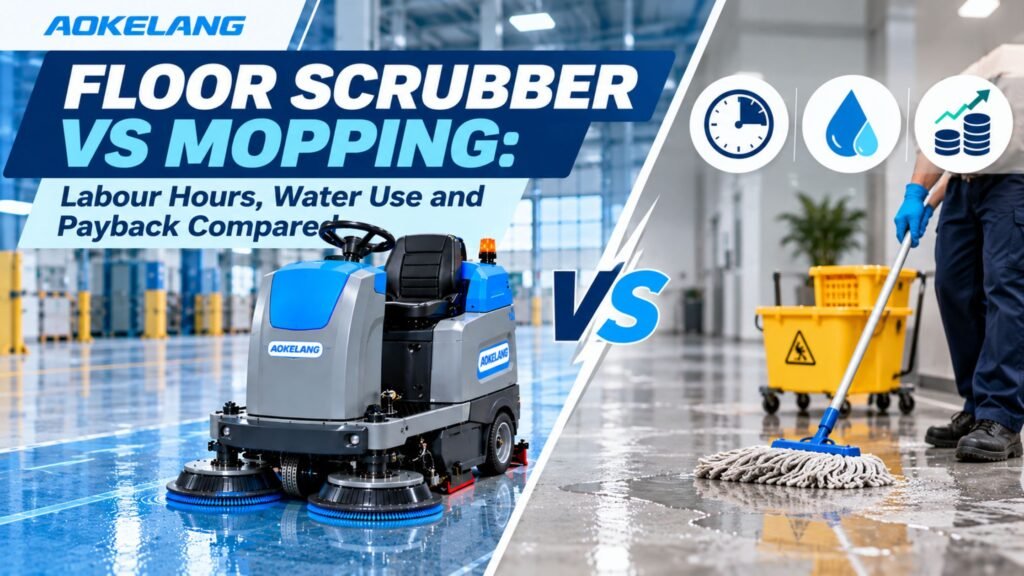
Floor Scrubber vs Mopping. A commercial floor scrubber–dryer trades higher upfront equipment cost for massive savings in labor time, water use, and hygiene consistency compared to manual mopping
Key takeaways
- A floor scrubber cleans several times more floor per hour than a mop. On a medium or large floor, that saves hours of labour every day.
- Payback depends almost entirely on floor size and cleaning frequency. A large floor cleaned daily can repay a scrubber in a few months. A small café floor may take years.
- Scrubbers generally use less water per square metre, and they never put dirty water back on the floor. Mops reuse the same bucket water as it gets dirtier.
- A scrubber leaves the floor almost dry, so the slip risk after cleaning is far shorter than with mopping.
- Keep a mop anyway. Scrubbers can’t reach tight corners, stairs or under fixtures.
A floor scrubber saves the most over mopping on large floors that are cleaned often. There, the labour hours saved repay the machine quickly. On small floors, the saving is small, and a mop is often the cheaper choice.
The rest of this guide shows how to work out which side of that line your floor falls on.
Table of Contents
How do a floor scrubber and a mop compare? Floor Scrubber vs Mopping
| Mopping | Floor scrubber | |
| Area cleaned per hour | Low. The operator wets, scrubs and wrings by hand. | Several times higher. The machine washes, scrubs and dries in one pass. |
| Water handling | One bucket. Water gets dirtier as cleaning goes on. | Separate clean and dirty tanks. Only clean solution reaches the floor. |
| Floor after cleaning | Wet, and slippery until it dries | Almost dry straight away |
| Dirt removal | Some soil is spread around in a thin film of dirty water | Soil is lifted and vacuumed into the recovery tank |
| Physical effort | Repetitive pushing, wringing and lifting buckets | Steering a machine |
| Upfront cost | Very low | Higher, from buying or renting the machine |
| Running costs | Mop heads, chemicals, labour | Electricity, pads, brushes, squeegee blades, servicing, labour |
| Tight spaces and corners | Good | Limited by the machine’s size |

What assumptions does this comparison use?
Real numbers vary from site to site, so every calculation below states its inputs. Replace them with your own figures for an accurate answer.
| Input | Value used | Notes |
| Wet mopping rate | 200 m²/h (about 2,150 sq ft/h) | A planning assumption. Time your own team for an accurate figure. |
| Walk-behind scrubber, real rate | 1,300 m²/h | A 0.5 m path at 4 km/h, with a 0.65 efficiency factor |
| Labour cost | $18 per hour | Use your fully loaded rate |
| Machine price | $6,000 | Illustrative only, not an Aokelang quote |
| Scrubber running costs | $60 per month | Electricity, pads, brushes, blades and servicing, averaged |
For how the 1,300 m²/h figure is worked out, see our guide to calculating floor cleaning productivity.
How many labour hours does a floor scrubber save?
The formula is the same for any floor:
Hours saved per clean = (floor area ÷ mopping rate) − (floor area ÷ scrubber rate)
Here’s how that works out for three floor sizes, using the assumptions above:
| Floor | Area | Mopping time | Scrubber time | Hours saved per clean |
| Small café or shop | 200 m² | 1.0 h | 0.15 h | 0.85 h |
| Medium retail store or clinic | 800 m² | 4.0 h | 0.6 h | 3.4 h |
| Large warehouse or supermarket | 3,000 m² | 15.0 h | 2.3 h | 12.7 h |
The scrubber time is real cleaning time. It includes turns, emptying and refilling, through the efficiency factor.
On a small floor, setup and pack-down still take time. Filling the tank, rinsing it and charging the machine can take most of the saving away. That’s why small floors rarely justify a machine on labour alone.
Does a floor scrubber use less water than mopping?
Usually, yes. The bigger difference, though, is where the water goes.
Mopping wets the whole floor, and the same bucket is reused until someone changes it. By the end of a section, the mop is putting back water that’s carrying the dirt it just picked up. Much of that water is left on the floor to dry.
A scrubber puts down a measured flow of clean solution. It scrubs it, then vacuums it straight back into a separate recovery tank. Dirty water never returns to the floor, and very little is left behind to dry.
To compare water use on your own site:
Mopping water per m² = bucket volume (L) ÷ area cleaned per bucket (m²)
Scrubber water per m² = solution flow (L/min) × 60 ÷ real productivity (m²/h)
Illustration:
- Mopping: a 15 L bucket changed every 100 m² uses about 0.15 L/m².
- Scrubber: a scrubber putting down 1.5 L per minute at 1,300 m²/h uses about 90 L per hour, or roughly 0.07 L/m².
That’s about half the water in this example. The gap grows if your team changes the mop water more often, as they should on dirty floors. Most scrubbers let you turn the flow down on lightly soiled floors, which cuts water use further.
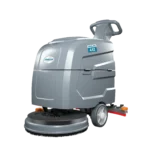
Tank size decides how often the operator stops. The compact Aokelang D2 carries 12 L of clean water and has a 14 L recovery tank. The Aokelang D4 carries 55 L, with a 60 L recovery tank, so it runs much longer between stops.
What about chemicals?
Mopping chemical use is hard to control. Detergent tends to be added to the bucket “by eye,” and every bucket change means a fresh dose.
With a scrubber, the dose is mixed once into the solution tank at a measured ratio. This is easier to keep consistent. Too much detergent is also one of the causes of a sticky film and streaks, so accurate dosing helps the floor as well as the budget.
How long does a floor scrubber take to pay for itself?
Payback compares the machine’s cost with what it saves each month:
Monthly saving = (hours saved per clean × cleans per month × labour rate) − scrubber running costs
Payback (months) = machine price ÷ monthly saving
Here’s how that works out for the same three floors, each cleaned about 22 times a month:
| Floor | Hours saved per month | Labour saving | Minus running costs | Monthly saving | Payback on $6,000 |
| Small (200 m²) | 18.7 h | $337 | $60 | $277 | About 22 months |
| Medium (800 m²) | 74.8 h | $1,346 | $60 | $1,286 | About 5 months |
| Large (3,000 m²) | 279 h | $5,029 | $60 | $4,969 | About 1.2 months |
Three things stand out:
- Floor area drives everything. The large floor saves almost 18 times as much per month as the small one.
- Cleaning frequency matters almost as much. A floor cleaned twice a day saves twice as many hours.
- On small floors, the result is borderline. A cheaper compact machine, a lower labour rate, or less frequent cleaning can push payback out to several years.
These figures leave out water and chemical savings, which shorten payback a little. They also leave out battery replacement and major repairs, which lengthen it over the machine’s life.
Does saving labour hours mean cutting staff?
Not necessarily, and it often doesn’t. Most facilities use the hours saved in other ways:
- Cleaning more often. For example, scrubbing busy areas twice a day instead of once.
- Covering tasks that were being skipped. Washrooms, high-touch surfaces and edge work often fall behind.
- Finishing inside a shorter window. Overnight cleaning in a supermarket has to finish before opening.
- Reducing overtime and agency hours.
Whichever way the hours are used, the saving is real. It shows up either as lower labour cost or as more cleaning for the same cost.
Is a floor scrubber safer than mopping?
In two ways.
Slip risk. A mopped floor stays wet until it air-dries, and that can take a while on a cool or humid day. A scrubber’s squeegee leaves the floor almost dry as it passes, so the area can reopen sooner.
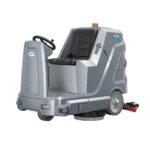
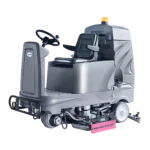
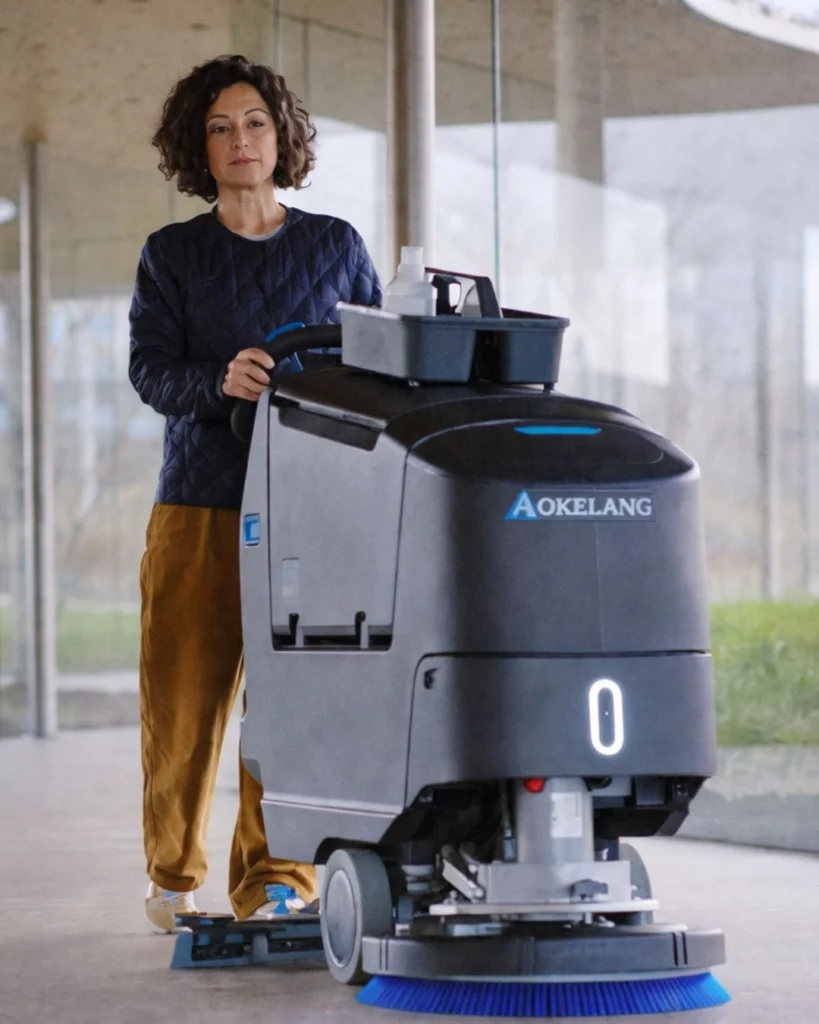
Operator strain. Mopping a large floor means hours of repetitive pushing, twisting and wringing, and carrying heavy buckets. Steering a scrubber takes much less physical effort. Ride-on models like the Aokelang D6 remove the walking as well.
When is mopping still the better choice?
A scrubber doesn’t replace the mop completely. Mopping is still the right tool for:
- Small floors, where setup time cancels out the speed gain
- Tight spaces, such as small washrooms, kitchen corners and under fixed counters
- Stairs, ramps too steep for the machine, and raised edges
- Edges and corners that the scrub head can’t reach
- Quick spot spills between full cleans
Most facilities that buy a scrubber keep a mop for these jobs. The scrubber does the open floor, and the mop does the detail.
Also read – How to Calculate Floor Cleaning Productivity
How do you run this comparison for your own site?
- Measure the floor area you clean by machine-friendly methods: open floor, not stairs or tiny rooms.
- Time your current mopping on a known area to get your real mopping rate.
- Pick a scrubber size and work out its real productivity: width × speed × 1,000 × efficiency factor.
- Count cleans per month, including any second daily clean.
- Use your loaded labour rate, including wages, taxes and benefits.
- Get a real machine price and an estimate of running costs.
- Run the labour and payback formulas above.
If you send us your floor area, layout and cleaning frequency, we can suggest a scrubber size and help you check the numbers.
Which scrubber size fits which floor?
Match the machine to the floor, not the other way round. A machine that’s too big for a small site wastes money, and one that’s too small for a big site wastes labour.
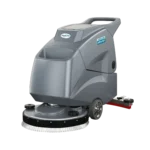
- Small floors and tight layouts: the Aokelang D2 has a 350 mm cleaning width and a compact body for corridors, offices and small shops.
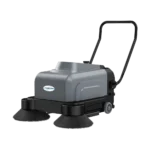
- Medium floors: the Aokelang D4 walk-behind has a 510 mm path and 3 to 4 hours of battery runtime.
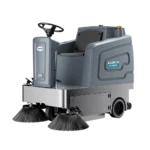
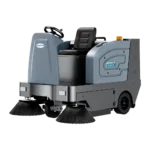
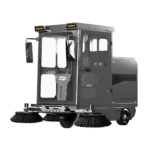
- Large floors: the Aokelang D6 ride-on covers a 760 mm path with dual brushes, and its larger tanks mean fewer stops.
For first-day setup and good operating habits, see our guide on how to use a floor scrubber.
Frequently Asked Questions – Floor Scrubber vs Mopping
What floor size makes a scrubber worth buying?
There’s no fixed cut-off, because frequency and labour cost matter as much as area. As a rough guide from the examples above, floors of several hundred square metres or more, cleaned daily, usually pay back within a year. Floors of around 200 m² or less often don’t on labour alone.
Does a floor scrubber clean better than a mop?
On open hard floors, generally yes. It scrubs with a powered brush or pad and removes the dirty water, while a mop tends to spread a thin film of dirty water around. Mops still do better in corners and tight spaces.
Can I rent a scrubber instead of buying one?
Yes. Renting suits short-term projects, or testing whether a machine fits your site. For daily cleaning, compare monthly rental cost with the payback period. Buying usually works out cheaper once the payback period has passed.
Does a floor scrubber need special chemicals?
Use a low-foam cleaner made for automatic scrubbers. Household or high-foam detergents can fill the recovery tank with foam and reduce suction.