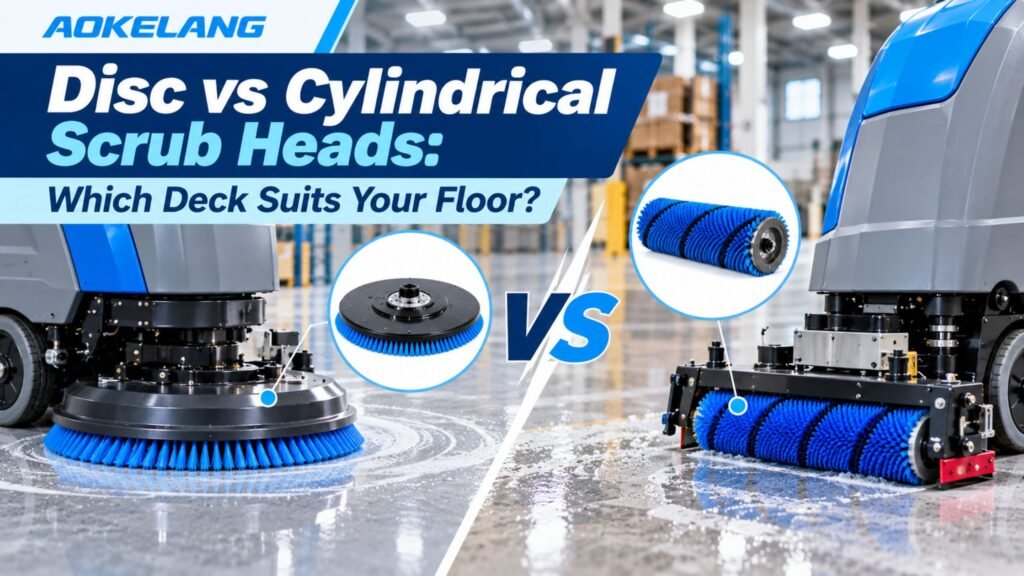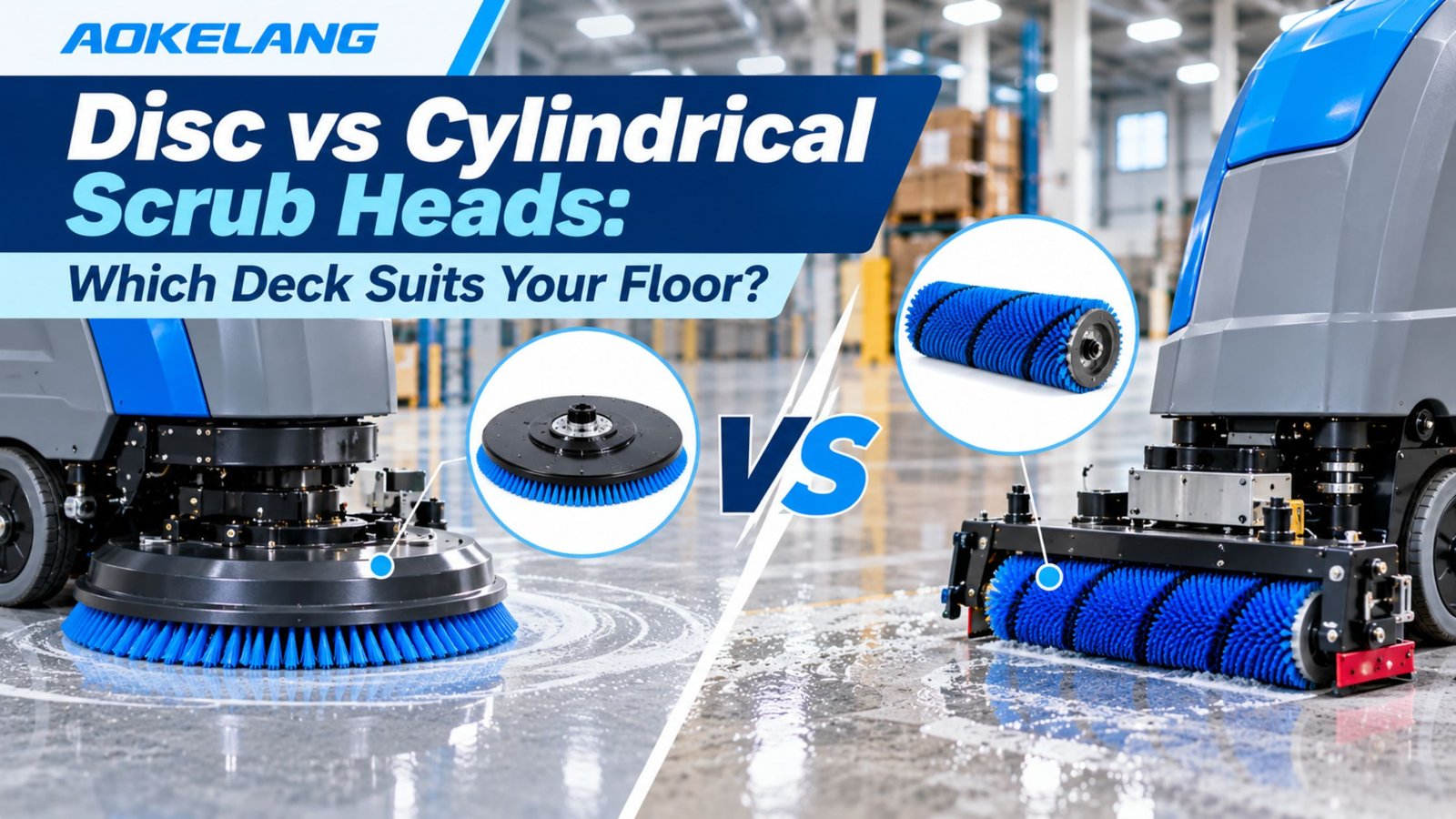
Disc vs Cylindrical Scrub Heads? Choosing between a disc and a cylindrical scrub head depends primarily on your floor texture, debris level, and maintenance routine
Key takeaways
- Disc decks suit smooth, flat floors that have already been swept. They press down harder, accept pads, and handle heavy soil and finish work well.
- Cylindrical decks suit uneven, grouted or textured floors. Their counter-rotating brushes reach into low spots and collect small loose debris while scrubbing.
- A cylindrical deck can remove the pre-sweep step, which can save more time than any difference in scrubbing speed.
- Disc decks are usually cheaper to run and more flexible, because one machine can use brushes or pads.
- Large debris still needs a sweeper, whichever deck you choose. A cylindrical deck’s tray is made for small debris such as grit, dust and wrappers.
A disc scrub deck is the better choice for smooth, flat floors that are swept before scrubbing. A cylindrical scrub deck is better for rough, uneven or grouted floors, because it sweeps up small debris and scrubs in the same pass.
Table of Contents
How does each scrub deck work?
A disc deck uses one or more flat, round brushes or pads that spin parallel to the floor. Solution is fed into the center of the brush. The deck presses down hard, so all its scrubbing force goes into the flat surface it touches.
A cylindrical deck uses two barrel-shaped brushes that spin in opposite directions, like a pair of rolling pins. Solution is spread from a drip tray in front of the brushes. As they spin, the brushes throw loose debris into a collection tray, while the bristles scrub the floor.
Speed differs too. According to Tennant, disc brushes typically run at about 250–300 RPM, while cylindrical brushes run at about 600–800 RPM.

What are the main differences? Disc vs Cylindrical Scrub Heads
| Disc deck | Cylindrical deck | |
| Brush shape | Flat and round | Barrel-shaped, in pairs |
| Brush speed | About 250–300 RPM | About 600–800 RPM |
| Down pressure | Higher | Lower |
| Best floor | Smooth, flat and even | Uneven, textured or grouted |
| Loose debris | Not collected, so the floor must be swept first | Small debris thrown into an onboard tray |
| Pads | Yes, using a pad driver | No standard flat pads |
| Grout lines | Bristles skim over shallow grout | Bristles flick into grout and recesses |
| Finish work | Suits stripping and polishing with pads | Not designed for finish work |
| Brush cost | Usually lower | Often higher |
| Maintenance | Brush or pad only | Brushes plus a debris tray to empty |
When is a disc deck the better choice?
Choose a disc deck when your floor is smooth and flat, and your team already sweeps before scrubbing.
Disc decks work best on:
- Sealed and polished concrete
- Vinyl composition tile (VCT) and sheet vinyl
- Smooth epoxy coatings
- Terrazzo and other polished hard floors
Disc decks have three main strengths.
More down pressure. A disc presses its full weight onto a flat surface. That gives it more scrubbing force on heavy soil, scuff marks and built-up grime.
Pads and brushes on one machine. Swap the brush for a pad driver, and the same scrubber can run a red pad for daily cleaning, a white pad for polishing, or a stripping pad for finish removal. Our guide to choosing scrubber brushes and pads covers which pad suits which floor.
Lower running costs. Disc brushes and pads are usually cheaper to replace, and there’s no debris tray to empty.
The trade-off is debris. A disc deck has nowhere to put grit, wrappers or dust. Anything left on the floor gets pushed back to the squeegee, where it can lift the blade and leave wet streaks. That’s why disc decks need a swept floor. For more on that problem, see why a floor scrubber leaves streaks.
When is a cylindrical deck the better choice?
Choose a cylindrical deck when your floor is uneven, grouted or textured, or when pre-sweeping takes up a lot of labour.
Cylindrical decks work best on:
- Rough or worn industrial concrete
- Quarry tile and grouted ceramic tile
- Anti-slip and safety flooring
- Natural stone with an uneven surface
- Floors with cracks, joints or expansion gaps
Cylindrical decks have three main strengths.
They clean the low spots. The bristles strike the floor on their way round, so they flick into grout lines, cracks and texture that a flat disc skims over.
They sweep while scrubbing. Small debris such as grit, dust, cable ties and wrappers goes into the tray, so the operator can often skip the separate pre-sweep.
No dust. The debris is collected wet, so it isn’t thrown into the air the way a dry broom can.
The trade-offs are lower down pressure, no pad option, and brushes that often cost more. Operators also need to empty the debris tray after each use.
Also read – Floor Scrubber vs Mopping
How much time does skipping the pre-sweep save?
The pre-sweep is easy to forget when comparing machines, but it can take longer than the scrubbing itself.
Compare total time, not just scrubbing time:
Disc deck total time = pre-sweep time + scrub time
Cylindrical deck total time = scrub time + tray emptying
Illustration: a 2,000 m² factory floor with light grit and packaging scraps. The rates below are planning assumptions.
| Step | Disc deck | Cylindrical deck |
| Pre-sweep with a push broom at 500 m²/h | 4.0 h | Not needed |
| Scrub at a real 1,300 m²/h | 1.5 h | 1.5 h |
| Empty the debris tray | Not needed | 0.1 h |
| Total | 5.5 h | 1.6 h |
In this example, the cylindrical deck saves almost four hours per clean. That saving comes entirely from skipping the sweep.
If you already pre-sweep with a ride-on sweeper, or the floor has very little loose debris, the gap is much smaller.
To work out real scrubbing rates for your site, see our guide to calculating floor cleaning productivity.
Can a cylindrical deck replace a sweeper?
Only on floors with light, small debris.
A cylindrical deck’s tray is made for grit, dust, small wrappers and similar debris. It isn’t built for:
- Large items such as pallet pieces, cardboard or shrink-wrap rolls
- Heavy loads of sand or gravel
- Outdoor yards and loading docks with lots of debris
On those floors, run a dedicated sweeper first. Our industrial floor sweeper buying guide explains how to size one.
What about orbital scrub decks?
Some scrubbers use a third type, the orbital deck. A square or rectangular pad moves in small, fast circles instead of spinning.
Orbital decks are mainly used for chemical-free finish removal and for getting into corners. They suit smooth floors with pads, much like disc decks, but they aren’t designed to collect debris. Most buyers choose between disc and cylindrical.
How do you choose the right deck?
Answer these questions in order:
- Is the floor smooth and flat, or uneven, textured or grouted? Smooth points to disc. Uneven points to cylindrical.
- How much loose debris is on the floor before scrubbing? None or little points to disc. Light, small debris points to cylindrical. Heavy or large debris needs a sweeper first, whichever deck you choose.
- Do you need pads for polishing or finish removal? If yes, choose disc.
- How long does pre-sweeping currently take? If it’s a large share of cleaning time, a cylindrical deck can pay for its higher brush costs.
- Do you have mixed floors? Choose for the floor that makes up most of your cleaning area, and handle the exceptions separately.
Here’s a summary by floor and debris type:
| Floor and conditions | Best deck |
| Polished concrete, swept daily | Disc |
| VCT or sheet vinyl in retail or healthcare | Disc |
| Smooth epoxy, with polishing needed | Disc |
| Grouted quarry tile in a commercial kitchen | Cylindrical |
| Rough warehouse concrete with light grit, no regular sweeping | Cylindrical |
| Anti-slip safety flooring | Cylindrical |
| Warehouse with large debris and long aisles | Sweeper first, then either deck |
How do you maintain each type of deck?

Disc decks
- Rinse the brush or pad after every use and let it dry.
- Many disc brushes have a built-in wear indicator. Replace the brush when the bristles wear down to it.
- Flip pads to their unused side, and replace them when they’re thin or glazed.
Cylindrical decks
- Empty and rinse the debris tray after every shift. A full tray stops collecting and can spill debris back under the squeegee.
- Pull out hair, string and wrap that gets tangled around the brushes.
- Rotate the brushes front to back regularly. Tennant suggests weekly, so they wear evenly.
- Tennant recommends replacing cylindrical brushes when the bristles are worn to about 1 cm (½ inch). Worn bristles throw debris poorly and scrub less.
With either deck, the squeegee finishes the job. Keep the blades in good condition using our guide to floor scrubber squeegee blades.
Which deck is right for your Aokelang scrubber?
Aokelang scrubbers are rated for tile, epoxy, terrazzo, marble, PVC and concrete floors. When you request a quote, tell us your floor type, how much loose debris you have, and whether you currently pre-sweep. We’ll match the deck and the brush or pad to your site.
Frequently asked questions
Is a disc or cylindrical scrubber better for warehouses?
It depends on the floor and the debris. A smooth, sealed warehouse floor that’s swept regularly suits a disc deck. A rough concrete floor with light grit and no regular sweeping suits a cylindrical deck. Heavy debris needs a sweeper whichever deck you choose.
Can I put a pad on a cylindrical scrubber?
Not a standard flat pad. Cylindrical decks use cylindrical brushes. Some manufacturers offer sleeve-style alternatives, but if you need regular polishing or finish removal, a disc deck is the better fit.
Why does my disc scrubber leave grit and streaks behind?
Disc decks don’t collect loose debris, so grit is pushed to the squeegee, where it lifts the blade. Sweep before scrubbing, or consider a cylindrical deck if the floor always has light debris.
Do cylindrical scrubbers use more water?
Not necessarily. Water use depends on the solution flow setting more than the deck type. Set the flow to the lowest level that cleans the floor properly.