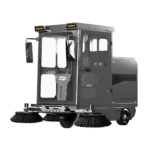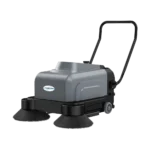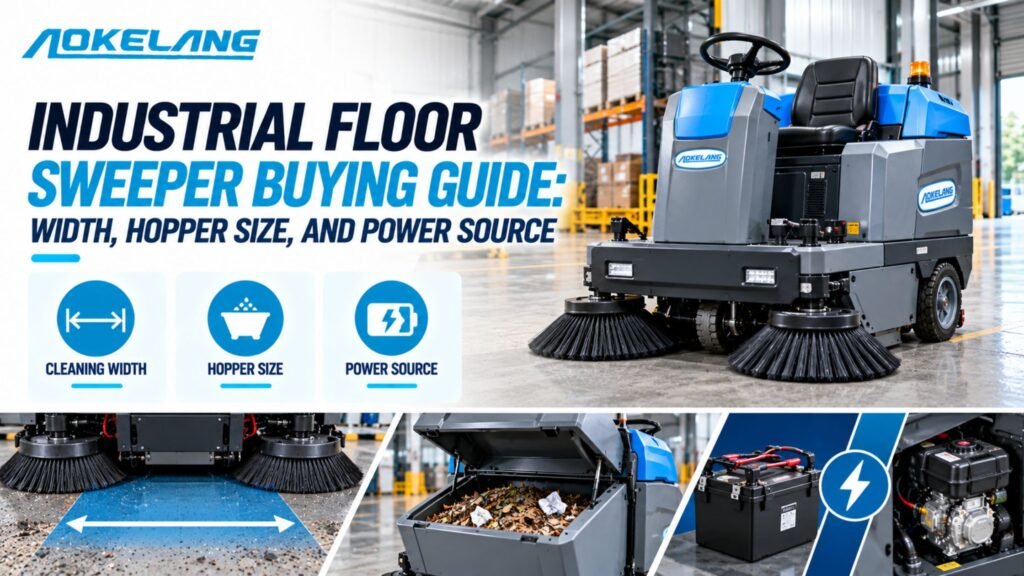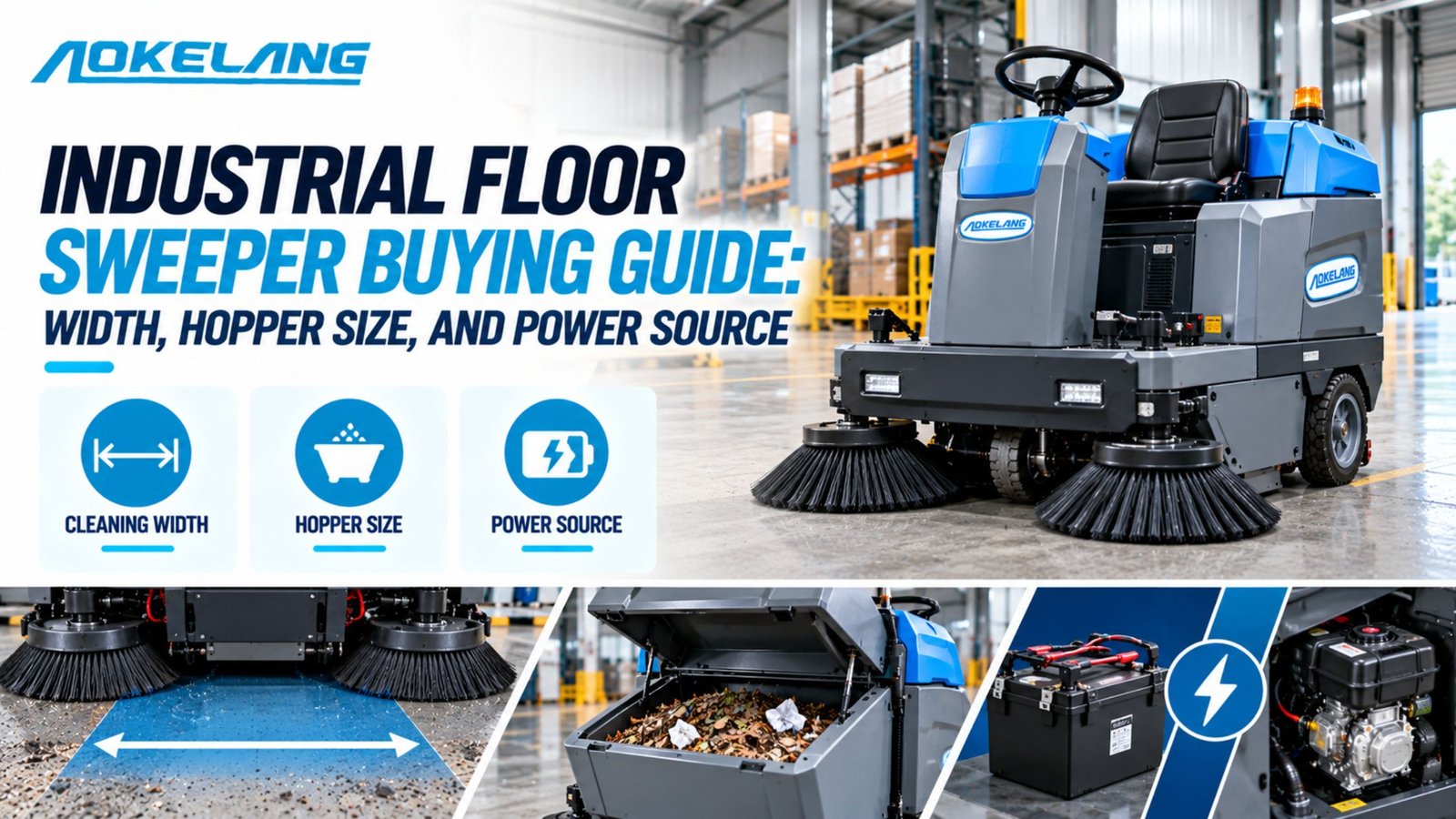
Industrial Floor Sweeper Buying Guide – Selecting the right industrial floor sweeper requires evaluating your specific facility layout, debris type, and total square footage. These specialized machines maximize commercial productivity by controlling fine dust and clearing debris significantly faster than manual sweeping.
To choose an industrial floor sweeper, match the sweeping width to your floor area and narrowest aisle, the hopper to the type and volume of your debris, and the power source to whether you sweep indoors or outdoors. Then check that the battery runtime or fuel range covers a full shift.
Key takeaways
- Choose sweeping width from your floor area and your narrowest aisle. A wider path covers more ground, but only if the machine fits through your doors and can turn at the end of each aisle.
- Real output is lower than the rated figure. Rated productivity is path width multiplied by top speed. Turns, obstacles and emptying stops cut it down, so plan for less.
- Hopper volume and debris weight both matter. Sand and grit hit the weight limit before the hopper looks full. Shrink wrap and cardboard fill it by volume fast.
- Battery power suits indoor work. Diesel and LPG suit long outdoor shifts. Match battery runtime to your shift before you buy.
- Before ordering, check five specs that are often missed: body width, turning radius, gradeability, filter type and parts availability.
Table of Contents
Do you need a sweeper or a scrubber?
Decide this first, because the two machines do different jobs.
- A sweeper collects dry debris, such as dust, grit, packaging scraps, pallet splinters and shavings. It covers ground quickly and uses no water or chemicals.
- A scrubber washes the floor. It removes oil, tire marks, spills and grime that is stuck to the surface. A sweeper would only spread these around.
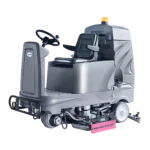
Many warehouses run both: a sweeper for daily debris, and a scrubber for scheduled wet cleaning. If your main problem is grime rather than loose debris, look at a ride-on scrubber like the Aokelang D6 instead.
What should you measure before choosing?
Gather these numbers first. Every decision in this guide uses them.
- Floor area to sweep per day, in square meters or square feet.
- Narrowest doorway or choke point the machine must pass through.
- Narrowest aisle where the machine must turn around.
- Steepest ramp, as a percentage gradient.
- Debris type: light and bulky (wrap, paper, cardboard) or heavy and dense (sand, grit, metal shavings).
- Indoor, outdoor or both.
- Length of the sweeping shift, in hours.
- Any dust-sensitive areas, such as food, packaging or electronics.
How wide should the sweeping path be?
Sweeping width sets how much floor each pass covers. Too narrow, and the operator makes extra passes all shift. Too wide, and the machine won’t fit where it needs to go.
Use floor area as your starting point:
| Daily floor area | Machine type | Typical sweeping width |
| Up to about 1,000 m² (10,000 sq ft) | Manual push or small walk-behind | 600–800 mm (24–31 in) |
| About 1,000–3,000 m² (10,000–30,000 sq ft) | Battery walk-behind | 800–1,000 mm (31–39 in) |
| About 3,000–8,000 m² (30,000–85,000 sq ft) | Compact ride-on | 1,000–1,300 mm (39–51 in) |
| Over 8,000 m² (85,000 sq ft) | Full-size ride-on | 1,400 mm (55 in) and wider |
These ranges are a starting point, not a rule. A site with many narrow aisles may need a smaller machine than its total area suggests. A site with long, open runs can use a wider one.
How much floor will a sweeper actually cover per hour?
Rated productivity is the sweeping width multiplied by the maximum forward speed. It assumes driving in a straight line without stopping.
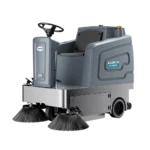
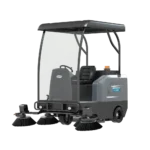
Take the Aokelang D1450 as an example. It sweeps a 1,450 mm path at up to 10 km/h:
1.45 m × 10,000 m/h = 14,500 m²/h
That is close to its rated 15,000 m²/h.
Real sweeping is slower. Operators turn at aisle ends, slow down around people and racking, and stop to empty the hopper. As a planning rule of thumb, assume you’ll achieve 50 to 70 percent of the rated figure. This is our working estimate; the exact figure depends heavily on your layout.
Worked example: a 20,000 m² warehouse swept with a D1450 at 60 percent of rated output:
- 15,000 m²/h × 0.6 = 9,000 m²/h
- 20,000 m² ÷ 9,000 m²/h ≈ 2.2 hours of sweeping
That fits inside the D1450’s 3 to 4 hour battery runtime, with a margin left over.
Run the same calculation for your own floor area. If the result is longer than one battery charge or one shift, you need a wider machine, a second machine, or a charging plan.
Will the sweeper fit through your doors and aisles?
Sweeping width and machine width are not the same number. Side brushes usually reach beyond the body, so the sweeping path can be wider than the machine itself.
The D1450, for example, sweeps 1,450 mm but has a 1,400 mm wide body. Doorway clearance depends on the body width, plus a margin for the operator to steer through without clipping the frame.
Turning is a separate check. The D1450 has an 1,800 mm turning radius. In a dead-end aisle, the machine needs room to turn around, or the operator has to reverse out.
Before ordering, check four specs:
- Body width against your narrowest doorway
- Turning radius against your narrowest aisle where the machine has to turn
- Gradeability against your steepest ramp. The D1450 is rated for a 25% gradient.
- Machine weight against any mezzanine or raised-floor load limits
How big should the hopper be?
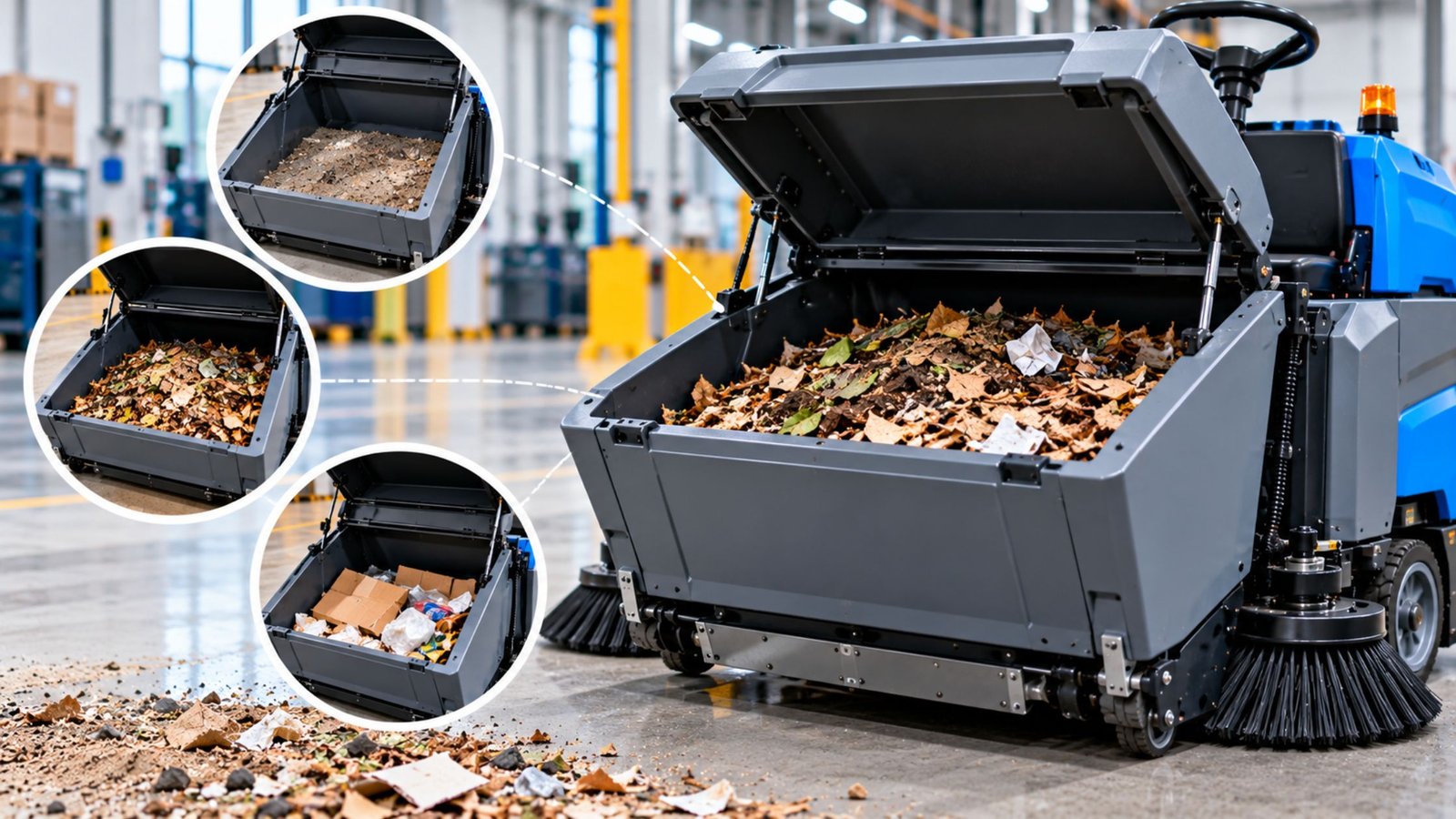
The hopper holds the debris until you empty it. A hopper that’s too small means constant stops. One that’s too large adds weight and cost you don’t need.
Typical capacities:
- Walk-behind sweepers: about 30–80 L (8–20 gallons)
- Ride-on sweepers: about 80–200 L or more (20–50+ gallons)
The D1450 has a 120 L debris container.
Volume or weight: which fills first?
The hopper fills differently depending on what you sweep:
| Debris type | Examples | What limits the load |
| Light and bulky | Shrink wrap, cardboard, paper, leaves | Volume. The hopper looks full quickly but is light. |
| Mixed | General warehouse dust, packaging scraps, pallet splinters | Usually volume |
| Heavy and dense | Sand, grit, gravel, metal shavings | Weight. The hopper reaches its weight limit before it looks full. |
For heavy debris, check the hopper’s weight capacity as well as its volume. An overloaded hopper strains the lift mechanism and is hard to empty by hand.
How will you empty it?
There are two common emptying systems:
- Manual dump: the operator pulls out the hopper or tips it at floor level. This suits smaller machines and light debris.
- High dump: the hopper lifts hydraulically and tips straight into a skip or dumpster. This suits ride-on machines handling large or heavy loads, and saves lifting.
To estimate emptying frequency, sweep one busy zone and time how long the hopper takes to fill. Then multiply that across your full area.
Battery, LPG or diesel: which power source fits?
The power source depends mainly on where you sweep and for how long.
| Power source | Best for | Strengths | Limits |
| Battery | Indoor warehouses, factories, food and retail | No exhaust, quiet, low running cost | Runtime limited by battery, plus charging time |
| LPG | Mixed indoor and outdoor use, where local rules allow | Fast refueling, long runtime | Exhaust; indoor use needs ventilation and depends on local rules |
| Diesel | Outdoor yards, car parks, docks | Long runtime, fast refueling, handles heavy outdoor debris | Exhaust and noise make it unsuitable indoors |
| Petrol | Outdoor sites | Simple refueling | Exhaust and noise |
Battery: check runtime against your shift
Battery sweepers are the default for indoor work. The D1450 runs on a 48V/80Ah battery system rated for 3 to 4 hours of continuous use.
Compare the runtime with the calculation from earlier:
- If sweeping time is shorter than the runtime: one charge per day is enough.
- If it’s longer: plan a midday charge, add a second battery pack, or consider lithium batteries, which handle short top-up charges better than lead-acid.
Our guide to battery powered floor scrubbers compares lead-acid and lithium. The same trade-offs apply to sweepers.
Combustion engines: for outdoor and long shifts
Diesel, LPG and petrol sweepers refuel in minutes and can run for a full shift without stopping. They’re the usual choice for outdoor yards and large sites where charging time isn’t practical.
Their exhaust rules them out of most enclosed spaces. If you sweep both indoors and outdoors, some buyers run a battery machine inside and a combustion machine outside, instead of one machine that compromises on both.
Also read –
Scrubber Brushes and Pads Explained
Floor Scrubber Squeegee Blades
Which other features are worth checking?
Dust control
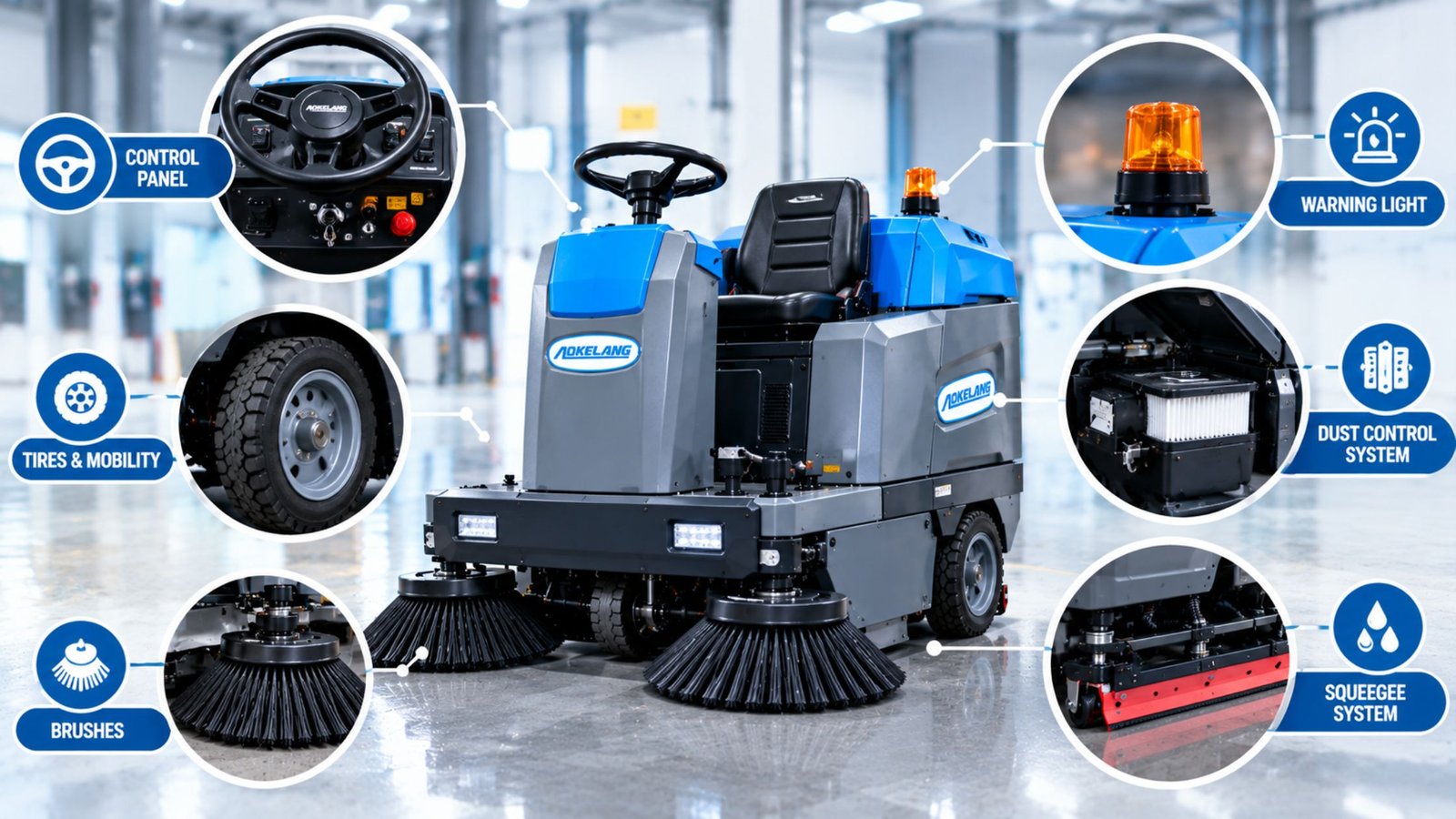
A sweeper’s brushes kick up fine dust. Without dust control, much of it settles back on the floor and racking. Look for:
- A vacuum fan and filter that pull dust into the hopper. The D1450 has a 500 W vacuum motor.
- A filter shaker, which knocks dust off the filter to keep suction steady through the shift.
- A water spray system, which damps dust at the brush on very dusty floors.
For food, packaging and electronics areas, ask about the filter’s rating for fine particles.
Brushes
Most industrial sweepers combine a cylindrical main brush with one or two side brushes. The side brushes reach along walls and racking. The D1450 uses a 700 mm main brush and two side brushes.
Brush bristles come in different stiffnesses. Softer bristles suit smooth indoor floors, and stiffer bristles suit outdoor grit and rough concrete.
Operator comfort
On ride-on machines, check:
- seat adjustment
- visibility over the hopper
- steering effort
- noise level
An operator who sweeps for three hours a day notices the difference, and comfort affects how carefully the job gets done.
What does a sweeper cost to run?
The purchase price is only part of the cost. Over the machine’s life, budget for:
- Brushes: main and side brushes wear with hours of use, and faster on rough or outdoor surfaces.
- Filters: replacement is more frequent in very dusty environments.
- Energy: electricity for battery models, fuel for combustion models.
- Batteries: packs need replacing after a number of years, depending on type and care.
- Operator time: every hour of sweeping is an hour of paid labor. A machine that cuts sweeping time by an hour a day saves hundreds of labor hours a year.
Because labor adds up quickly, the cheapest machine is often not the cheapest to run. A wider machine that finishes in half the time can pay back its higher price.
What should you ask a sweeper manufacturer?
Before you place an order, ask:
- Can you send a full specification sheet, including body width, turning radius, gradeability and hopper weight capacity?
- How is the hopper emptied: manually or with a high dump?
- What filter does it use, and does it have a shaker?
- Which spare parts do you keep in stock, such as brushes, filters and batteries? What is the lead time?
- What battery type comes standard, and is lithium available?
- Can you show the machine working on video, ideally on a floor like yours?
Aokelang builds its sweepers and scrubbers at its own 20,000 m² manufacturing base in Hefei, China. Read more about Aokelang, or send us your floor area, aisle widths and debris type for a model recommendation.
Frequently asked questions
Can an industrial sweeper pick up water or wet debris?
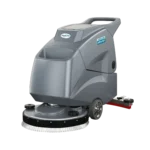
Sweepers are built for dry debris. Damp debris can be swept, but standing water and wet sludge clog filters and brushes. For wet floors, use a floor scrubber. A compact walk-behind like the Aokelang D4 suits smaller areas.
Should I buy one large sweeper or two smaller ones?
One wide machine is usually the best value on large, open floors. Two smaller machines work better when the site splits into separate zones, such as narrow-aisle storage and an open dock, or when you need cover if one machine is down for service.
How often should a sweeper’s filter be cleaned?
Shake or tap the filter clean during or after every shift. Machines with a filter shaker can do this at the push of a button. Replace the filter when cleaning no longer restores suction, or as the manual recommends.
Can one sweeper be used both indoors and outdoors?
Yes, if it’s battery-powered and its brushes and tires suit outdoor surfaces. Combustion sweepers are generally kept outdoors because of their exhaust.