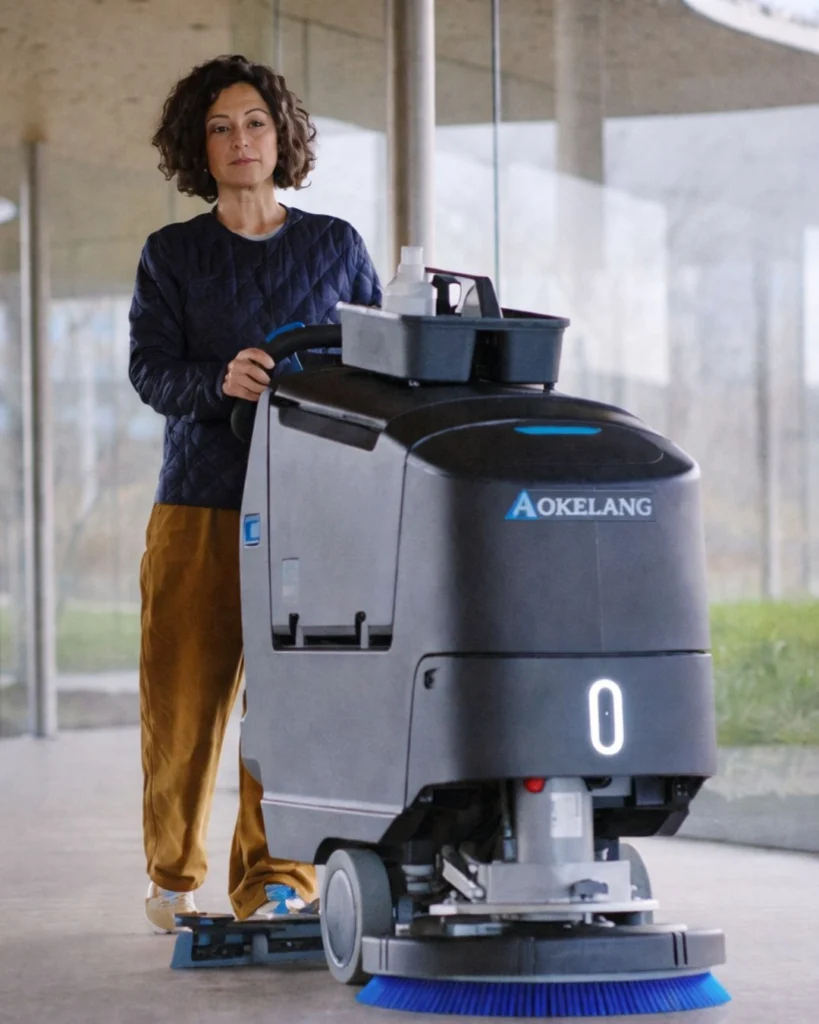
Commercial Floor Cleaning Machine FAQs
We’ve compiled the most common questions from distributors, facility managers, cleaning contractors, and industrial buyers to help you choose the right commercial floor cleaning equipment with confidence. If you can’t find the answer you’re looking for, our team is always ready to assist with expert guidance and customized recommendations.
Brand / Company Questions
Aokelang is a manufacturer. It is a specialized manufacturer of commercial and industrial floor cleaning equipment, focused on building reliable machines for demanding environments. The brand operates under Hefei Kuer Environmental Protection Technology Co., Ltd.
Aokelang operates from a 20,000 m² intelligent manufacturing base in Hefei, China. More specifically, the manufacturing address is Anhui Kelien Intelligent Manufacturing Co., Ltd., Feidong Economic Development Zone, Hefei, Anhui Province, China. All machines are manufactured in-house at this facility.
The website references exports to the UK, USA, and Australia by name, and states it serves customers globally. The exact number of countries is displayed as a counter on the homepage but the specific figure wasn't captured in the page content. Contact Aokelang directly at info@aokelang.com for current export market details.
Aokelang primarily develops and produces a variety of floor scrubbers, including manual, self-propelled, and intelligent models, as well as sweepers, integrated washer-sweepers, and other cleaning equipment. The product lineup includes walk-behind floor scrubbers (D2, D3, D4, D4Z, T3, T3Z, X2), ride-on floor scrubbers (D6, D7, D8, DX6, X5), and industrial floor sweepers (D1050, D1250, D1450, D1850, D1900, D2000, D2300, D2400).
Yes. Aokelang offers Custom Manufacturing & Private Label Solutions as one of its core service offerings. Distributors looking for branded machines can contact Aokelang to discuss OEM arrangements.
Aokelang displays multiple certificates on its About Us page. The website shows certificate images but doesn't list them by name in text form. Based on the export markets (UK, EU, USA, Australia), machines are expected to carry CE certification. Contact Aokelang directly to request specific certification documentation for your market.
The website does not explicitly mention a demo or trial program. However, Aokelang invites potential buyers to request a free quote and states it responds within 2 hours. It's reasonable to ask about demo arrangements directly — reach out via info@aokelang.com or WhatsApp at +86-13665698381.
Specific warranty terms are not stated on the homepage or About Us page. This detail would be covered in your purchase agreement or by contacting the Aokelang sales team directly.
Aokelang offers Service, Parts & Ongoing Support as one of its four core service pillars. The company emphasizes global reach with responsive service and parts access. International buyers should confirm spare parts availability for their region at the time of ordering.
The website does not list payment terms or Incoterms on public pages. These are typically negotiated during the quote process. Common arrangements for Chinese manufacturers include T/T (bank transfer), L/C, FOB, CIF, and DDP — confirm with Aokelang's sales team.
Aokelang serves warehouses & logistics centers, manufacturing & factories, hospitals & healthcare facilities, shopping malls & commercial buildings, and airports & transportation hubs.
Floor Sweeper Questions
A floor sweeper picks up dry debris — dust, dirt, gravel, packaging scraps — using brushes and a collection hopper. No water is involved. A floor scrubber uses water and detergent to wet-clean and remove embedded dirt and stains. If your floor has loose debris, sweep first; if it has grime, grease, or stains, scrub. Many facilities use both in sequence.
Yes, in most cases. Large debris can clog the scrubber's recovery system or damage brushes. Pre-sweeping removes loose material and makes the scrubbing process more effective and efficient.
Industrial floor sweepers handle fine dust, sand, gravel, small stones, cardboard scraps, packaging film, and general industrial debris. Aokelang's sweeper range, from the D1050 to the D2400, is designed for demanding warehouse and factory environments with heavy debris loads.
Walk-behind sweepers (like the Aokelang D1050 and D1250) are suited for smaller warehouses and areas with tight spaces. Ride-on sweepers (like the D1450, D1850, D1900, D2000, D2300, D2400) are designed for large floor areas, offering higher hopper capacity, faster sweeping speed, and less operator fatigue.
A walk-behind sweeper typically covers 2,000–4,000 m²/hour. A ride-on sweeper can cover 6,000–15,000+ m²/hour depending on the model and sweeping width. Aokelang's heavy-duty ride-on sweepers like the D2300 and D2400 are built for high-throughput large-area cleaning.
Standard dry sweepers do not require water or chemicals. Some models have a dust suppression water spray system that uses a small amount of water to reduce airborne dust — but this is minimal. No cleaning chemicals are needed for sweeping operations.
Hopper capacity varies by model. Larger ride-on models like the D2300 and D2400 are designed for heavy-duty industrial use with larger hoppers, reducing the frequency of emptying. Specific capacity figures in liters are available on individual product pages at aokelang.com.
Sweepers generally have a comparable or slightly longer lifespan than scrubbers — 8–12 years with proper maintenance — since they don't involve water exposure to internal components. The absence of water systems reduces corrosion risk over time.
Floor Scrubber Questions
A walk-behind scrubber is operated on foot — the operator walks behind or alongside the machine. It's compact, maneuverable, and suited for smaller or medium-sized spaces. A ride-on scrubber has a seat for the operator and is designed to cover large floor areas quickly with less physical effort and higher productivity per hour.
As a general guideline: for spaces under 20,000–30,000 sq ft, a walk-behind model (such as Aokelang D3, D4, or T3) is typically efficient. For facilities above 30,000–50,000 sq ft, a ride-on model (such as Aokelang D6, D7, or D8) becomes more practical to reduce cleaning time and operator fatigue
Battery-powered scrubbers offer freedom of movement, no trailing cables, and are suitable for large open areas. Corded (AC-powered) models have unlimited runtime but restrict movement to the cord's reach. Aokelang offers battery-powered walk-behind models including the D4 and D4Z.
Wider cleaning paths cover more floor per pass. A typical walk-behind scrubber has a path of 45–65 cm, while ride-on models can reach 80–100+ cm. As a rough calculation: a 65 cm path at 4 km/h covers approximately 2,600 m²/hour. The wider the path and the faster the machine, the higher the hourly coverage.
For spaces under 25,000 sq ft (~2,300 m²), Aokelang's compact and mid-range walk-behind models — such as the X2, D3, D4, or T3Z — are well-suited, offering good maneuverability and sufficient tank capacity for the area without over-investing in machine size.
For facilities over 50,000 sq ft (~4,600 m²), you need a ride-on scrubber with a cleaning path of at least 80 cm, a solution/recovery tank of 100+ liters, and battery runtime of 3–4 hours. Aokelang's D7, D8, and X5 models are designed for large-scale industrial and commercial use.
Battery runtime varies by model and battery type (lead-acid vs. lithium). Most commercial scrubbers offer 2–4 hours of runtime per charge. Exact figures for Aokelang models should be confirmed in individual product specifications or by contacting the Aokelang team.
Aokelang scrubbers are designed for a wide range of hard floor surfaces including concrete, epoxy-coated floors, ceramic tile, vinyl/VCT, and marble. The appropriate brush or pad type should be selected based on floor hardness and sensitivity — disc brushes for standard floors, softer pads for polished or delicate surfaces.
Most commercial floor scrubbers are designed for ease of use. Operator training for a walk-behind model typically takes 30–60 minutes. Ride-on models may require 1–2 hours of familiarization. Aokelang emphasizes easy operation as a key product feature.
A well-maintained commercial floor scrubber typically lasts 7–10 years. Regular maintenance of brushes, squeegees, tanks, and batteries is the primary factor in extending machine life.
Brushes and pads typically last 100–300 operating hours depending on floor abrasiveness and pressure settings. Squeegee blades usually need replacement every 300–500 hours or when water recovery deteriorates. Regular inspection is recommended.
Industry & Application Questions
For a warehouse, the ideal setup is a ride-on sweeper for daily debris removal paired with a ride-on scrubber for periodic deep cleaning. Aokelang machines are specifically designed for warehouses and logistics centers, offering fast cleaning of large floor areas with minimal downtime.
Always sweep first. Remove loose debris with a sweeper, then follow with a scrubber to clean and sanitize the floor surface. Scrubbing over unswept debris reduces cleaning quality and can damage the scrubber.
Aokelang serves hospitals and healthcare facilities with machines designed for hygienic, reliable cleaning that supports safety standards. For healthcare environments, look for low-noise models with effective water recovery to prevent slip hazards and prevent cross-contamination. Models like the D6 or DX6 ride-on scrubbers are suitable for corridor and hall cleaning in larger facilities.
Aokelang serves airports and transportation hubs — these spaces require large ride-on scrubbers and sweepers with high coverage rates, quiet operation for occupied zones, and the ability to navigate wide concourse areas. Ride-on models from the D7, D8, and X5 range are appropriate.
Malls need quiet, compact, and presentable machines that can operate around shoppers. Walk-behind and smaller ride-on scrubbers work well during off-hours, while sweepers handle daytime dust and litter. Aokelang serves shopping malls and retail spaces with equipment suited to public-facing environments.
Food processing facilities require scrubbers with high brush pressure, hot-water compatibility (or chemical-resistant tanks), and cylindrical brush systems that can agitate greasy surfaces effectively. Aokelang's heavy-duty machines are built for oil, dust, and industrial debris in manufacturing and factory environments.
A traditional ride-on scrubber is more cost-effective, easier to maintain, and better for irregular or obstacle-heavy layouts. An autonomous scrubber (like Aokelang's X5) makes sense in large, open, consistent floor layouts where labor costs are high and cleaning schedules are repetitive and predictable.
Aokelang's industrial sweepers and heavy-duty scrubbers can handle semi-outdoor areas like covered loading docks and parking structures. Fully open outdoor environments with uneven surfaces may require specialized outdoor sweepers. Confirm suitability with Aokelang based on your specific outdoor surface type.
For multi-floor office buildings, a compact walk-behind scrubber that fits in a service elevator is essential. The Aokelang X2 or D3 walk-behind models are appropriate for office corridors and open floor areas, with manageable weight and dimensions for elevator transport.
Technical & Specifications Questions
Aokelang offers multiple brush configurations depending on the model. Disc brush systems work well on smooth, even floors. Cylindrical brush systems are better for picking up debris while scrubbing and work on slightly uneven surfaces. Pad drivers are used with floor pads for polishing or light scrubbing on sensitive floors.
As a rule: for areas up to 2,000 m², tanks of 40–60 liters are sufficient. For 2,000–5,000 m², look for 60–100 liters. For larger areas, 100–200+ liter tanks are needed to reduce refill/disposal frequency. Solution and recovery tanks are typically equal in size.
Brush pressure (measured in kg) determines how forcefully the brush contacts the floor. Higher pressure removes stubborn dirt and grease but can damage soft or polished surfaces. Adjustable brush pressure is a key feature on quality scrubbers — lower for marble and vinyl, higher for concrete and epoxy.
Yes. Aokelang scrubbers are compatible with standard pH-neutral commercial floor cleaning detergents. Avoid highly caustic or acidic chemicals that could damage tank materials. Always follow dilution guidelines to prevent foaming in the recovery tank.
Aokelang machines are available across different voltage configurations depending on the model (typically 24V for smaller walk-behinds and 36V–48V for larger ride-on models). Specific electrical specifications are listed on each product page and can be customized for different market voltage standards on request.
Lead-acid batteries typically last 300–500 charge cycles (roughly 2–3 years with daily use). Lithium batteries last 1,500–2,000+ charge cycles (5–7 years), charge faster, weigh less, and require no water maintenance. Lithium is the preferred option for high-frequency operations despite a higher upfront cost.
Aokelang produces intelligent floor scrubbers and features Smart, Practical Innovation as a brand pillar — including the X5 autonomous ride-on scrubber. Smart control and monitoring features vary by model; higher-end models are likely to include digital displays, error diagnostics, and operational monitoring.
Commercial scrubbers typically operate at 60–70 dB, similar to a normal conversation or moderate background noise. Most Aokelang models are designed for use in occupied commercial spaces. Exact decibel ratings per model should be confirmed in product specifications.
Turning radius varies by model. Compact ride-on models can achieve tighter turns suitable for standard warehouse racking aisles (typically 2–3 m wide). Larger industrial ride-on models require wider turning clearance. Check individual product specs on aokelang.com or request the technical datasheet.
Eco-Friendly & Sustainability Questions
Yes — significantly. A commercial floor scrubber uses approximately 0.1–0.3 liters of water per m² and recycles the dirty water into a recovery tank. Traditional mop-and-bucket cleaning uses 3–5x more water per m² and leaves wet floors longer, increasing slip risk.
Aokelang exports to EU markets (UK included) and displays certifications on its website. CE compliance is expected for EU-sold machines. Specific environmental compliance details should be confirmed with Aokelang's export team.
A ride-on scrubber cleans a large facility using a fraction of the water that traditional mopping requires, while also collecting dirty water rather than leaving it to evaporate or drain untreated. This can reduce water usage by 60–80% compared to manual methods.
In many settings, yes. Modern floor scrubbers with effective brush pressure and clean water systems can achieve good results with mild, diluted detergents or even just water on lightly soiled surfaces. This reduces chemical usage, costs, and environmental impact.
Lithium batteries are available on select Aokelang models. They are more eco-friendly due to longer lifespan (fewer replacements), no acid leakage risk, more efficient charging (less energy waste), and they don't contain lead — a hazardous heavy metal.
Yes. Scrubbers use precise, diluted chemical dosing compared to the inconsistent, often excessive chemical use of manual mopping. Over time, the reduction in chemical consumption provides measurable cost savings.
Aokelang positions itself on energy efficiency and sustainability. Using a certified commercial scrubber that reduces water and chemical consumption can contribute to a facility's LEED operations and maintenance credits. Confirm specific energy consumption figures with Aokelang for documentation purposes.
Sourcing, Ordering & Logistics Questions
MOQ is not stated on the public website. For single-unit purchases or distributor bulk orders, contact Aokelang directly. As a manufacturer, they likely accommodate both single machines and container-quantity orders for distributors.
Yes. Custom Manufacturing & Private Label Solutions is explicitly listed as a core Aokelang offering. Distributors can request customized branding and specifications.
Lead time is not published on the website. Typical Chinese manufacturer lead times range from 15–45 days depending on order volume and customization. Confirm at time of order with the Aokelang sales team.
Aokelang provides Global Equipment Supply & Technical Support to international buyers. Specific Incoterms (FOB, CIF, DDP) and freight options should be confirmed during the quote process.
Standard export documentation from Chinese manufacturers includes commercial invoice, packing list, bill of lading, certificate of origin, and relevant CE/compliance certificates. Confirm specific documentation with Aokelang based on your country's import requirements.
Aokelang emphasizes global reach with responsive service and parts access. International buyers should confirm the spare parts availability and delivery timeline for their region at time of purchase.
Yes — this is standard practice for Chinese manufacturers exporting globally. Voltage customization (e.g., 110V for North America, 220V for Europe) can typically be arranged. Confirm at the time of ordering.
Generally yes — most manufacturers accommodate mixed-model container orders. Confirm with Aokelang's logistics team based on your specific order composition.
Turning radius varies by model. Compact ride-on models can achieve tighter turns suitable for standard warehouse racking aisles (typically 2–3 m wide). Larger industrial ride-on models require wider turning clearance. Check individual product specs on aokelang.com or request the technical datasheet.
Industry & Market Questions
The global commercial floor cleaning equipment market was valued at approximately USD 5–6 billion in 2024 and is projected to grow at a CAGR of 5–7% through 2030, driven by increasing warehouse automation, rising hygiene standards, and labor cost pressures.
The ROI is substantial. A single ride-on scrubber can replace 3–5 manual cleaners for large-area floor cleaning, paying back the machine cost within 12–24 months in many facilities. Additional savings come from reduced water, chemical, and injury-related costs.
An autonomous (robotic) scrubber navigates and cleans independently using sensors and mapping technology. Traditional scrubbers require a human operator. Autonomous models are better for predictable, open layouts with high labor costs. Aokelang manufactures intelligent scrubbers including the X5 autonomous ride-on model. Both will coexist — autonomy is the direction for large facilities, while traditional models remain dominant for complex or smaller spaces.
Buying directly from the manufacturer like Aokelang eliminates distributor markups, which typically range from 20–50%. For large orders, this saving is significant. The trade-off is managing shipping, import duties, and after-sales support independently — which Aokelang mitigates by offering direct global technical support.
Key trends include: autonomous and semi-autonomous scrubbers, lithium battery adoption replacing lead-acid, IoT-enabled fleet monitoring, eco-friendly low-water machines, and increased demand from e-commerce warehouse expansion. Aokelang's X5 autonomous scrubber and intelligent machine range reflect these trends directly.
A manual worker with a broom or mop covers approximately 300–500 m²/hour. A walk-behind sweeper covers 2,000–4,000 m²/hour. A ride-on sweeper like Aokelang's D2300 or D2400 can cover 8,000–15,000+ m²/hour — representing a 20–30x productivity improvement over manual cleaning.
Aokelang positions itself on energy efficiency and sustainability. Using a certified commercial scrubber that reduces water and chemical consumption can contribute to a facility's LEED operations and maintenance credits. Confirm specific energy consumption figures with Aokelang for documentation purposes.