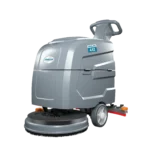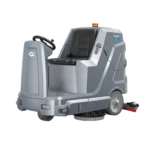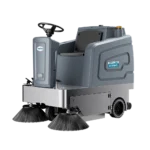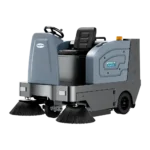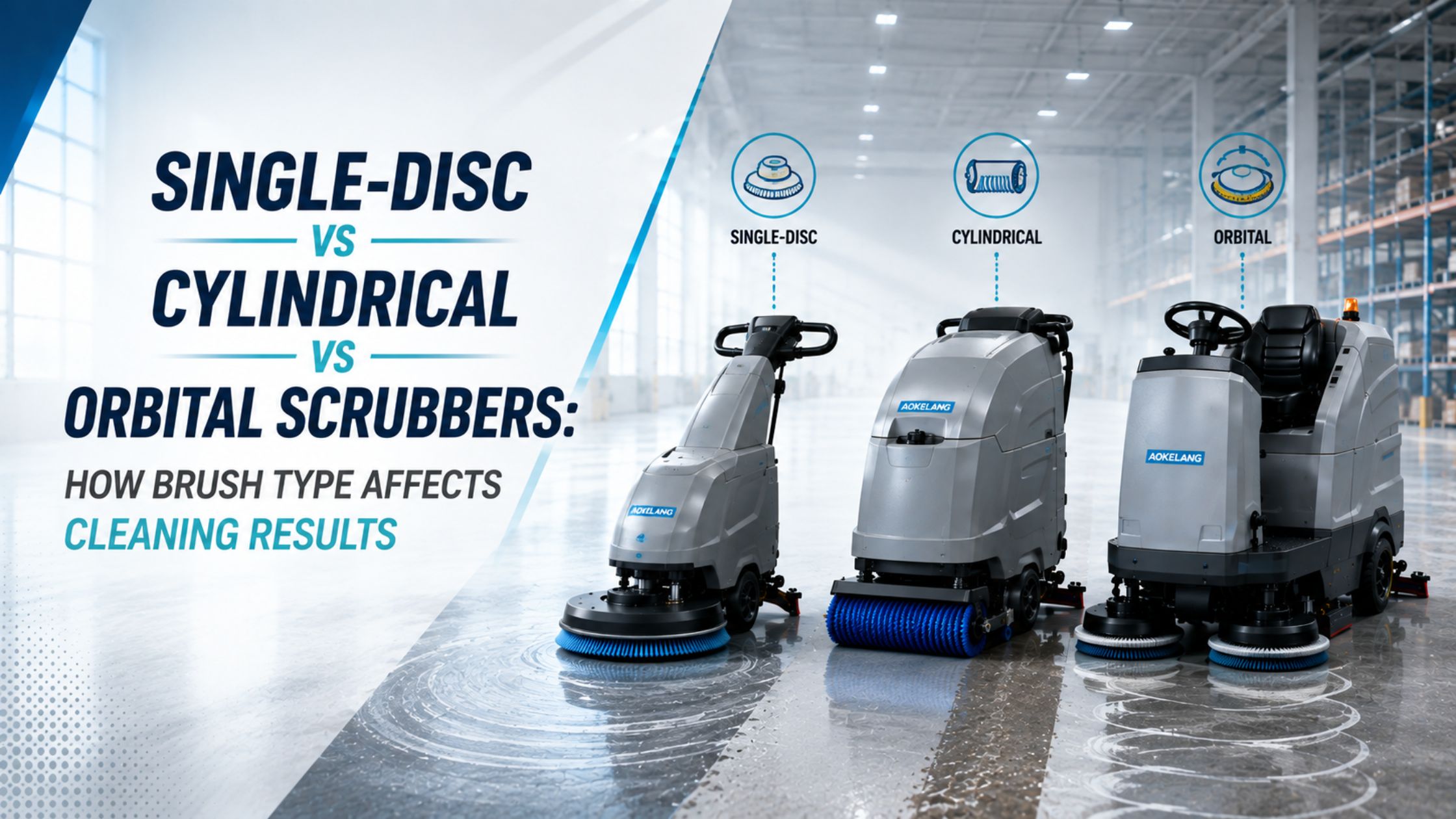
Single-Disc vs Cylindrical vs Orbital Scrubbers: Single-disc scrub decks apply the most downward pressure at the slowest speed (roughly 140–300 RPM), making them best for smooth, pre-swept floors and finish stripping. Cylindrical decks use two counter-rotating brushes at 600–800 RPM that sweep and scrub in a single pass, making them best for uneven or debris-heavy floors. Orbital (oscillating) decks vibrate at up to 2,000–2,250 RPM for fast, low-moisture cleaning with strong reach into edges and corners. The right mechanism depends on your floor’s texture, how much debris it carries, and whether you’re willing to pre-sweep before scrubbing.
This guide Single-Disc vs Cylindrical vs Orbital Scrubbers explains how each mechanism actually works, what it does differently to your floor, and which one fits which cleaning situation.
Table of Contents
What’s the Difference Between Single-Disc vs Cylindrical vs Orbital Scrubbers?
| Factor | Single-Disc | Cylindrical | Orbital / Oscillating |
| Motion | Flat pad or brush rotates horizontally | Two brushes rotate in opposite directions | Rectangular pad vibrates in tight, rapid oscillations |
| Typical speed | 140–300 RPM | 600–800 RPM | Up to 2,000–2,250 RPM |
| Down-pressure | Highest of the three | Moderate | Lower, compensated by vibration frequency |
| Water use | Lowest | Higher (spread via drip tray) | Low |
| Pre-sweeping needed | Yes, floors should be debris-free first | No — sweeps and scrubs in one pass | Yes, similar to disc |
| Best floor types | Smooth, flat — VCT, sealed tile, polished concrete | Uneven, textured — grout lines, rough concrete | Smooth to lightly textured, including edges/corners |

Single-Disc Scrub Decks: How They Work and Where They Excel
A single-disc deck uses one or two flat, round pads or brushes that rotate horizontally against the floor, typically at 140–300 RPM, with cleaning solution dispensed at the center of the disc. Because the disc applies strong, direct downward pressure at a relatively slow rotation, it’s effective enough to strip old floor finish in addition to routine scrubbing — a capability cylindrical decks generally don’t match. Disc decks also use less water than cylindrical decks, since the pad spreads solution efficiently across a flat contact area rather than relying on a continuous drip tray.
The tradeoff is that disc decks need a relatively clean, debris-free floor to start with — loose debris can clog or damage the pad, which is why facilities using disc-deck machines typically sweep first. This makes disc decks the standard choice for smooth commercial floors in retail, healthcare, education, and office settings, where pre-sweeping is already part of the cleaning routine. Disc decks are also the most common configuration on compact and mid-size walk-behind scrubbers, since the mechanism suits the smaller, flatter machines used in these settings.
Cylindrical Scrub Decks: How They Work and Where They Excel
A cylindrical deck uses two tube-shaped brushes mounted parallel to each other, spinning in opposite directions at roughly 600–800 RPM — noticeably faster than a disc deck. The front brush scrubs the floor while the rear brush throws loose debris backward into a collection hopper, which means cylindrical machines can sweep and scrub in a single pass without a separate pre-sweeping step. This is the mechanism’s defining advantage: in a facility that generates ongoing debris — metal shavings, wood chips, glass, or general industrial residue — a cylindrical deck handles it without slowing down the cleaning process.
Cylindrical brushes also reach further into grout lines, cracks, and textured or uneven surfaces than a flat disc can, since the round brush profile makes contact with surface irregularities that a flat pad would ride over. This makes cylindrical decks a common choice in warehouses, manufacturing plants, and parking garages, where floors are often rougher and debris is a constant rather than an occasional issue.
Also read – How to calculate the right scrubber size for your facility
Orbital (Oscillating) Scrub Decks: How They Work and Where They Excel
Orbital decks — also called oscillating decks — use a rectangular pad that vibrates in tight, rapid back-and-forth motions rather than rotating, reaching speeds up to 2,000–2,250 RPM, dramatically faster than either disc or cylindrical mechanisms. This high-frequency vibration loosens soil effectively even at lower down-pressure, and the rectangular pad shape gives orbital machines an advantage disc and cylindrical decks don’t have: better physical reach into corners and along edges, where round brushes and pads leave a gap.
Orbital decks are a newer scrubbing technology relative to disc and cylindrical designs, and they still generally require a reasonably debris-free floor going in, similar to disc decks. Where they tend to stand out is in facilities where edge and corner cleanliness matters — retail aisles, healthcare corridors, and any environment where a visible strip of missed floor along a wall is a real problem, not just a cosmetic one.
How Brush Type Affects Cleaning Results by Floor Type
- Smooth, flat commercial floors (VCT, sealed tile, polished concrete): Disc or orbital decks are typically the better fit, especially where pre-sweeping is already standard practice.
- Textured, uneven, or grooved floors (grout lines, rough or aggregate concrete): Cylindrical decks reach into surface irregularities more effectively than flat disc or orbital pads.
- Floors with ongoing loose debris (metal shavings, glass, wood chips, general industrial residue): Cylindrical decks handle this without a separate sweeping step, saving time in facilities where debris is a constant condition rather than an occasional one.
- Floors needing finish stripping or heavy soil removal: Disc decks apply the strongest direct pressure, making them the more common choice for stripping and deep restorative cleaning.
- Layouts with significant edge and corner floor area: Orbital decks reach closer to walls and into corners than round disc or cylindrical mechanisms, reducing the visible “missed strip” along edges.
As a general performance comparison point, mechanized scrubbing of any deck type is dramatically faster than manual mopping — a standard 24-inch disc scrubber is commonly cited as cleaning roughly 1,400% faster than a mop and bucket, which is the baseline all three deck types are competing against, not just each other.
Choosing the Right Deck Type for Your Facility
- Check whether pre-sweeping is already part of your cleaning routine. If it is, disc or orbital decks fit naturally into that workflow. If it isn’t — or if debris is a constant issue that makes pre-sweeping impractical — a cylindrical deck’s sweep-and-scrub-in-one-pass design saves a real operational step.
- Assess your floor’s texture. Smooth and flat favors disc or orbital; uneven, grooved, or textured favors cylindrical.
- Identify whether you need finish stripping capability. If periodic floor stripping and restoration is part of your maintenance plan, prioritize a disc deck’s higher down-pressure.
- Evaluate how much your floor plan depends on edge and corner cleanliness. Facilities with significant wall-adjacent floor area may see a visible benefit from an orbital deck’s rectangular pad reach.
- Confirm deck type directly with the manufacturer before purchasing, since not all product listings specify this clearly — it’s a fair and important question to ask alongside brush motor power and tank capacity. See Questions to Ask a Floor Scrubber Manufacturer Before You Buy for a full list of what else to confirm before ordering.
Also read – Walk-behind vs. ride-on scrubbers
Deck Type and Brush/Pad Compatibility
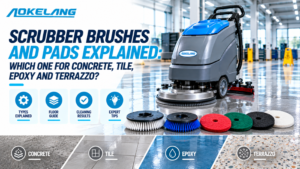
Deck type also determines which consumables you can use — disc and orbital decks accept both pads and brushes, while cylindrical decks work exclusively with brushes. If you’re deciding between a brush and a pad for a specific machine, see Floor Scrubber Brush vs Pad: Which Is Better? for how material and aggressiveness factor into that separate decision once your deck type is settled.
Aokelang’s walk-behind and ride-on scrubber ranges are compatible with tile, epoxy, terrazzo, marble, PVC, and concrete floor surfaces across the lineup — if you’re unsure which deck configuration fits your specific floor texture and debris profile, it’s worth contacting the Aokelang team directly with your floor type before finalizing an order.
Next Steps
To confirm which deck configuration fits your specific floor type and debris profile, browse the full floor scrubber range, or contact the Aokelang team with your floor surface and typical debris conditions for a tailored recommendation. Once you’ve settled on a deck type, see Floor Scrubber Brush vs Pad: Which Is Better? to choose the right consumable, or request a quote for a machine matched to your facility.
Single-Disc vs Cylindrical vs Orbital Scrubbers FAQs
Do I need to pre-sweep before using a cylindrical scrubber?
No — this is the main advantage of a cylindrical deck. The rear brush throws loose debris into a collection hopper as the machine scrubs, combining sweeping and scrubbing into a single pass.
Can a disc scrubber strip old floor finish?
Yes, this is one of the disc deck’s strengths — its slower rotation speed combined with higher direct pressure makes it effective for finish stripping and heavy restorative cleaning, a capability cylindrical decks generally don’t match.
Which deck type is best for a warehouse with metal shavings on the floor?
A cylindrical deck is typically the better fit, since its sweep-and-scrub design handles ongoing loose debris like metal shavings without requiring a separate sweeping step first.
Are orbital scrubbers better than disc scrubbers?
Neither is universally better — orbital decks clean faster at higher RPM and reach closer to edges and corners, while disc decks apply stronger direct pressure and remain the standard choice for finish stripping. The right choice depends on your floor type and what you need the machine to do beyond routine scrubbing.