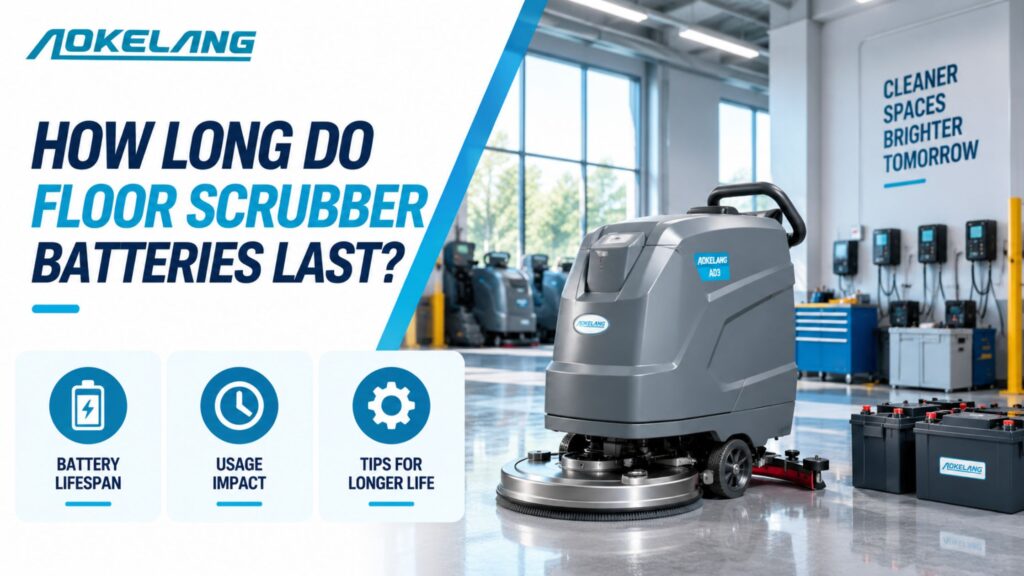
How Long Do Floor Scrubber Batteries Last? Floor scrubber batteries last 2 to 5 years for traditional lead-acid types and 5 to 10 years for modern lithium-ion packs, depending on chemistry, usage intensity, and maintenance. Floor scrubber battery lifespan is measured in two ways, total charge cycles and total calendar years, and these two numbers do not always move together, since a battery can run out of cycles quickly under heavy daily use or age out calendar-wise even with light use.
This guide breaks down how long each battery type actually lasts, what factors change that lifespan in practice, and how to extend the life of whichever battery your machine uses.
Table of Contents
Floor Scrubber Battery Lifespan by Type
How long a floor scrubber battery lasts depends heavily on which chemistry it uses:
| Battery Type | Typical Lifespan | Charge Cycles | Maintenance |
| Flooded Lead-Acid | 1.5 to 4 years | 300 to 500 cycles | Requires regular checks and refilling with distilled water |
| AGM / Gel Lead-Acid | 2 to 5 years | 500 to 1,000 cycles | Sealed and maintenance-free, but sensitive to improper charging |
| Lithium-Ion (LiFePO4) | 5 to 10 years | 1,500 to 3,500+ cycles | No watering or terminal maintenance required |
Flooded lead-acid is the most affordable option and has powered commercial floor scrubbers for decades, but it needs the most hands-on care: regular electrolyte level checks and distilled water top-offs to stay healthy.
AGM and gel lead-acid batteries are sealed, so they skip the watering routine entirely, but they’re more sensitive to charger mismatches. Using the wrong charging profile on a sealed lead-acid battery can shorten its life significantly compared to flooded types, which are somewhat more forgiving.
Lithium-ion (LiFePO4) batteries cost more upfront but handle deep discharges without losing capacity quickly, unlike lead-acid, which degrades faster when regularly discharged too low. Lithium packs in multi-shift commercial use commonly retain around 90% of their original capacity even after 5 years of heavy operation.

How Long Do Floor Scrubber Batteries Last in Real Commercial Use?
The lifespan ranges above are manufacturer ratings under typical conditions, but real-world commercial use often tells a different story, especially for lead-acid batteries. Facilities running a scrubber daily, multiple shifts, or in a demanding environment often see flooded lead-acid batteries land at the shorter end of the range, sometimes closer to 1.5 to 2 years, rather than the full 4-year ceiling.
Two reasons this happens:
- Cycle count adds up faster with daily use. A battery rated for 300 to 500 cycles reaches that limit in roughly a year and a half of daily use, which is why heavy-use facilities burn through lead-acid batteries faster than the general lifespan range suggests.
- Calendar aging happens even when the battery sits idle. Lead-acid batteries develop sulfation, a buildup on the plates, whenever they’re stored below a full charge for extended periods. This means a battery used only occasionally can still degrade over time if it isn’t kept properly charged between uses.
Lithium batteries are far less prone to both issues: they tolerate more cycles before wearing out and don’t suffer from the same calendar-based degradation when stored, which is a major reason facilities running multiple daily shifts increasingly favor lithium despite the higher upfront cost.
What Factors Affect Floor Scrubber Battery Lifespan?
Several variables shift a battery’s actual lifespan up or down from the general ranges above:
- Charging habits. Letting a lead-acid battery sit at a low charge, or repeatedly discharging it too deeply, shortens its life meaningfully. Lead-acid batteries generally shouldn’t be discharged below about 50%, while lithium batteries can safely handle discharges down to 20% or lower without the same damage.
- Charger compatibility. Using a charging profile that doesn’t match the battery chemistry, especially on sealed AGM or gel batteries, can degrade the battery faster than normal wear would.
- Usage intensity. More shifts per day means more charge cycles consumed per week, which matters most for lead-acid batteries with a lower total cycle count.
- Storage conditions. Storing any lead-acid battery in a discharged state accelerates sulfation and permanent capacity loss, even if the machine itself isn’t being used.
- Climate and temperature. Extreme heat or cold can affect both battery types, though lithium chemistry generally tolerates a wider operating temperature range than lead-acid.
Tips to Extend Floor Scrubber Battery Life
- Recharge after every use. Do not wait until the battery drains completely, since letting it sit discharged accelerates wear, particularly for lead-acid chemistries.
- Check water levels on lead-acid batteries only. Add distilled water after a full charge cycle, never before, since checking levels on a partially charged battery can give a misleading reading.
- Keep terminals clean. Wipe away corrosion weekly to maintain a solid electrical connection and prevent charging inefficiency.
- Avoid deep discharges. Stay above roughly 50% charge for lead-acid batteries when possible; lithium batteries tolerate deeper discharges but still benefit from avoiding a full drain as routine practice.
- Use the charger designed for your battery’s chemistry. A charger with the wrong voltage profile for your battery type is one of the most common causes of premature failure, especially on sealed lead-acid batteries.
- Take advantage of opportunity charging if you have lithium. Lithium batteries can be topped up during short breaks without the damage this would cause a lead-acid battery, which generally needs full charge cycles rather than partial top-ups.
Lead-Acid vs. Lithium: Cost and Lifespan Comparison
| Factor | Lead-Acid (Flooded/AGM) | Lithium-Ion (LiFePO4) |
| Typical unit cost | $150 to $400 per battery | $800 to $2,200 per battery |
| Typical 24V pack cost (two batteries) | $300 to $800 | Roughly 2.5 to 4 times more than lead-acid |
| Typical lifespan | 1.5 to 5 years depending on subtype | 5 to 10 years |
| Charge cycles | 300 to 1,000 depending on subtype | 1,500 to 3,500+ |
| Maintenance | Watering (flooded only), terminal cleaning | None required |
| Deep discharge tolerance | Poor, avoid below 50% | Strong, safe to 20% or lower |
Lithium costs more on day one, but its longer floor scrubber battery lifespan and lower maintenance burden often make up the difference over a multi-year ownership period, particularly for facilities running multiple shifts. For the fuller cost breakdown across both battery types, see Battery-Powered Floor Scrubbers: Lithium vs. Lead-Acid and Floor Scrubber Total Cost of Ownership.
When Should You Replace a Floor Scrubber Battery?
- Runtime drops noticeably below the rated spec. If a machine that once ran a full shift now needs a mid-shift charge, the battery is likely nearing the end of its usable life.
- The battery has reached or exceeded its typical age range. Once a lead-acid battery passes 3 to 4 years, or a lithium battery approaches 7 to 10 years, test capacity rather than assuming it’s still performing at full strength.
- Visible signs of wear appear. Swelling, corrosion, or leakage on lead-acid batteries are clear signs it’s time to replace, not repair.
- A battery management system (BMS) flags a fault, on lithium packs equipped with one, which is a more reliable signal than guessing based on age alone.
Next Steps
To choose the right battery chemistry for your facility’s usage pattern, see Battery-Powered Floor Scrubbers: Lithium vs. Lead-Acid for the fuller comparison, or the maintenance schedule for the daily and weekly habits that help any battery type reach its full expected lifespan. Browse the full floor scrubber range to compare battery options across models, or contact the Aokelang team for guidance on which battery chemistry fits your shift schedule.
Floor Scrubber Battery Lifespan FAQs
How long do floor scrubber batteries last on average?
Lead-acid batteries typically last 2 to 5 years depending on subtype, while lithium-ion batteries typically last 5 to 10 years, with actual lifespan varying based on usage intensity, charging habits, and maintenance.
Why does my lead-acid battery need replacing sooner than the rated lifespan suggests?
Daily or multi-shift use consumes charge cycles faster than lighter use, and improper storage or charging habits can cause sulfation, which shortens lifespan independent of how many cycles the battery has actually completed.
Is it worth paying more for a lithium battery upfront?
For facilities running daily or multi-shift operations, lithium’s longer lifespan, faster charging, and zero maintenance requirement often offset its higher upfront cost within a few years. For lighter, occasional use, lead-acid may still be the more cost-effective choice.
Can I use a lead-acid charger on a lithium battery, or vice versa?
No, not without a compatible charging profile. Using the wrong charger voltage and profile for your battery’s chemistry is one of the most common causes of premature battery failure.
How do I know if my battery is the reason my scrubber is losing runtime?
If runtime has dropped noticeably compared to when the machine was new, and other components like the vacuum and brush motor are functioning normally, the battery is the most likely cause, especially once it’s approaching or past its typical age range.