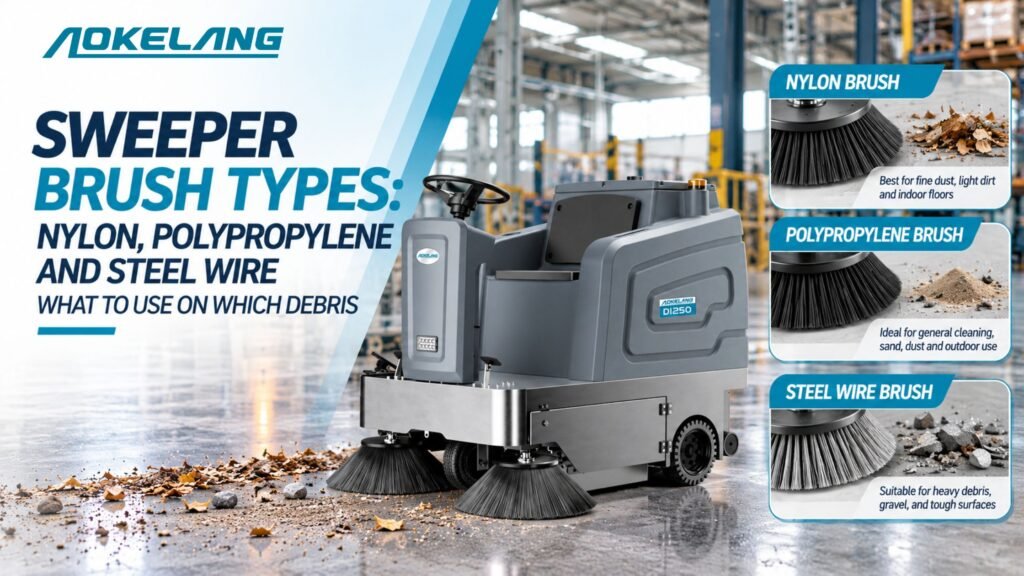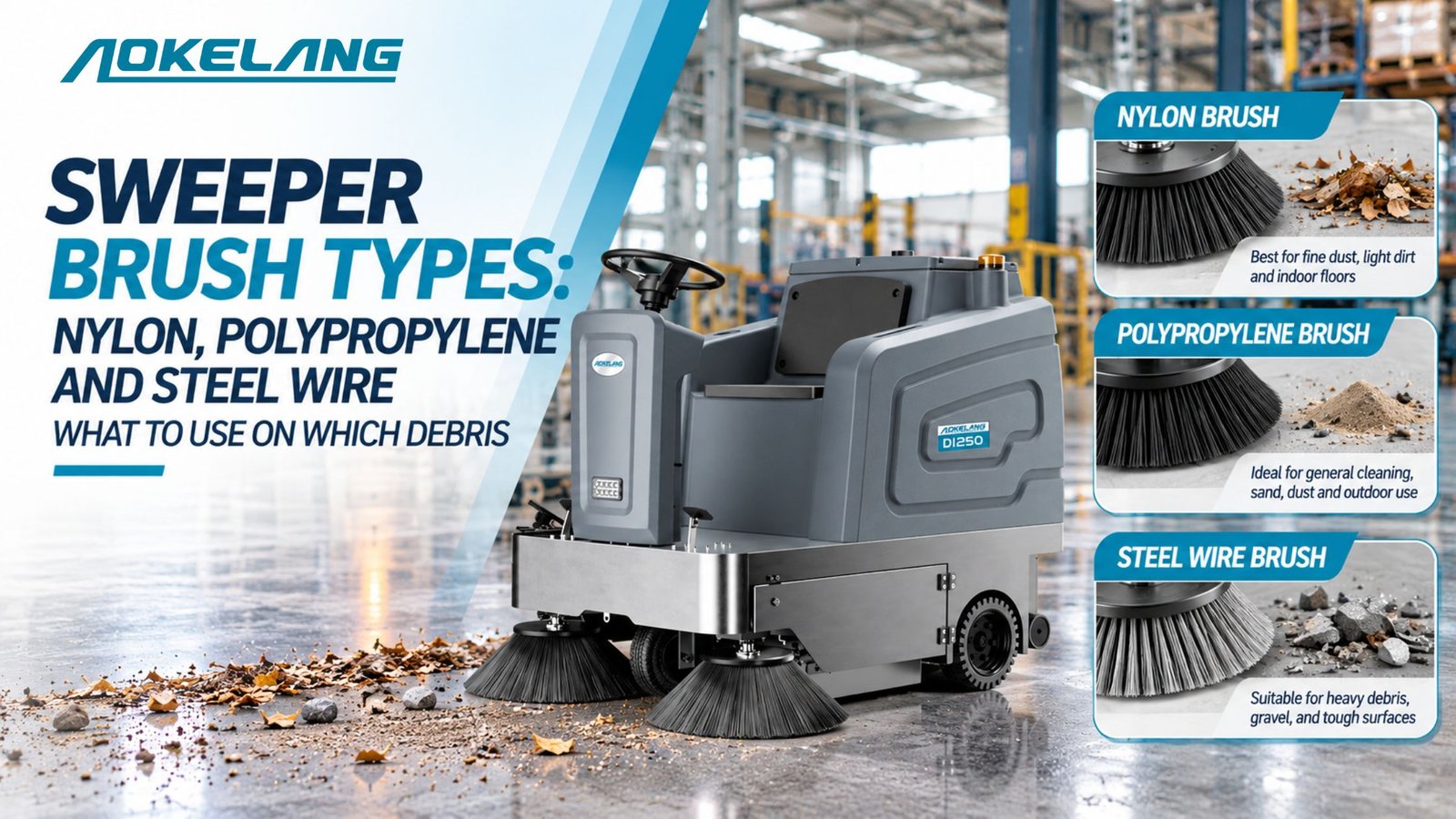
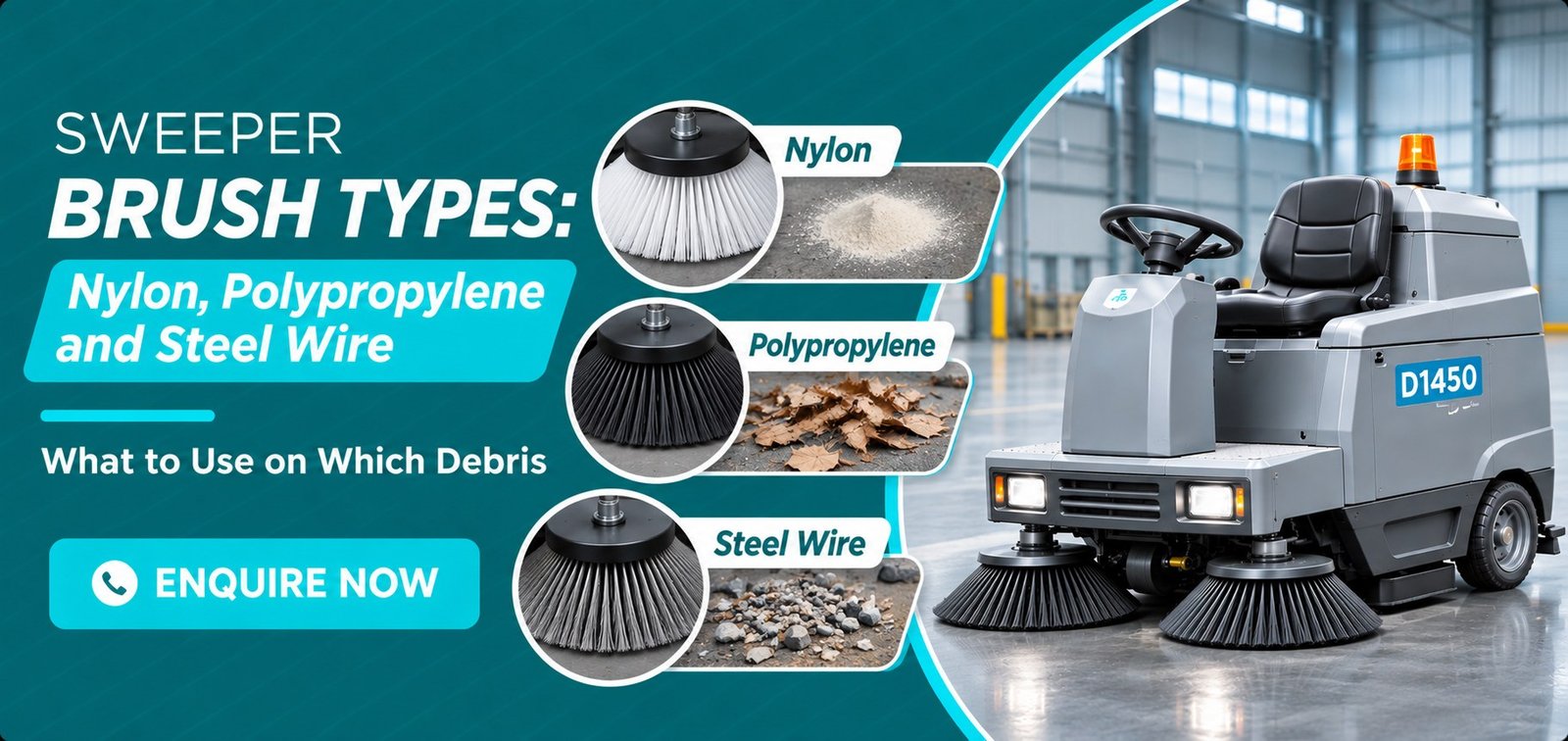
The three main sweeper brush types are nylon, polypropylene and steel wire. Polypropylene suits most mixed debris, indoors and out. Nylon suits fine dust on smooth floors. Steel wire suits only compacted dirt and heavy outdoor grime on hard surfaces it can’t damage.
Key takeaways
- Polypropylene is the all-round choice. It handles mixed debris indoors and outdoors, doesn’t absorb water, and is the most affordable.
- Nylon is the long-life choice for fine dust and smooth floors. It keeps its shape well and resists wear, but it costs more.
- Steel wire is only for compacted dirt, packed mud and heavy outdoor grime. Never use it on coated, painted or polished floors.
- Bristle pattern matters as much as material. A dense fill suits fine dust. An open or strip pattern suits bulky debris such as leaves and litter.
- Match the brush to your floor first, then to your debris. A brush that cleans well but scratches the floor is the wrong brush.
The three main sweeper brush types are nylon, polypropylene and steel wire. Polypropylene suits most mixed debris, indoors and out. Nylon suits fine dust on smooth floors. Steel wire suits only compacted dirt and heavy outdoor grime on hard surfaces it can’t damage.
Table of Contents
What are the main sweeper brush types?
| Polypropylene | Nylon | Steel wire | |
| Stiffness | Medium | Medium-soft and flexible | Very stiff |
| Best for | Mixed debris, indoors and outdoors | Fine dust, smooth floors | Compacted dirt, packed mud, heavy grime |
| Wear life | Good | Longest of the three on most floors | Good on hard surfaces, but wires can shed |
| Water | Doesn’t absorb water | Absorbs some water and can soften when wet | Can rust unless it’s stainless |
| Floor safety | Safe on most floors | Safest on delicate floors | Scratches coatings, paint and polished surfaces |
| Cost | Lowest | Higher | Varies |
Most sweepers use the same family of materials for both the main brush and the side brushes, but they don’t have to match. A common setup pairs a polypropylene main brush with tougher side brushes for kerbs and edges.
When should you use a polypropylene sweeper brush?
Polypropylene is the default on many sweepers, because it handles the widest range of conditions.
Strengths
- Stiff enough to move sand, grit and small stones
- Doesn’t absorb water, so it keeps its stiffness on damp floors and wet debris
- Resists most cleaning chemicals and oils
- The lowest-cost replacement
Limits
- Wears faster than nylon on rough surfaces
- Can become brittle in very cold conditions
- Less effective than nylon at picking up very fine dust on smooth floors
Use it for: general warehouse sweeping, loading docks, car parks, mixed indoor and outdoor work, damp conditions and wet leaves.
When should you use a nylon sweeper brush?
Nylon bristles flex and spring back to their shape better than polypropylene. That makes them good at flicking fine dust off smooth floors, and they last longer.
Strengths
- Excellent shape recovery: bristles return to straight after bending
- Strong abrasion resistance, so they last a long time on smooth floors
- Safe on sealed concrete, epoxy, vinyl and other delicate surfaces
- Holds up better than polypropylene in cold and warm conditions
Limits
- Costs more than polypropylene
- Absorbs some water and can soften when wet, so it’s less effective in very wet conditions
- Too soft for compacted dirt or heavy outdoor debris
Use it for: fine dust in factories and warehouses with smooth or coated floors, clean manufacturing areas, and indoor sites where the floor finish must be protected.
When should you use a steel wire sweeper brush?
Steel wire is the aggressive option. It breaks up material that softer bristles slide over.
Strengths
- Breaks up compacted dirt, packed mud and caked-on grime
- Digs debris out of rough concrete and asphalt
- Stays stiff in heat and cold
Limits
- Scratches epoxy, paint, sealed concrete, polished floors and line markings
- Wire bristles can break off and get left behind, where they can puncture tyres
- Carbon steel can rust and leave stains; stainless steel avoids this but costs more
- Throws small stones harder, which can be a safety concern near people and vehicles
Use it for: construction sites, quarry and aggregate yards, foundries, outdoor areas with packed mud, and side brushes working rough kerbs where softer bristles wear out quickly.
Many outdoor brushes use a poly/wire mix: polypropylene bristles with a share of steel wire. This combines the sweeping action of polypropylene with some of wire’s ability to scrape. It’s often a better choice than full wire for outdoor side brushes.
Also read – Choosing a Ride-On Sweeper
Which brush type suits which debris?
| Debris | Best brush type | Why |
| Fine dust (indoor) | Nylon | Flexible bristles flick fine dust into the hopper |
| General warehouse debris | Polypropylene | Handles dust, packaging scraps and grit |
| Sand and grit | Polypropylene | Stiff enough to move dense, heavy particles |
| Gravel and small stones | Polypropylene, set slightly higher | Moves stones without throwing them hard |
| Dry leaves | Polypropylene, open fill pattern | Bulky debris needs space between bristles |
| Wet leaves and damp debris | Polypropylene | Doesn’t absorb water or lose stiffness |
| Litter, cans, bottles | Polypropylene, strip pattern | Gaps carry larger items toward the hopper |
| Compacted dirt and mud | Steel wire or poly/wire mix | Needs stiff bristles to break it up |
| Metal shavings | Polypropylene or nylon | Avoid wire; wire doesn’t add much and can shed |
| Oily debris | Polypropylene | Resists oil and doesn’t soak it up |
Which brush types are safe on which floors?
Check the floor before you choose for the debris. The right brush for the debris is still the wrong brush if it damages the floor.
| Floor | Safe choices | Avoid |
| Epoxy and painted floors | Nylon, soft polypropylene | Steel wire |
| Sealed or polished concrete | Nylon, polypropylene | Steel wire |
| Smooth unsealed concrete | Polypropylene, nylon | Steel wire, unless the concrete is very rough |
| Rough concrete | Polypropylene, poly/wire mix | Soft nylon (it wears too fast) |
| Asphalt | Polypropylene, poly/wire mix | Nothing in particular |
| Pavers and block paving | Polypropylene | Steel wire (it can loosen joint sand) |
| Floors with painted line markings | Nylon, polypropylene | Steel wire |
If you sweep on both coated indoor floors and rough outdoor surfaces, use a separate brush for each. A wire brush that suits the yard will scratch the warehouse floor.
Does bristle pattern matter as much as material?
Yes. Two brushes made from the same material can sweep very differently depending on how the bristles are arranged.
Full fill
The bristles cover the whole brush core with no gaps.
- Best for: fine dust, sand and small debris
- Why: more bristle tips touch the floor, so less dust slips through
- Limit: bulky items such as leaves, cups and wrappers can ride over the top instead of being carried into the hopper
Strip or row pattern
The bristles are arranged in rows, with gaps between them.
- Best for: leaves, litter, cans and bulky debris
- Why: the gaps act like scoops, carrying larger items up and into the hopper
- Limit: less effective on very fine dust
Chevron or spiral pattern
The rows are set at an angle or in a V shape.
- Best for: mixed debris
- Why: the angled rows push debris toward the centre of the brush and into the hopper, so less is thrown out to the sides
When ordering a replacement brush, match the pattern as well as the material to your debris.
Does bristle thickness matter?
Yes. Thicker bristles are stiffer and last longer on rough surfaces. Thinner bristles are more flexible and pick up fine dust better. Choose:
- Thinner bristles for smooth indoor floors and fine dust
- Thicker bristles for rough outdoor surfaces, grit and heavier debris
Main brush vs side brushes: should they match?
Not always. The two brushes do different jobs.
- The main brush sweeps the full path and throws debris into the hopper. Choose it for your most common debris and your floor surface.
- The side brushes sweep along walls, kerbs, racking and corners, and push debris inward. They meet the roughest edges and wear fastest.
A common setup is a polypropylene main brush with polypropylene side brushes indoors, or a poly/wire mix outdoors.
On machines with several side brushes, such as the Aokelang D1850 with four 500 mm side brushes, the side brush choice has a big effect on how well edges are cleaned.
How does brush choice affect dust?
Stiffer, more aggressive bristles throw more dust into the air. If your sweeper is raising dust, a softer bristle or a slightly higher brush setting can help, as can water spray at the side brushes.
For more on reducing dust, see our guide to floor sweeper dust control.
How do you know when to change brush type?
Your current brush may be wrong for the job if you see:
- Debris left behind on rough surfaces: the brush is too soft. Try polypropylene or a poly/wire mix.
- Scratches or dull patches on the floor: the brush is too aggressive. Switch to nylon or a softer polypropylene.
- Bristles worn out within weeks: the brush is too soft for the surface. Choose a tougher material or thicker bristles.
- Leaves and litter riding over the brush: the fill is too dense. Switch to a strip pattern.
- Fine dust left in a film: the brush is too stiff or too open. Switch to nylon or a full fill.
- Wire bristles found on the floor: the wire brush is worn or overloaded. Replace it, or switch to a poly/wire mix.
Before blaming the brush material, also check the brush height. A brush set too high or too low causes many of the same symptoms. Our floor sweeper maintenance checklist explains how to run a sweep pattern test.
Ordering a replacement brush
When you order a main brush or side brush, specify:
- Machine model
- Brush position: main brush or side brush
- Length and diameter, such as the 700 mm main brush on the Aokelang D1450
- Bristle material: polypropylene, nylon, steel wire or a mix
- Fill pattern: full, strip or chevron
Aokelang stocks replacement brushes and ships parts internationally. If you’re unsure which brush type suits your site, describe your floor and debris when you get in touch.
For outdoor sites, our guide to choosing an outdoor ride-on sweeper covers brushes along with tyres, hoppers and dust control. For a new machine, see the industrial floor sweeper buying guide.
Frequently asked questions
Which sweeper brush types are best for a warehouse?
Polypropylene suits most warehouses with mixed debris and unsealed concrete. Nylon is better if the floor is sealed, coated or polished and the debris is mostly fine dust.
Is nylon or polypropylene better for a sweeper brush?
It depends on the job. Nylon lasts longer and is better on smooth floors and fine dust. Polypropylene is cheaper, handles wet debris, and copes better with mixed outdoor debris.
Can I use a steel wire brush indoors?
Only on rough, uncoated concrete where scratching doesn’t matter, and even then with care. Wire will damage epoxy, paint, sealer, polished concrete and line markings.
What brush should I use for leaves?
Use polypropylene with an open or strip fill pattern. The gaps between rows carry bulky leaves into the hopper. Polypropylene also handles wet leaves without losing stiffness.