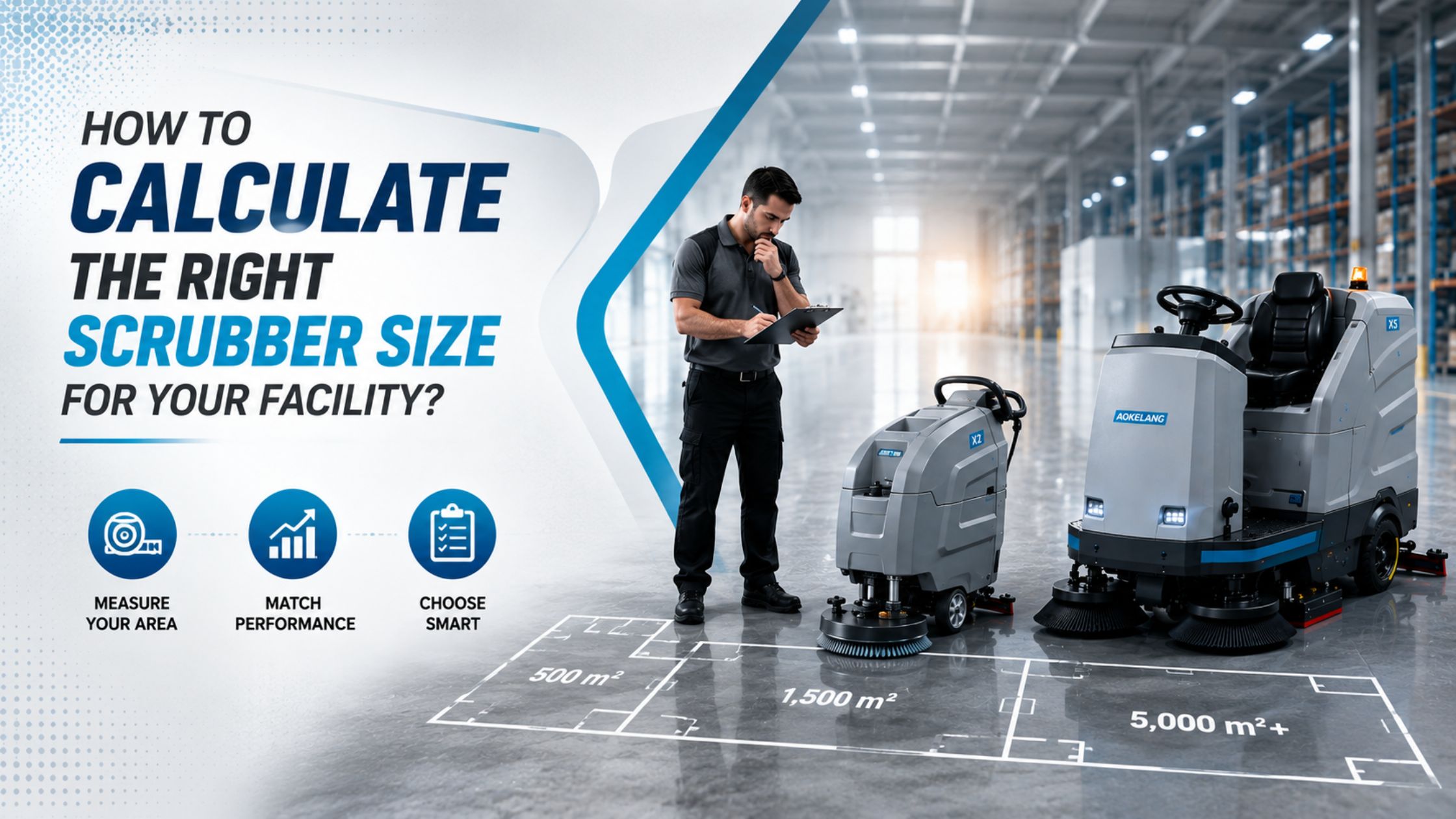
How to Calculate the Right Scrubber Size? The right scrubber size is the smallest cleaning width that can realistically cover your total floor area within your available cleaning window, calculated using the formula: Productivity = Cleaning Width × Travel Speed. Once you know the productivity rate you need, you can work backward to find the minimum cleaning width required, then apply a real-world efficiency discount to account for turns and obstacles.
This guide breaks down the formula itself, walks through a full worked example, and gives you a reference table showing how it plays out across real machine specs.
Table of Contents
The Core Formula: Productivity = Cleaning Width × Travel Speed
Every scrubber’s productivity rating (in m²/hour or sq ft/hour) comes from a simple relationship: how wide a path the brush covers, multiplied by how fast the machine travels while cleaning. In metric units:
Productivity (m²/h) = Cleaning width (m) × Travel speed (km/h) × 1,000
This formula also works in reverse — if you know the productivity rating and the cleaning width, you can back out the assumed travel speed a manufacturer used to calculate that rating. Doing this across Aokelang’s own lineup shows how travel speed (and therefore productivity) scales with machine type:
| Model | Cleaning Width | Rated Productivity | Implied Travel Speed | Machine Type |
| Aokelang D2 | 0.35 m | 1,350 m²/h | ~3.9 km/h (~2.4 mph) | Push walk-behind |
| Aokelang X2 | 0.50 m | 1,750 m²/h | ~3.5 km/h (~2.2 mph) | Push walk-behind |
| Aokelang T3 | 0.51 m | 2,000 m²/h | ~3.9 km/h (~2.4 mph) | Push walk-behind |
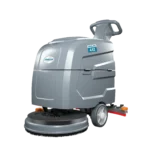
| Aokelang D4 | 0.51 m | 3,000 m²/h | ~5.9 km/h (~3.7 mph) | Self-propelled walk-behind |
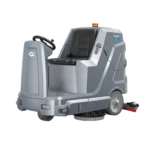
| Aokelang D6 | 0.76 m | 5,200 m²/h | ~6.8 km/h (~4.3 mph) | Ride-on |
This confirms the practical pattern: push walk-behind machines operate around 2–2.5 mph (a comfortable walking pace with a machine in front of you), self-propelled walk-behinds run somewhat faster since the operator isn’t limited to pushing speed, and ride-on machines run fastest since the operator isn’t walking at all. Knowing this lets you sanity-check any manufacturer’s productivity claim — if the implied speed works out to something unrealistic for the machine type, the rating may be optimistic.
Step 1: Calculate the Productivity You Need
Start with your total floor area and how much time you actually have to clean it:
Required productivity (sq ft or m²/hour) = Total floor area ÷ Available cleaning hours
For example, a 40,000 sq ft facility with a 2-hour overnight cleaning window needs a machine capable of at least 20,000 sq ft/hour of real-world productivity — not rated productivity, which brings us to Step 3.
Step 2: Work Backward to Find Your Minimum Cleaning Width
Since productivity equals width times speed, and travel speed is fairly consistent within a machine category (per the table above), you can rearrange the formula to solve for the cleaning width you need:
Minimum cleaning width = Required productivity ÷ Typical travel speed for your machine category
Using the 20,000 sq ft/hour requirement from the example above, and assuming a self-propelled walk-behind traveling at roughly 3.7 mph (about 19,540 ft/hour), the math works out to a minimum cleaning width of roughly 1.02 ft, or about 12 inches — but this ignores the real-world efficiency loss covered next, which is why raw formula output alone isn’t the final answer.
Step 3: Apply a Real-World Efficiency Factor
Manufacturer-rated productivity assumes continuous travel at rated speed with no interruptions — which doesn’t reflect daily use. Turns, obstacles, and pass overlap between cleaning rows typically reduce real-world output by roughly 25–30% below the rated maximum. Apply this discount to your productivity requirement before finalizing a width:
Adjusted minimum width = (Required productivity ÷ 0.70 to 0.75) ÷ Typical travel speed
Continuing the example: dividing the 20,000 sq ft/hour requirement by 0.72 (the midpoint of the discount range) brings the real requirement to roughly 27,800 sq ft/hour, which at a self-propelled walk-behind’s typical speed points toward a wider cleaning width — closer to the 20-inch (510mm) class of machine, like the Aokelang D4, rather than the narrower theoretical result from Step 2 alone.
Also read – Walk-behind vs. ride-on scrubbers
Full Worked Example
Facility: 40,000 sq ft warehouse Cleaning window: 2 hours per session, 5 days a week Step 1: Required productivity = 40,000 ÷ 2 = 20,000 sq ft/hour Step 2 (raw): At a self-propelled walk-behind speed of ~19,540 ft/hour, this suggests a cleaning width of just over 1 ft — clearly too narrow to be realistic once real-world losses are factored in Step 3 (adjusted): 20,000 ÷ 0.72 = ~27,800 sq ft/hour required in practice Result: This points to a machine in the 20-inch (510mm) productivity class rated around 3,000 m²/hour (~32,300 sq ft/hour), like the Aokelang D4, which comfortably covers the adjusted requirement with margin left over for an occasional larger cleaning task or unexpected delay
Running your own numbers through this same three-step process — rather than picking a machine off a size chart — is what actually tells you whether a given model fits your facility’s real operating conditions.
Reference Table: Cleaning Width vs. Productivity Across Aokelang Models
| Model | Cleaning Width | Rated Productivity | Realistic Productivity (×0.70–0.75) |
| D2 | 350 mm | 1,350 m²/h | ~945–1,013 m²/h |
| X2 | 500 mm | 1,750 m²/h | ~1,225–1,313 m²/h |
| T3 | 510 mm | 2,000 m²/h | ~1,400–1,500 m²/h |
| D4 | 510 mm | 3,000 m²/h | ~2,100–2,250 m²/h |
| D6 | 760 mm | 5,200 m²/h | ~3,640–3,900 m²/h |
Browse the full floor scrubber range, or narrow to just walk-behind or ride-on models, to compare additional sizes against your calculated requirement.
Common Calculation Mistakes
- Using rated productivity as your final answer. Without the efficiency discount in Step 3, you’ll consistently undersize the machine you actually need.
- Ignoring machine category when estimating travel speed. A push walk-behind and a ride-on machine don’t travel at the same speed even with a similar cleaning width — use the speed typical for the category you’re actually comparing.
- Solving for width without checking it against your facility’s aisle widths. The formula tells you the productivity-driven minimum width, but a wider machine still needs to physically fit and turn within your layout verify both before finalizing.
- Calculating productivity once and never revisiting it. If your cleaning window, staffing, or facility footprint changes, rerun the calculation rather than assuming your original sizing still holds.
Next Steps
To run this calculation for your own facility, you’ll need your total floor area, your available cleaning window, and your tightest aisle width to confirm maneuverability. Browse the full floor scrubber range to compare cleaning width and productivity across models, or request a quote with your facility details for a tailored sizing recommendation. You can also read Walk-Behind vs. Ride-On Scrubbers: How to Decide Based on Floor Area for how this calculation feeds into the walk-behind vs. ride-on decision, or contact the Aokelang team if you’d like help running the numbers for your specific facility.
Scrubber Sizing Calculation FAQs
What’s a typical travel speed for a walk-behind scrubber?
Push walk-behind machines typically travel around 2–2.5 mph, while self-propelled walk-behind models run faster, often in the 3.5–4 mph range, since the operator isn’t limited by pushing speed.
Why does my calculated cleaning width seem smaller than the machines available on the market?
This usually means your calculation hasn’t yet applied the real-world efficiency discount from Step 3 — raw formula output before that adjustment often understates the width you actually need once turns, obstacles, and overlap are accounted for.
Can I use this formula for ride-on machines too?
Yes — the formula works the same way, just with a higher typical travel speed input (roughly 4–4.5 mph for most ride-on scrubbers) reflecting the faster pace a seated, driven machine can sustain.
How often should I recalculate my scrubber sizing?
Recalculate whenever your floor area, cleaning frequency, or available cleaning window changes meaningfully — a machine sized correctly for your facility two years ago may no longer fit if your footprint or schedule has shifted since.
Does this formula account for tank refills?
No — this formula calculates productivity and width only. Tank capacity is a separate variable that affects how many refill/empty interruptions occur during a session; see the floor scrubber sizing guide for how to factor tank size into your total sizing decision.