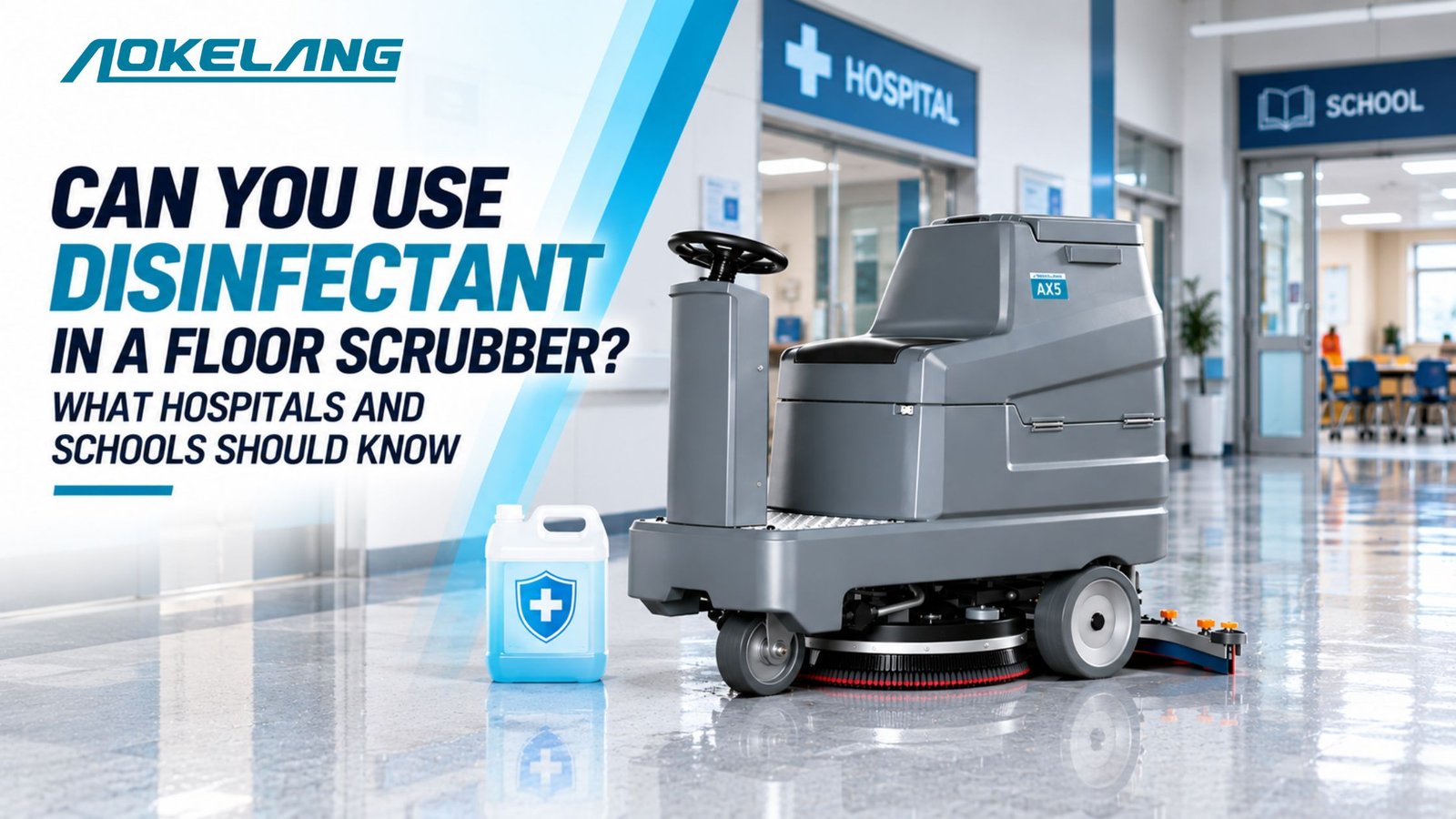
Can You Use Disinfectant in a Floor Scrubber? You can use disinfectant in a floor scrubber if the product is low-foam, compatible with auto scrubbers, safe for your floor, and used at the label dilution. To actually disinfect rather than just clean, the floor must stay wet for the product’s contact time. That usually means a first pass with the squeegee up, a wait, and a second pass to pick up the solution.
Key takeaways
- Yes, you can use disinfectant in a floor scrubber, provided the product is low-foam, suits automatic scrubbers, is safe for your floor, and is used at the dilution on its label.
- Disinfectants need contact time: the floor has to stay wet for a set number of minutes. A scrubber picks up water within seconds, so you need a two-pass method to disinfect properly.
- Avoid bleach unless your machine supplier approves it. It can corrode metal parts and damage seals, and it is dangerous if mixed with other chemicals.
- Disinfectant works best on a floor that is already clean. Soil and residue weaken it.
- The recovery tank holds dirty, possibly contaminated water. Empty it, rinse it and leave it open to dry after every use.
Table of Contents
Can you use disinfectant in a floor scrubber?
In most cases, yes. Many hospitals, schools and care facilities do. Before you add anything to the solution tank, check four things:
- The product label. It should say the product is suitable for floors and for automatic scrubbers or machine use. It should also give a dilution rate and a contact time.
- Foam level. Disinfectants that foam heavily fill the recovery tank with foam and can trip the float, which cuts suction. Choose low-foam products.
- Your machine supplier’s guidance. Some chemicals, especially chlorine bleach and strong acids, can damage tanks, pumps, valves and seals.
- Your floor. Some disinfectants can dull floor finishes, haze epoxy coatings or affect rubber and vinyl. Test a small area first.
If all four check out, the disinfectant can go in the solution tank at the label dilution.
What is the difference between cleaning and disinfecting?
The two are not the same, and the difference changes how you use the machine.
- Cleaning removes dirt, grease and germs from the surface. A floor scrubber does this very well, because it scrubs and then vacuums the dirty water away.
- Disinfecting kills germs on the surface using a chemical. It needs the right product, the right dilution and enough contact time.
Disinfectants work best on clean surfaces. Dirt, grease and old residue can shield germs and weaken the disinfectant. That’s why many facilities clean first and disinfect second, or use a one-step cleaner-disinfectant that’s registered and labelled for that purpose.
In healthcare, floors are generally treated as housekeeping surfaces. Infection-prevention guidance, such as the CDC’s guidelines for environmental infection control in healthcare facilities, treats routine floor cleaning with a detergent as appropriate in many areas. Disinfection is reserved for specific situations, such as spills of blood or body fluids and certain high-risk areas.
Follow your own infection prevention team’s policy. It decides where and when floors need disinfecting.
Why does contact time matter so much?
Every disinfectant has a contact time on its label, sometimes called dwell time or wet time. This is how long the surface must stay wet for the product to kill the germs listed on it. It is often several minutes.
An auto scrubber removes the solution almost immediately. The squeegee picks it up within seconds of the brush passing. That’s good for slip safety, but the disinfectant doesn’t stay on the floor long enough to work.
So a single normal pass:
- cleans the floor well
- doesn’t disinfect it to the label’s standard
If you need true disinfection, use the two-pass method below.
How do you disinfect a floor with a scrubber? The two-pass method
- Sweep or dust mop to remove loose debris.
- Mix the disinfectant in the solution tank at the label dilution.
- First pass, with the squeegee raised and the vacuum off. Scrub the area so it’s evenly wet with disinfectant solution.
- Wait for the contact time on the label. Keep the area closed and signed, and don’t let it dry out before the time is up.
- Second pass, with the squeegee lowered and the vacuum on. Scrub and pick up all the solution. If the label calls for a rinse, use clean water for this pass.
- Check the edges and corners and dry any damp spots.
Work in sections small enough to stay wet for the full contact time. On large or warm floors, the solution may dry before the time is up. In that case, use smaller sections.
This method uses more time and water than normal cleaning, so keep it for the areas and situations your infection prevention policy requires.
Which disinfectants work in a floor scrubber?
| Disinfectant type | Use in a scrubber | Watch out for |
| Quaternary ammonium (quats) | Common in floor care, and often available in low-foam versions | Some foam; residue can build up over time, so do occasional clean-water scrubs |
| Hydrogen peroxide-based | Generally suitable, and leaves little residue | Check the concentration and compatibility with your machine and floor |
| One-step cleaner-disinfectants | Clean and disinfect together, so they suit routine use | Still need the full contact time to disinfect |
| Chlorine bleach (sodium hypochlorite) | Generally not recommended unless the machine supplier approves it | Corrodes metal, damages seals, can affect floors, and is dangerous if mixed with other chemicals |
| Phenolic disinfectants | Use only if the floor and machine are confirmed compatible | Can affect some floor finishes and rubber parts |
| Acid-based disinfectants | Avoid unless the floor and machine are confirmed compatible | Can etch stone and terrazzo, and can damage metal parts |
Whatever product you choose:
- Never mix chemicals. Bleach mixed with ammonia or acids gives off toxic gases.
- Don’t add disinfectant to a tank that still has detergent in it unless the label says they’re compatible.
- Use the label dilution. Stronger is not better. Too much leaves residue and a slippery floor.
Can you use bleach in a floor scrubber?
It’s best avoided unless your machine supplier specifically approves it. There are four reasons:
- Corrosion: bleach can corrode metal parts, such as fittings, valves and brush hubs.
- Seals and hoses: it can harden or crack rubber and plastic parts over time.
- Floor damage: it can discolour or dull some floors and finishes.
- Safety: it gives off fumes, and reacts dangerously with ammonia-based or acidic cleaners that may still be in the tank or lines.
If your policy requires a chlorine product for certain situations, such as some outbreak responses, follow your infection prevention team’s procedure. Check with your machine supplier before using it in the scrubber.
How should hospitals use disinfectant in a floor scrubber?
| Area | Typical approach |
| Corridors and public areas | Routine cleaning with detergent or a one-step cleaner-disinfectant, as your policy requires |
| Patient rooms | As your policy requires; often cleaning, with disinfection on a schedule or at discharge |
| Isolation rooms | Disinfection as your policy requires; consider dedicated pads and equipment |
| Operating theatres and high-risk areas | Follow your infection prevention team’s specific procedures |
| Spills of blood or body fluids | Use a spill kit first, never the scrubber, then clean and disinfect as your policy requires |
Key points for hospitals:
- Avoid cross-contamination. Use separate pads, colour-coded by zone, and change them between areas.
- Plan your route. Clean from cleaner areas toward dirtier areas, not the other way round.
- Keep the machine clean. The recovery tank and squeegee carry dirty water from one area to the next.
Aokelang’s AD4 walk-behind scrubber is used in hospitals and other commercial buildings. Its 510 mm cleaning path suits corridors and wards.
How should schools use disinfectant in a floor scrubber?
Schools have different needs from hospitals. The focus is usually on busy shared spaces and on outbreaks of illness.
| Area | Typical approach |
| Classrooms and corridors | Routine cleaning daily; disinfection during illness outbreaks |
| Cafeterias | Clean daily with a degreasing cleaner; disinfect eating areas as required |
| Restrooms and entrances to them | Clean and disinfect frequently |
| Gyms and sports floors | Check the floor maker’s guidance; many wood sports floors shouldn’t be scrubbed with water and chemicals |
| Nurse’s office | Clean and disinfect as required, as for a small clinical area |
Key points for schools:
- During outbreaks, choose a disinfectant whose label lists the illness of concern, and use the two-pass method in affected areas.
- Schedule disinfection when students aren’t present, so the floor can stay wet for the contact time.
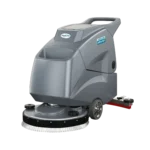
- Compact machines help. A small walk-behind like the Aokelang AD2, with a 350 mm cleaning width, fits classrooms, corridors and restroom entrances.
How do you keep the scrubber hygienic?
A scrubber that isn’t cleaned can spread germs instead of removing them. The recovery tank in particular collects dirty water that may be contaminated.
After every use:
- Wear gloves when handling the recovery tank, squeegee and pads.
- Empty the recovery tank into a suitable drain, as your site’s rules require.
- Rinse the recovery tank with clean water. If your policy requires it, disinfect it with a product approved for the machine.
- Leave the tank lid open so the tank dries. Closed, damp tanks grow bacteria and develop odours.
- Rinse the solution tank and lines with clean water, so no disinfectant sits in the pump and valves overnight.
- Clean the squeegee blades and rinse the float and filter.
- Wash or replace pads. Launder reusable pads, or follow your policy for single-use pads.
Our floor scrubber maintenance guide covers the full daily, weekly and monthly routine.
What problems can disinfectant cause in a scrubber?
| Problem | Likely cause | Fix |
| Foam in the recovery tank, with suction dropping | High-foam product or too much product | Use a low-foam product at the label dilution |
| Sticky or hazy floor | Residue build-up | Do a clean-water scrub; check the dilution |
| Floor finish looks dull | Product not compatible with the finish | Test the product; switch to one approved for the floor |
| Corroded fittings or leaking seals | Harsh chemical, often bleach | Stop using it; check with the supplier; rinse lines after each use |
| Odour from the recovery tank | Dirty water left in the tank | Empty, rinse and air-dry after every use |
If foam is cutting suction, see what to do when a floor scrubber isn’t picking up water.
Don’t forget slip safety
Disinfecting with the two-pass method leaves the floor wet on purpose during the contact time. During that time:
- close the area or put up wet floor signs
- work in sections, so walkways stay open
- pick up all the solution on the second pass, and check that the floor is dry before reopening it
For more on keeping floors dry and safe, see our guide to slip and fall prevention.
Frequently asked questions
Can you use disinfectant in a floor scrubber?
Yes, if the product is low-foam, labelled for floors and machine use, safe for your floor, and used at the label dilution. Check with your machine supplier before using harsh chemicals such as bleach.
Does a floor scrubber disinfect the floor?
On a single normal pass, it cleans the floor very well but usually doesn’t disinfect it. The solution is picked up too quickly to meet the contact time. To disinfect, use a two-pass method: apply the solution, wait the contact time, then pick it up.
What disinfectant is safe for floor scrubbers?
Low-foam quaternary ammonium products, hydrogen peroxide-based products and one-step cleaner-disinfectants made for floors are common choices. Always check the label and confirm compatibility with your machine and floor.
Should I rinse the scrubber after using disinfectant?
Yes. Rinse the solution tank and lines with clean water, empty and rinse the recovery tank, and leave the lid open to dry. This protects the machine and stops bacteria growing in the tanks.