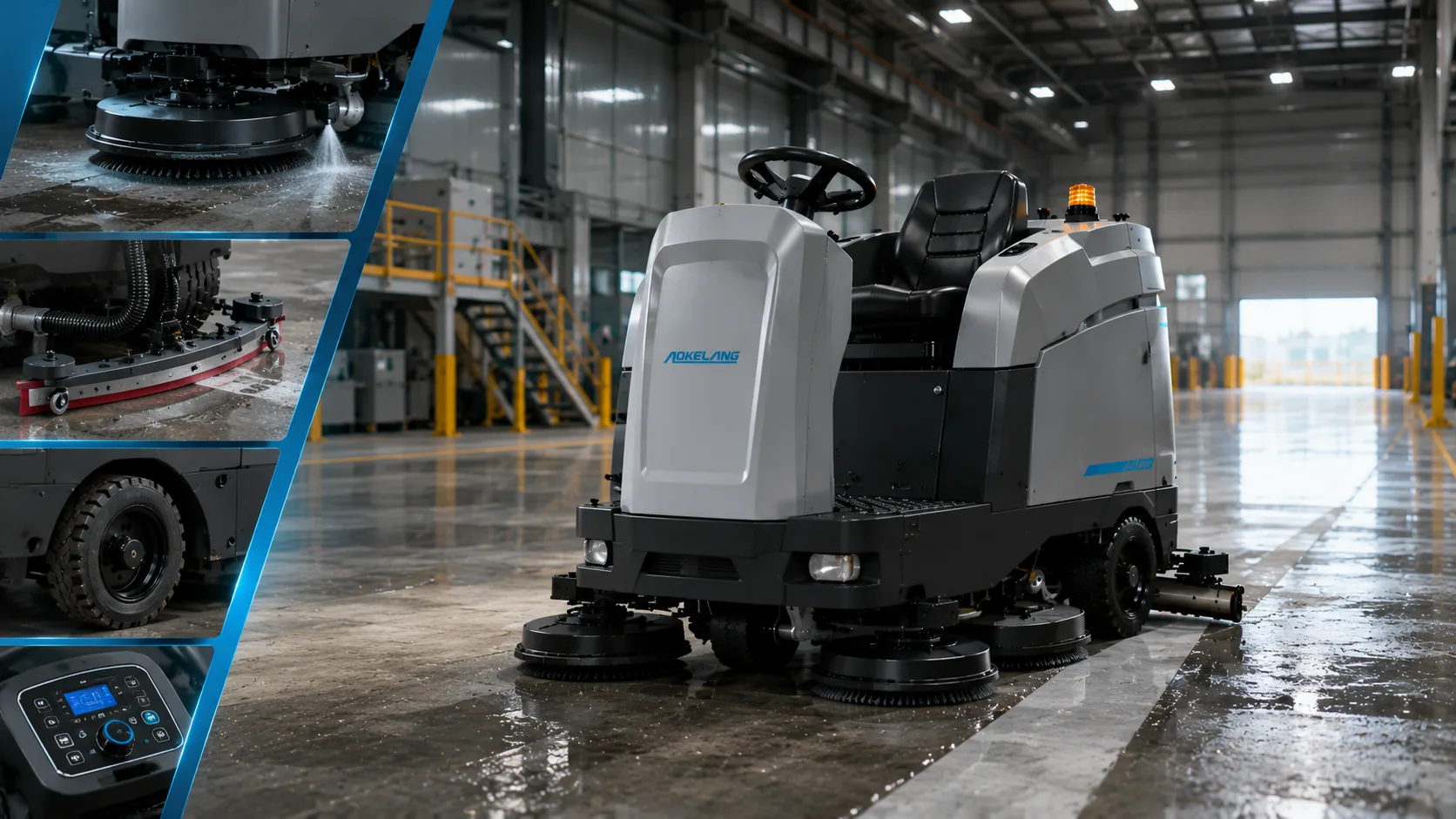
Concrete is the most common and most demanding floor surface in industrial facilities and it punishes the wrong machine quickly. Oil, grease, grit, metal debris, and forklift traffic create soil conditions that most commercial-grade scrubbers aren’t built to handle. This (Industrial Floor Scrubber for Concrete Floors) guide covers exactly what a concrete floor scrubber needs to deliver, which brush configuration works best, and how to match the right machine to your facility’s scale and layout.
Table of Contents
Why Concrete Floors Need Industrial-Grade Cleaning
Concrete floors need strong brush pressure and reliable water recovery. These surfaces are common in warehouses, factories, and industrial environments where dirt and residue build up quickly.
Concrete is porous, which means oil, grease, and coolant residue don’t just sit on the surface, it penetrates and embed in the material. A scrubber that’s underpowered for the soil load, or one with the wrong brush type for the surface condition, will produce visibly poor results and accelerate consumable wear at the same time.
Modern industrial-grade floor scrubbers feature variable-speed brush motors running at 200–600 RPM and precision chemical injection pumps essential for safely neutralizing acidic coolant residues in machining zones without damaging the underlying flooring. These aren’t features found on light commercial machines, and their absence is what causes commercial-grade scrubbers to underperform in industrial concrete environments.
Disc vs Cylindrical Brush: The Most Important Decision for Concrete
Getting the brush configuration right matters more on concrete than on any other surface. The choice is not one-size-fits-all — it depends on whether your concrete is smooth or rough, sealed or unsealed, and how much loose debris accumulates on the floor before each clean.
Disc Brushes — Best for Polished, Sealed, or Smooth Concrete
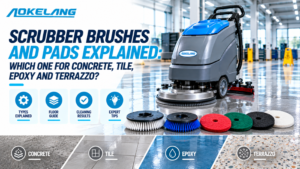
Disc machines have greater overall down pressure than cylindrical machines, so they do a better job at cleaning tough soils and stains. The heads turn at slower RPMs, which makes them suitable for stripping floor finish on smooth or polished concrete.
If you are cleaning polished concrete, a disc scrubber is usually the best option — it delivers smoother results, more consistent pad pressure, and better floor finish protection. For facilities with sealed epoxy or polished warehouse floors where appearance matters alongside hygiene, disc is the correct configuration.
One important operational note: floors will need to be swept before scrubbing with disc machines — they’re not designed to collect debris. Running a disc scrubber over an unswept concrete floor reduces cleaning effectiveness and damages brush consumables.
Cylindrical Brushes — Best for Rough, Textured, or Debris-Heavy Concrete
Cylindrical scrub brushes turn much faster than disc scrubbers at 600–800 RPM. With cylindrical scrubbers, there’s no need to pre-sweep; they wet-sweep small debris into a removable tray while simultaneously washing the floor.
On rough concrete or gritty industrial spaces, cylindrical scrubbers outperform disc machines because they are designed for heavy-duty environments where debris is common. They perform well on textured, non-slip surfaces and rough concrete where disc scrubbers may struggle to reach into grooves.
From real-world operator experience in industrial workshops: a cylindrical brush is preferred because the scrub head has a debris trap and picks up small things that get missed when sweeping and on oily floors, a silicone squeegee outperforms the standard gum rubber squeegee significantly.
Brush Hardness on Concrete: Match to the Surface Condition
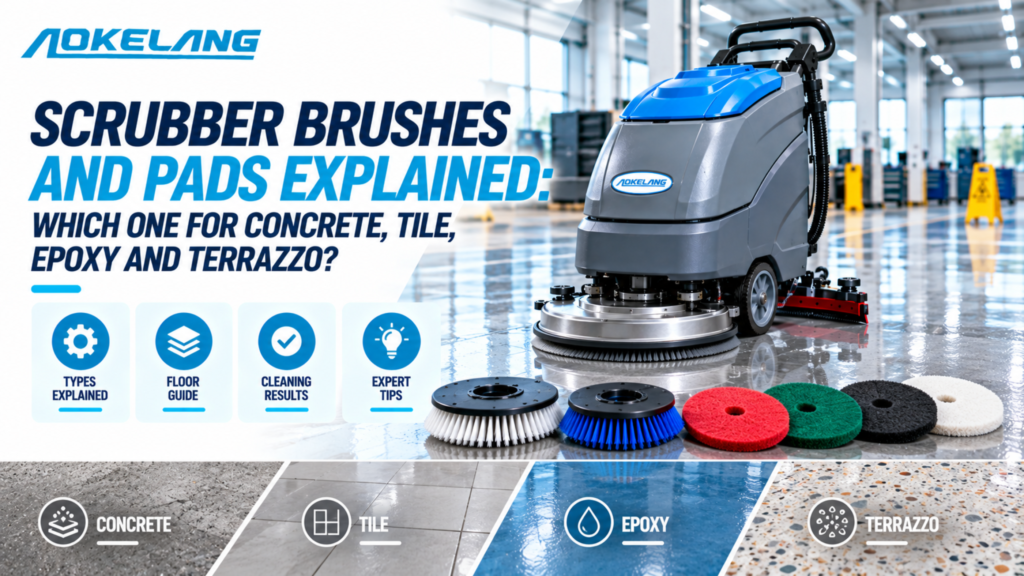
Resin-based concrete floor coatings — including epoxy and urethane — are sensitive to damage from long-term mechanical scrubbing, making soft-to-medium polypropylene brushes the right choice. Stained or painted concrete is similarly sensitive, where hard bristles can scratch and scour away the coating’s surface.
For raw, unsealed industrial concrete with embedded grease: heavy grit brushes are the most aggressive type and are designed for cleaning the heaviest buildup and stains — particularly effective on concrete to remove grease or grime stuck in the pores.
Disc brush configurations deliver 45% more downward force, making them effective for degreasing heavily soiled machined areas, while cylindrical brushes with their even pressure distribution prevent swirl marks on epoxy-coated floors.
Also read – New vs Used Floor Scrubbers: Which Should You Choose
Walk-Behind vs Ride-On for Concrete Floors
Concrete industrial floors span an enormous range of sizes, from a 5,000 sq ft workshop to a 500,000 sq ft distribution centre. The right machine format is determined primarily by floor area and layout constraints.
Walk-Behind Scrubbers — Production Zones and Mid-Size Facilities
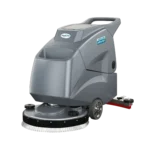
For industrial workshops, maintenance bays, and manufacturing facilities under 30,000–40,000 sq ft per cleaning shift, a robust walk-behind scrubber is often the best answer. It’s more manoeuvrable around machinery and equipment, simpler to operate, and lower in capital cost than a ride-on.
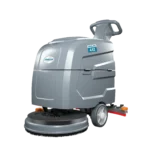
The Aokelang T3 Industrial Walk-Behind Floor Scrubber is built specifically for this type of environment — industrial-grade construction, high brush pressure suitable for concrete, and designed to handle the demanding soil loads of a manufacturing or workshop setting. For tighter zones between machinery and equipment where manoeuvrability is the priority, the Aokelang T3Z Small Floor Scrubber covers the gaps that a full-size industrial walk-behind can’t reach. The Aokelang D4Z Battery-Powered Walk-Behind Scrubber provides battery-powered cord-free operation across mid-size concrete floors on a single charge — the right choice for facilities where cord hazards are unacceptable in active production zones.
Ride-On Scrubbers — Large Warehouses, Distribution Centres, and Open Production Halls
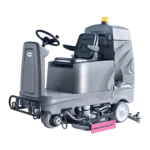
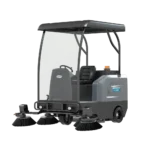
For large warehouses or wide-open industrial facilities, a ride-on model is the more efficient choice. Industrial environments like manufacturing plants and warehouses require machines with high durability, strong brush pressure, and large tanks and a ride-on scrubber is better suited for heavy-duty environments where continuous operation, extensive coverage, and operator efficiency matter more than compact size.
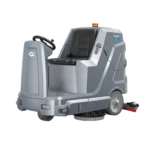
The Aokelang D7 Industrial Ride-On Floor Scrubber is the core heavy-duty option for large industrial concrete floor applications built for sustained multi-shift operation across extensive concrete floor areas with the tank capacity to minimize service stops. The Aokelang D8 Commercial Ride-On Scrubber suits very large open floor footprints where cleaning width and recovery tank size are the primary efficiency drivers, and the Aokelang DX6 provides another high-capacity option for facilities covering large concrete areas daily. Aokelang’s post on whether a ride-on scrubber is worth it makes the financial and operational case clearly for large-facility buyers.
Aokelang Scrubbers for Concrete Floors: By Zone and Application
| Concrete Zone | Condition | Recommended Model | Key Strength |
| Workshop/maintenance bay | Rough, oily, debris-heavy | Aokelang T3 | Industrial build, high brush pressure |
| Tight production zones | Mixed debris, sealed concrete | Aokelang T3Z | Compact, navigates around equipment |
| Mid-size factory floor | Concrete, active production | Aokelang D4Z | Battery-powered, cord-free in active zones |
| Large warehouse/logistics | Open bare concrete | Aokelang D7 | Industrial ride-on, multi-shift capable |
| Very large distribution centre | Extensive concrete | Aokelang D8 or DX6 | Maximum tank capacity and cleaning width |
The full Aokelang commercial floor cleaning machines range covers detailed specifications for every model across both formats.
Does Concrete Need a Sweeper Before Scrubbing?
For disc brush configurations: always. For cylindrical brush configurations: usually not, but it helps on floors with heavy particulate debris.
Cylindrical scrub brushes sweep small debris into a removable hopper tray while also washing the floor — eliminating the pre-sweep step that disc machines require. This makes cylindrical scrubbers a smart choice for large spaces such as warehouses, where pre-sweeping would add significant time. Sproutmation
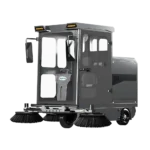
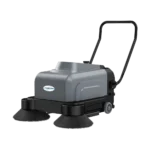
For very heavy industrial debris — significant metal shavings, large cardboard fragments, pallet waste — a dedicated sweeper first pass makes the scrubber significantly more effective regardless of brush type. Aokelang’s industrial floor sweeper range covers this first-pass requirement. The Aokelang D2000 Factory Floor Sweeper and Aokelang D2300 Heavy-Duty Industrial Sweeper handle heavy industrial debris loads before the scrubber cleans and dries the surface.
How to Handle Oil and Grease on Industrial Concrete
Oil and grease are the hardest cleaning challenge on concrete floors, and a scrubber alone is rarely sufficient without the right chemical approach.
Pre-treating wet and greasy spots with a degreaser before running the scrubber across the floor significantly helps to get the floor clean. This is consistent real-world operator guidance across manufacturing and workshop environments — the scrubber handles the mechanical cleaning and water recovery, but the chemical pre-treatment does the work of breaking down the oil before the brush makes contact. US Cleaning Tools
Oil and grease contamination typically requires 8–10 minutes of dwell time for the cleaning solution before mechanical scrubbing begins — this is the difference between surface cleaning and genuinely removing embedded contamination from concrete pores. LVTONG
On squeegee selection: for oily floors, silicone squeegees are the strongly preferred option over standard gum rubber, which doesn’t perform well against oil films. This is a low-cost upgrade that makes a meaningful difference on greasy concrete and is worth confirming with the supplier before purchase. For a full breakdown of machine features relevant to these applications, Aokelang’s guide on features to look for in a professional floor cleaning machine covers squeegee, brush, and chemical system specifications in detail.
Also read – How Long Should a Commercial Floor Scrubber Last
What Tank Capacity Does an Industrial Concrete Floor Require?
A generous tank capacity minimizes refill stops across expansive concrete floors and for facilities over 50,000 sq ft, this is one of the most important operational specifications on the machine. Lavor
Concrete floors absorb and require more cleaning solution than smooth tile or VCT, which means machines cover less area per tank on concrete than their rated productivity suggests on smoother surfaces. When evaluating tank capacity against cleaning area, apply a conservative multiplier of 20–30% less coverage than the manufacturer’s rated figure for bare unsealed concrete, particularly with heavy soil loads. Understanding how floor cleaning machines save your business money through reduced refills and labour time is a useful context for sizing tank capacity correctly against your actual operational demands.
External references: OSHA Walking-Working Surfaces Standard 29 CFR 1910.22 | National Floor Safety Institute — Industrial Floor Safety Standards
Frequently Asked Questions
What type of brush is best for industrial concrete floors?
For rough concrete or gritty industrial spaces, cylindrical scrubbers outperform disc machines because they handle textured, non-slip surfaces and pick up debris while scrubbing. For polished or sealed concrete where appearance matters, a disc scrubber with the appropriate pad delivers better finish results. On raw, heavily soiled, unsealed concrete with embedded grease, heavy grit brushes combined with a cylindrical brush deck is typically the strongest combination.
Do I need to sweep before scrubbing concrete floors?
It depends on the brush type. With cylindrical scrubbers, there’s no need to pre-sweep they wet-sweep small debris into a removable tray while washing the floor. With disc scrubbers, pre-sweeping is required. For very heavy industrial debris loads, a dedicated sweep pass is beneficial regardless of brush type.
Can a floor scrubber remove oil from concrete?
Yes, with the right combination of machine, brush, and chemical approach. Use an industrial degreaser as a pre-treatment with adequate dwell time, a machine with sufficient brush pressure, and where possible a silicone squeegee for better oil recovery than standard gum rubber blades. A standard commercial floor scrubber with insufficient brush pressure will struggle with embedded oil — industrial-grade machines with heavy grit brushes are the correct tool.
What size scrubber do I need for a 50,000 sq ft warehouse concrete floor?
A ride-on scrubber with a 32–36 inch cleaning path is recommended for facilities at this scale. Walk-behind machines can technically cover this area but the operator fatigue and time cost make a ride-on the far more practical and cost-effective choice for daily cleaning operations.
Is sealed or epoxy-coated concrete easier to clean than bare concrete?
Significantly easier sealed and epoxy-coated surfaces are non-porous, which means oil and grime sits on the surface rather than penetrating into pores. They’re also more resistant to water damage and chemical cleaning agents. However, resin-based coatings, including epoxy and urethane are sensitive to damage from long-term mechanical scrubbing soft-to-medium polypropylene brushes are the right choice to avoid wearing through the protective coating.