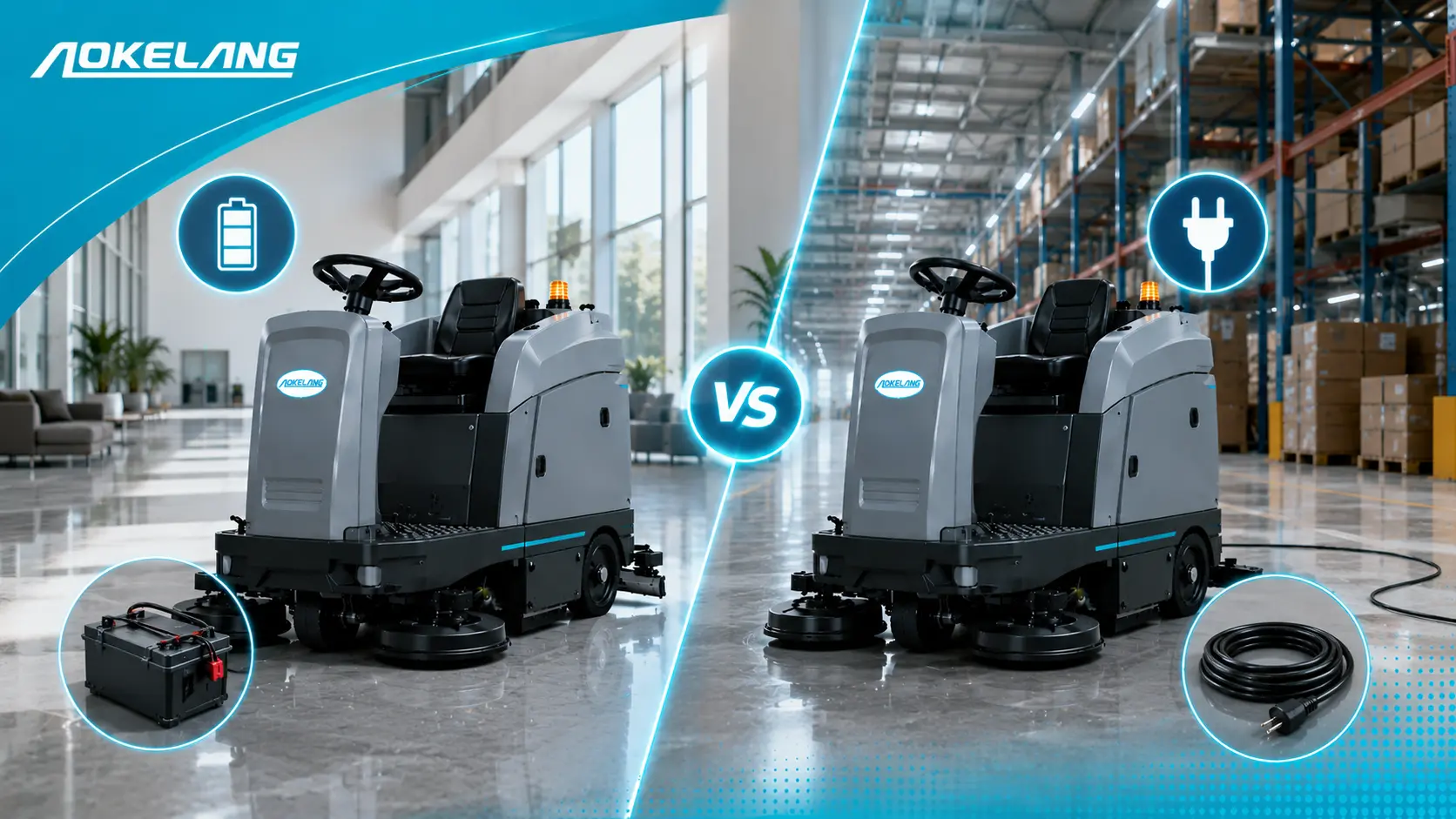
For most commercial facilities, while deciding Battery-Powered vs Corded Floor Scrubbers, battery-powered floor scrubbers are the stronger choice but corded machines still have a place, and choosing wrong costs you in ways that aren’t obvious at purchase. This guide breaks down exactly when each makes sense, what the real cost difference looks like over time, and how to match your power source to your operation.
Table of Contents
What’s Actually Different Between Battery-Powered vs Corded Floor Scrubbers?
The cleaning mechanism brushes, water, squeegee recovery is identical in both. The difference is entirely in how they’re powered, and that single difference cascades into meaningful operational gaps in mobility, safety, maintenance, and total cost.
Battery-powered floor scrubbers offer increased mobility and flexibility, allowing use in areas without easy access to power outlets. Corded floor scrubbers provide consistent power and are ideal for large, continuous cleaning tasks without the need for recharging.
Both statements are true. Neither tells the full story. Here’s the complete picture. Also read – automatic scrubbers maintenance
The Case for Battery-Powered Floor Scrubbers
Mobility and Freedom of Movement
Battery-powered scrubbers eliminate extension cord management, trip hazards, and the limitation of cleaning only within cord reach, making them essential for most commercial applications.
In a busy warehouse, a hospital corridor, or a retail floor during trading hours, trailing a power cord is not just inconvenient — it’s a genuine safety hazard. Battery operation removes that problem entirely. The operator cleans the full floor in one uninterrupted pass without navigating around cord length or hunting for outlet access points.
Noise and Indoor Suitability
Battery-powered scrubbers are usually quieter than corded or industrial machines and are better for daytime cleaning. This matters particularly in environments like hospitals, schools, and offices where cleaning happens during or adjacent to occupied hours.
The Aokelang Battery-Powered Range
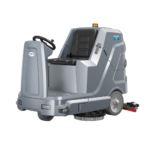
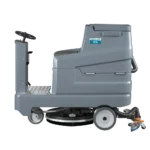
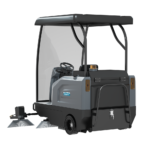
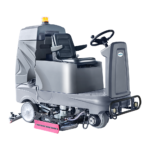
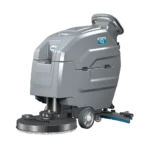
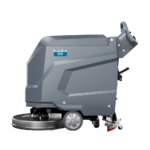
Aokelang’s battery-powered lineup covers a broad range of facility sizes. The Aokelang D4 Battery Walk-Behind Scrubber and Aokelang D4Z are built for medium-size commercial operations where cord-free operation is non-negotiable. For larger open areas, the Aokelang D6 Ride-On Scrubber and Aokelang X5 Automatic Ride-On deliver high-capacity battery operation across extended shifts.
The Case for Corded Floor Scrubbers
Corded machines have genuine advantages that battery advocates tend to gloss over.
Unlike battery-powered models that require regular charging and may have limited run times, corded scrubbers can operate continuously as long as they are plugged in. This feature is particularly advantageous for large facilities where extensive cleaning is required without interruptions.
They’re also cheaper upfront. Corded models provide unlimited runtime and typically cost $300–600 less than comparable battery-powered units. For a small facility where the cleaning route is consistent, compact, and power points are accessible throughout, corded can be a sensible choice.
Corded machines work well for tight areas where you can plug in and don’t need runtime flexibility. A single back-office cleaning zone, a small restaurant kitchen, or a defined service corridor with an accessible outlet are all environments where corded makes practical sense.
Also read – Battery Powered Floor Scrubbers
When Battery Wins and When Corded Works: A Direct Comparison
| Factor | Battery-Powered | Corded |
| Mobility | Full freedom of movement | Limited by cord length |
| Safety | No cord trip hazard | Active cord hazard in busy spaces |
| Runtime | 2.5–5 hours per charge (varies by type) | Unlimited while plugged in |
| Upfront cost | Higher | Lower by $300–600 typically |
| Noise level | Lower — better for occupied spaces | Slightly higher |
| Maintenance | Battery requires management | No battery maintenance |
| Best facility size | 5,000+ sq ft | Under 5,000 sq ft with good outlet access |
| Best use case | Warehouses, hospitals, retail, schools | Small offices, compact service zones |
Lead-Acid vs Lithium-Ion: The Battery Decision Inside the Battery Decision
If you go battery-powered, you face a second choice that most buyers underestimate: lead-acid or lithium-ion. This is where the real cost difference hides.
Lead-Acid: Lower Upfront, Higher Long-Term Cost
Cordless commercial floor scrubbers typically run on large lead-acid deep cycle batteries, which are rechargeable but lose life over time — expect up to 1,500 charge cycles before replacement is needed.
Lead-acid batteries charge slowly, taking 8–12 hours for a full charge, and require full discharge cycles to avoid sulfation damage, which permanently reduces battery capacity. Flooded lead-acid variants also require regular water top-ups — a maintenance task that, when missed, accelerates battery degradation significantly.
Lithium-Ion: Higher Upfront, Lower Total Cost of Ownership
Lithium batteries charge faster (2–3 hours vs 8–10 hours for lead-acid), last longer at 3,000+ cycles vs 1,000–1,500, and require less maintenance. For most commercial operations, lithium-ion offers the best total cost of ownership despite the higher upfront price.
The numbers bear this out clearly. Lithium costs $1,000–$2,500 more upfront but eliminates maintenance, charges 3–4x faster, lasts 2–3x longer, and avoids mid-shift downtime. Over 5 years, the total cost of ownership for lithium is comparable to or lower than lead-acid.
There is also a performance consistency advantage. Lithium-ion delivers consistent voltage until fully depleted, ensuring steady performance throughout the shift — whereas lead-acid voltage drops as it discharges, leading to weaker cleaning power over time. In practice, this means a lead-acid machine cleans less effectively in the second half of a shift than the first.
One practical advantage of lithium that many buyers miss: opportunity charging (partial charging during breaks) is safe with lithium and adds 30–50% capacity in 30–60 minutes. With lead-acid, partial charging causes sulfation meaning the battery must always be fully charged in a single 6–8 hour session. For facilities running back-to-back shifts, this is operationally significant.
Also read – battery operated walk behind floor scrubber
When Lead-Acid Still Makes Sense
Lead-acid is a reasonable choice when your facility is under 15,000 sq ft and the scrubber runs less than 2 hours per day, when upfront budget is the absolute constraint, or when you have a dedicated person who will maintain the battery on schedule — every time without exception.
How Does This Affect Aokelang Machine Selection?
Aokelang’s walk-behind floor scrubber range spans both battery configurations, so the power source choice doesn’t limit your machine options — it shapes which model within the range suits your facility best.
For facilities where daily use is intensive and shift coverage is critical, the Aokelang D4Z and Aokelang D3 Commercial Walk-Behind offer reliable battery operation built for sustained commercial use. For larger footprints where operator productivity across extended shifts is the priority, the Aokelang D7 Industrial Ride-On Scrubber and Aokelang D8 Commercial Ride-On deliver high-capacity battery performance at scale. Aokelang’s post on whether a ride-on scrubber is worth it is a useful read if you’re deciding between walk-behind and ride-on battery formats.
For a thorough overview of what battery operation delivers across different use cases, the benefits of a floor scrubber machine guide covers the full performance picture.
Does the Power Source Affect Cleaning Performance?
The cleaning quality itself brush pressure, water application, suction recovery is not directly determined by whether the machine is corded or battery-powered. What the power source affects is consistency.
A corded machine delivers the same power at minute one as it does at hour three. A well-configured lithium battery machine does the same. A lead-acid battery machine, by contrast, delivers noticeably less brush motor power toward the end of its charge cycle. For facilities where consistent, hygiene-compliant cleaning standards must be maintained across the entire floor area every shift, this is a meaningful operational consideration.
The features to look for in a professional floor cleaning machine guide covers this in the context of overall machine specification — useful reading if you’re still building your shortlist.
Also read – Warehouse floor cleaning guide
External references: U.S. EPA on Lead-Acid Battery Recycling | OSHA Walking-Working Surfaces and Slip/Trip Hazard Standards
Frequently Asked Questions
Is a battery-powered floor scrubber better than a corded one for commercial use?
For most commercial operations, battery-powered wins offer mobility, eliminate tripping hazards, and are essential for facilities over 5,000 sq ft or spaces with limited power outlets. Corded machines remain a valid choice for small, well-defined cleaning zones with reliable outlet access.
How long does a battery-powered floor scrubber run on a single charge?
It depends on battery type and machine size. Lead-acid machines typically run 2.5–3.5 hours. Lithium-ion machines commonly reach 4–5 hours. Cold environments reduce both: cold conditions can reduce runtime by 15–30% for lead-acid and 10–15% for lithium.
Can I charge a battery floor scrubber during a break
Only if it’s lithium-ion. Opportunity charging is safe with lithium and adds meaningful capacity in 30–60 minutes. With lead-acid, partial charging causes permanent battery damage through sulfation — the battery must always complete a full charge cycle.
What’s the real cost difference between lead-acid and lithium over 5 years?
While a lithium scrubber may cost $1,800 more upfront than an equivalent lead-acid model, AGM lead-acid batteries only last 2–3 years in daily use, meaning you’ll need two to three replacement packs over a 5-year period. Total cost of ownership over five years typically favours lithium.
Are battery-powered scrubbers safe to use in occupied facilities during the day?
Yes this is one of their primary advantages. Battery-powered scrubbers are usually quieter than corded or industrial machines, making them better suited for daytime cleaning in hospitals, schools, and offices. No fumes, lower noise, and no cord hazards make them the right choice for cleaning during operational hours.