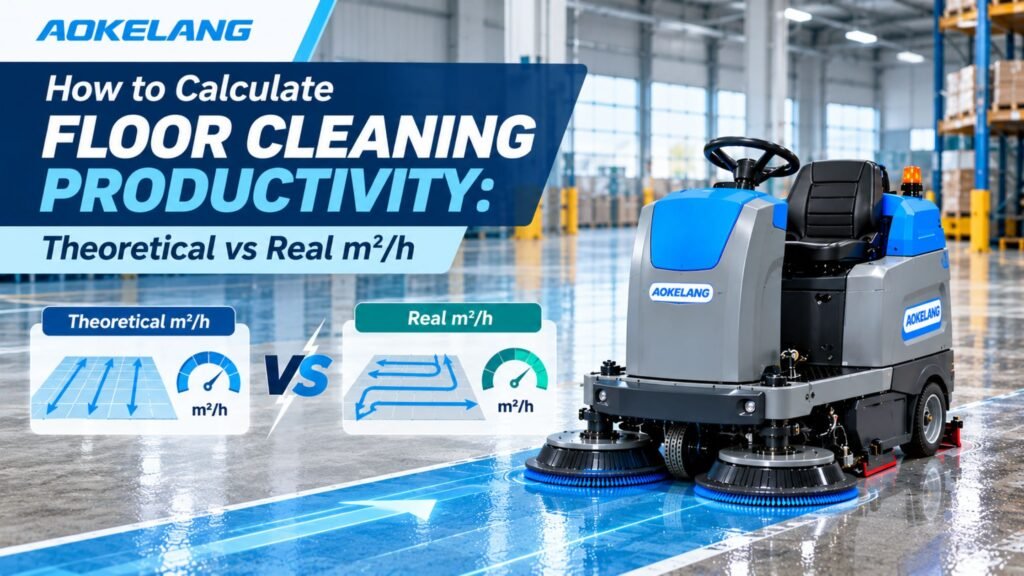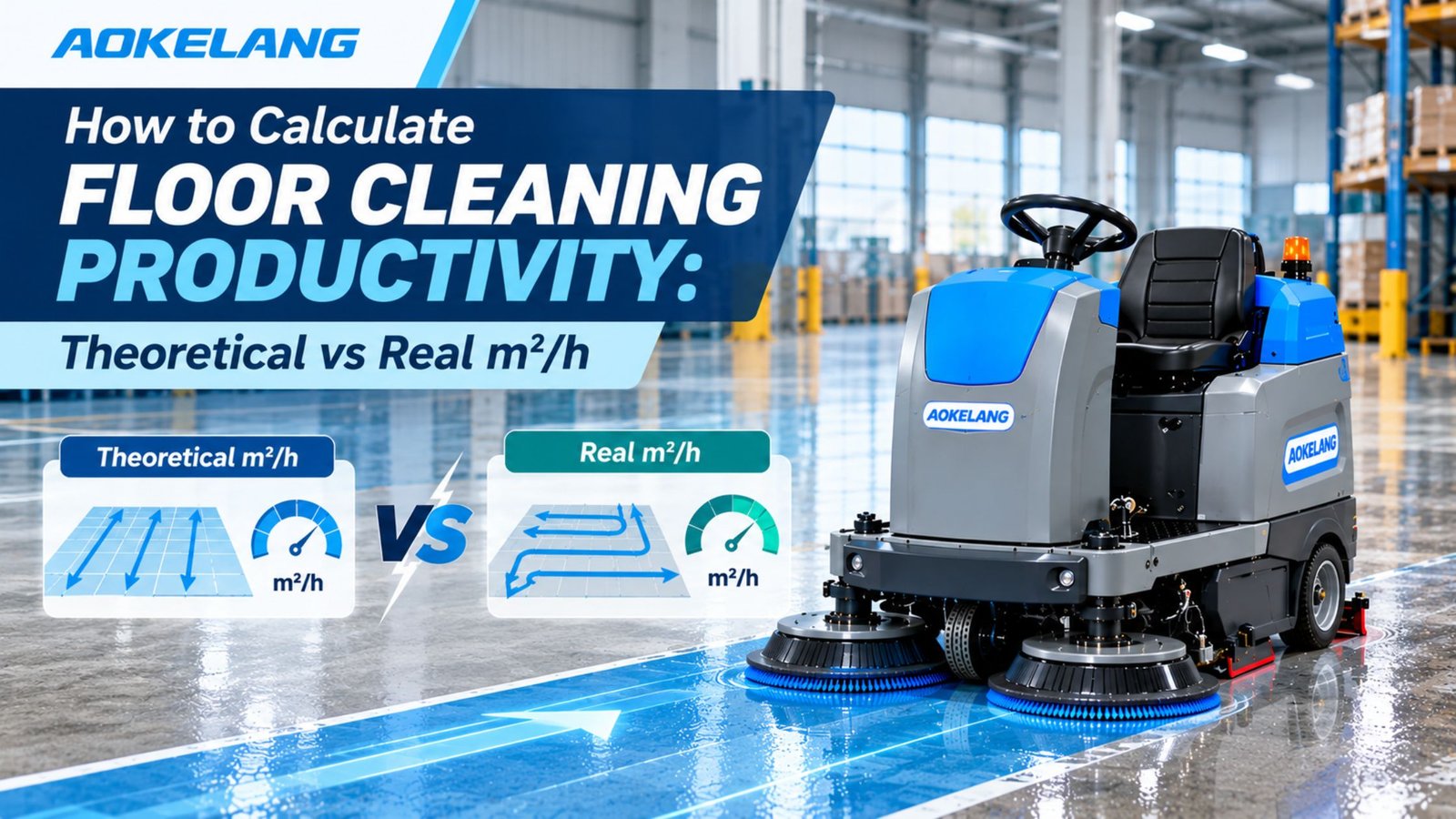
How to Calculate Floor Cleaning Productivity? To calculate floor cleaning productivity, divide the net cleanable floor area by the total direct labor hours or use machine specifications to determine theoretical versus actual output.
Key takeaways
- Theoretical productivity (m²/h) is cleaning width in meters × speed in km/h × 1,000. It’s the figure on spec sheets.
- Real productivity is theoretical productivity multiplied by an efficiency factor. The factor usually falls between 0.5 and 0.8, depending on the site.
- Three things cause the gap between the two: overlap between passes, driving below top speed, and time spent not cleaning, such as emptying, refilling and moving obstacles.
- The most accurate efficiency factor is one you measure yourself. Time a full clean of a known area once and you’ll have it.
- Use real productivity for scheduling, labor costs and contract bids. Use theoretical productivity only to compare machines with each other.
Theoretical floor cleaning productivity is the cleaning width in meters multiplied by the speed in km/h, multiplied by 1,000. Real productivity is that figure multiplied by an efficiency factor, typically 0.5 to 0.8, which accounts for overlap, slower driving and stops.
Table of Contents
What are the two productivity formulas?
Theoretical productivity is the most area a machine could clean in one hour, driving at top speed in a straight line without stopping.
Theoretical productivity (m²/h) = cleaning width (m) × speed (km/h) × 1,000
The 1,000 converts kilometers to meters.
Real productivity is what the machine actually achieves on your floor, with turns, obstacles and stops included.
Real productivity (m²/h) = theoretical productivity × efficiency factor
In imperial units:
Theoretical productivity (sq ft/h) = cleaning width (in) × speed (mph) × 440
To convert m²/h to sq ft/h, multiply by 10.764.
How do you calculate it step by step?
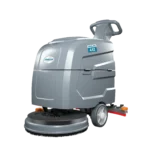
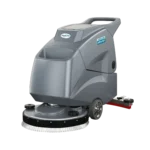
Take a walk-behind scrubber with a 50 cm (0.5 m) cleaning width and a top working speed of 4 km/h.
Step 1: Theoretical productivity
0.5 m × 4 km/h × 1,000 = 2,000 m²/h
Step 2: Real productivity, using a 0.65 efficiency factor
2,000 m²/h × 0.65 = 1,300 m²/h
On a real floor, this machine cleans about 1,300 m² per hour. That is 700 m² less than the spec sheet suggests. Over a six-hour shift, the gap adds up to 4,200 m².

Why is real productivity lower than theoretical?
The efficiency factor isn’t a fudge figure. It’s the combined effect of three separate losses, and splitting it into those three shows where your time actually goes.
Efficiency factor = overlap factor × speed factor × uptime factor
1. Overlap factor. Each pass has to overlap the last one slightly to avoid leaving strips. That overlap is cleaned twice, so the machine’s effective width is smaller than its rated width.
Overlap factor = (cleaning width − overlap) ÷ cleaning width
2. Speed factor. Operators rarely hold top speed. They slow down for turns, corners, doorways, people and heavily soiled areas.
Speed factor = average working speed ÷ top speed
3. Uptime factor. Part of every hour goes to tasks other than cleaning. These include:
- emptying the recovery tank and refilling the solution tank
- emptying a sweeper hopper
- moving pallets, carts or furniture
- putting out wet floor signs
- traveling between areas
Uptime factor = minutes actually cleaning ÷ 60
Here’s how the three combine for the walk-behind example above. The figures are illustrative assumptions; your own will differ.
| Loss | Assumption | Factor |
| Overlap | 5 cm overlap on a 50 cm path | 45 ÷ 50 = 0.90 |
| Speed | Averages 3.4 km/h against a 4 km/h top speed | 3.4 ÷ 4 = 0.85 |
| Uptime | 48 minutes of every hour spent cleaning | 48 ÷ 60 = 0.80 |
| Combined | 0.90 × 0.85 × 0.80 | 0.61 |
That works out to a real productivity of 2,000 × 0.61 ≈ 1,220 m²/h.
Breaking the factor down this way shows you what to fix. If uptime is the biggest loss, larger tanks or a better emptying routine help more than a faster machine.
What efficiency factor should you use for your site?
If you haven’t measured your own yet, start with a planning range based on your layout:
| Site type | Typical layout | Planning efficiency factor |
| Open warehouse or distribution center | Long straight runs, few obstacles | 0.70–0.80 |
| Factory floor | Machines, walkways and some open areas | 0.60–0.70 |
| Supermarket or large retail | Aisles, displays, shoppers | 0.55–0.65 |
| Offices, hospitals, schools | Corridors, doorways, furniture, many short runs | 0.50–0.60 |
| Small or highly congested spaces | Constant turning and obstacles | 0.40–0.50 |
These are rule-of-thumb starting points for estimating. The next section shows how to replace them with a measured figure.
How do you measure your own efficiency factor?
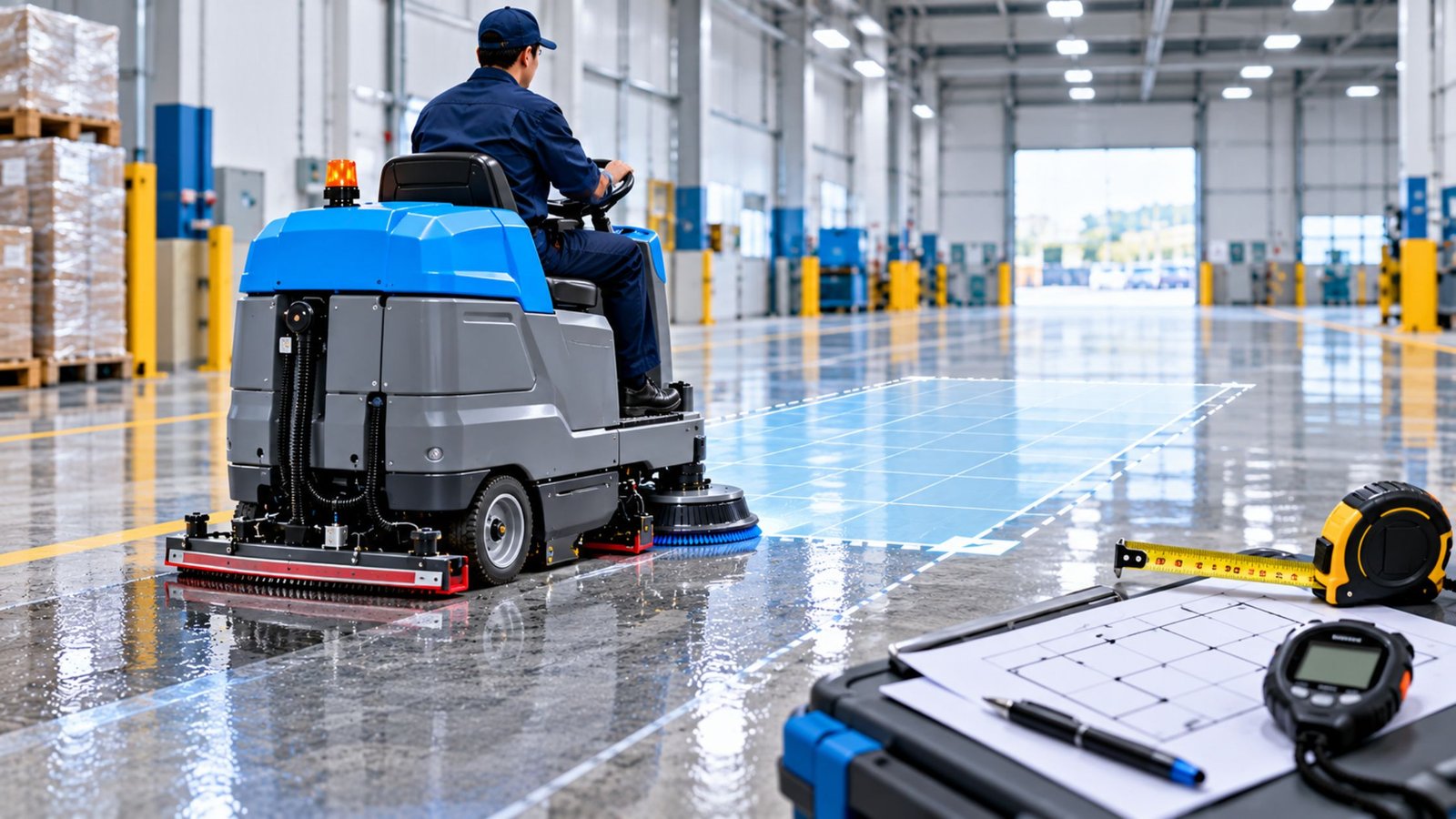
One timed trial gives you a factor based on your floor, your machine and your operator.
- Pick a representative area of known size, such as one full zone or aisle block. Use floor plans or measure it.
- Note the machine’s theoretical productivity using the formula above.
- Start a timer when the operator begins setting up, and include putting out signs.
- Clean the area normally, including turns, emptying, refilling and moving obstacles.
- Stop the timer when the area is finished and the machine is parked.
- Calculate real productivity: area cleaned ÷ hours taken.
- Calculate the efficiency factor: real productivity ÷ theoretical productivity.
Example: the operator cleans 2,400 m² in 2 hours with the 2,000 m²/h machine.
- Real productivity = 2,400 ÷ 2 = 1,200 m²/h
- Efficiency factor = 1,200 ÷ 2,000 = 0.60
Repeat the trial with a different operator or on a different day if you can. Averages from two or three runs are more reliable than one.
How do you use real productivity to plan cleaning?
Once you have a real figure, four planning questions become simple sums.
1. How long will the clean take?
Hours needed = floor area ÷ real productivity
A 6,000 m² supermarket cleaned with the walk-behind above, at 1,220 m²/h:
6,000 ÷ 1,220 ≈ 4.9 hours
2. Does the battery last that long?
Compare the hours needed with the machine’s battery runtime. Many walk-behind scrubbers run for around 3 to 4 hours per charge. The Aokelang D4, for example, is rated for 3 to 4 hours. A 4.9-hour job needs a mid-shift charge, a second battery, or a larger machine.
3. Would a bigger machine pay off?
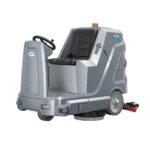
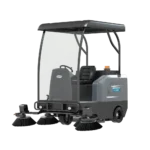
Run the same sum for a ride-on. As an illustration, take a ride-on with a 0.8 m path at 6 km/h and a 0.60 efficiency factor:
- Theoretical: 0.8 × 6 × 1,000 = 4,800 m²/h
- Real: 4,800 × 0.60 = 2,880 m²/h
- Time for 6,000 m²: 6,000 ÷ 2,880 ≈ 2.1 hours
That saves almost three operator hours every night. Multiply the hours saved by your labor rate and your cleaning days per year, and you have the annual labor saving to weigh against the higher price.
4. How many machines do you need?
Machines needed = hours needed ÷ hours available per machine per shift
If the clean must finish in a 3-hour window and the job takes 4.9 hours, you need two walk-behinds or one larger machine.
How do tank size and refills affect productivity?
For scrubbers, tank size directly controls uptime. Each time the solution tank runs dry or the recovery tank fills, the operator stops to empty and refill.
Use this to estimate how often that happens:
Minutes per tank = solution tank volume (L) ÷ solution flow rate (L/min)
As an illustration: a 55 L solution tank at a flow rate of 1.5 L/min lasts about 37 minutes. If each empty-and-refill stop takes 10 minutes, roughly a fifth of each hour goes to tank handling.
A larger tank or a lower flow rate means fewer stops. The Aokelang D6 ride-on has a 90 L clean water tank and a 100 L recovery tank. On a big floor, that difference shows up directly in the uptime factor.
The same applies to sweepers: the hopper size decides how often the operator stops to empty it. See our industrial floor sweeper buying guide for sizing hoppers to your debris.
Also read – Industrial Floor Sweeper Buying Guide
How do you check a productivity figure on a spec sheet?
Divide the rated productivity by the cleaning width to find the speed it assumes:
Implied speed (km/h) = rated productivity ÷ (cleaning width in m × 1,000)
Then ask whether that speed is realistic for the machine.
Example: the Aokelang D1450 ride-on sweeper is rated at 15,000 m²/h with a 1,450 mm sweeping width.
15,000 ÷ (1.45 × 1,000) ≈ 10.3 km/h
That matches its 10 km/h top speed, so the rated figure is a true theoretical maximum.
When comparing machines, check three things:
- Which width is used. Is it the brush width, the squeegee width, or the sweep including side brushes?
- Which speed is used. Is it the top speed or a typical working speed?
- Whether both machines are measured the same way. If not, recalculate both from width and speed.
What mistakes do people make with productivity numbers?
- Scheduling with the spec-sheet figure. The job overruns every night.
- Using one factor for every site. A warehouse and an office in the same contract need different factors.
- Forgetting setup and pack-down. Signs, filling, emptying and cleaning the machine afterward all take time and belong in the uptime factor.
- Ignoring overlap. On narrow machines, a few centimeters of overlap per pass is a significant share of the width.
- Buying the fastest machine when uptime is the real loss. A bigger tank can save more time than a higher top speed.
For operating habits that reduce wasted passes, such as pass overlap and pacing, see our guide on how to use a floor scrubber.
Frequently asked questions
What is a good efficiency factor for floor cleaning?
For open warehouses, 0.70 to 0.80 is achievable. For retail, offices and healthcare, plan on 0.50 to 0.65. Measure your own with a timed trial for the most accurate figure.
Should I use cleaning width or squeegee width in the formula?
Use the cleaning width, meaning the brush or pad path, because that’s the strip actually scrubbed. The squeegee is wider than the brush so it can catch all the water, but the extra width isn’t scrubbed.
How do I convert m²/h to sq ft per hour?
Multiply by 10.764. For example, 1,300 m²/h is about 14,000 sq ft/h.
Does battery charging affect productivity?
It doesn’t change the hourly rate, but it limits how many hours a machine can work per shift. If a job needs more hours than one charge provides, plan a mid-shift charge, a second battery, or lithium batteries that accept quick top-ups. Our guide to battery powered floor scrubbers covers the options.