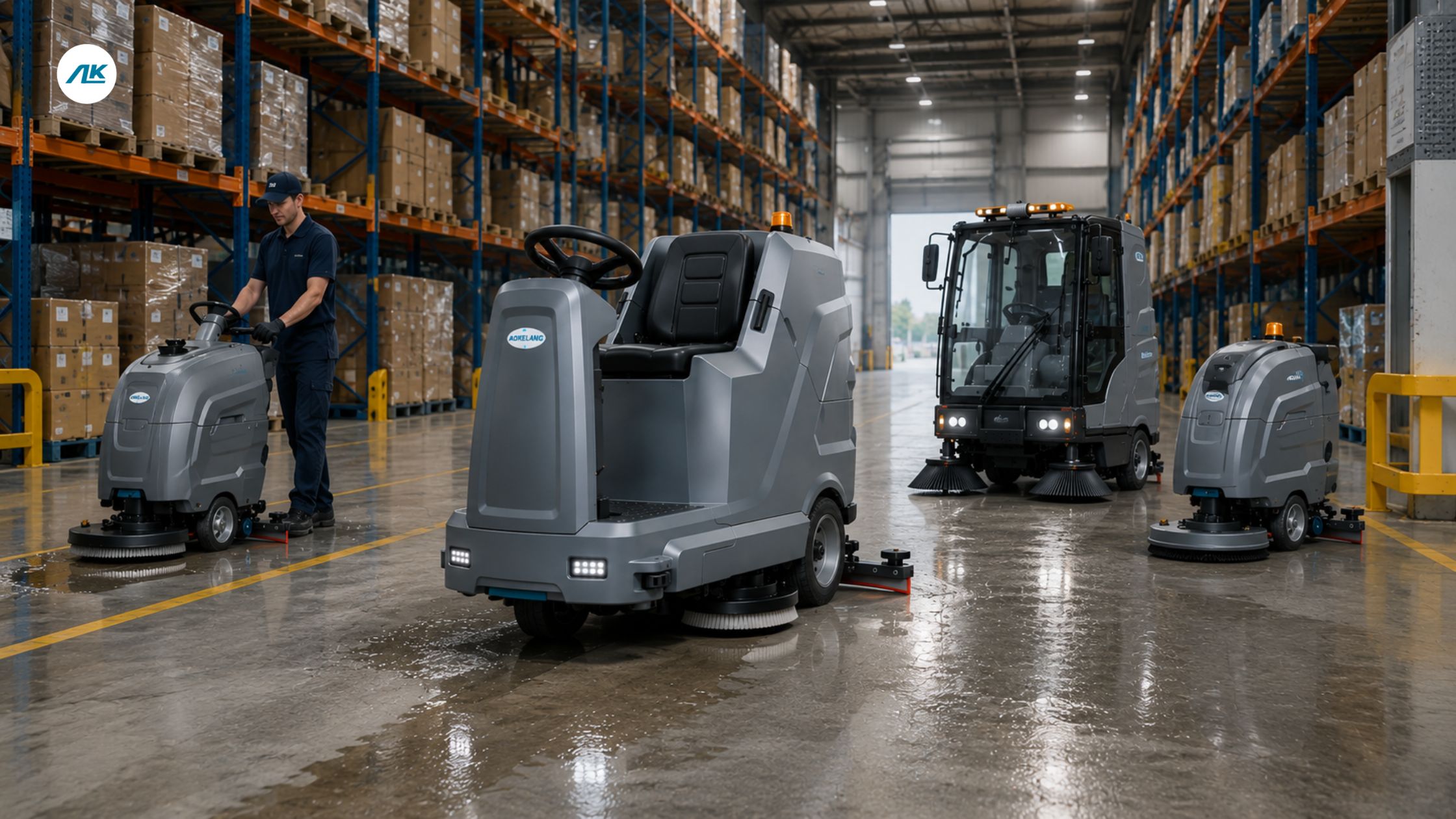
Here’s something nobody tells you when you take over Warehouse Floor Cleaning operations: you will spend an unreasonable amount of your time thinking about floors.
Not inventory. Not headcount. Floors.
Because a dirty warehouse floor isn’t just ugly, it’s a liability, a compliance risk, and a slow drain on productivity that gets worse every month you ignore it. Dust builds up. Forklift tire marks layer on top of each other. A hydraulic fluid leak in aisle 7 turns into a slip-and-fall incident report. OSHA shows up, and suddenly, your floor problem is a $13,000 citation.
SOURCE: OSHA citations for housekeeping violations avg $13,000–$15,000 — OSHA penalty data
This guide is for the warehouse manager or operations director who knows the floors need attention but doesn’t have time to become a cleaning expert. We’ll cover exactly what goes wrong with Warehouse Floor Cleaning, which machines fix which problems, a cleaning schedule you can actually follow, and the cost math that gets your budget approved.
Table of Contents
For a deep dive on floor scrubber types and sizing, see our complete guide → Ultimate Guide to Floor Scrubbers
Explore Aokelang’s warehouse floor cleaning equipment → Warehousing & Logistics cleaning equipment
Why Warehouse Floors Get Dirty (And Why It Matters More Than You Think)
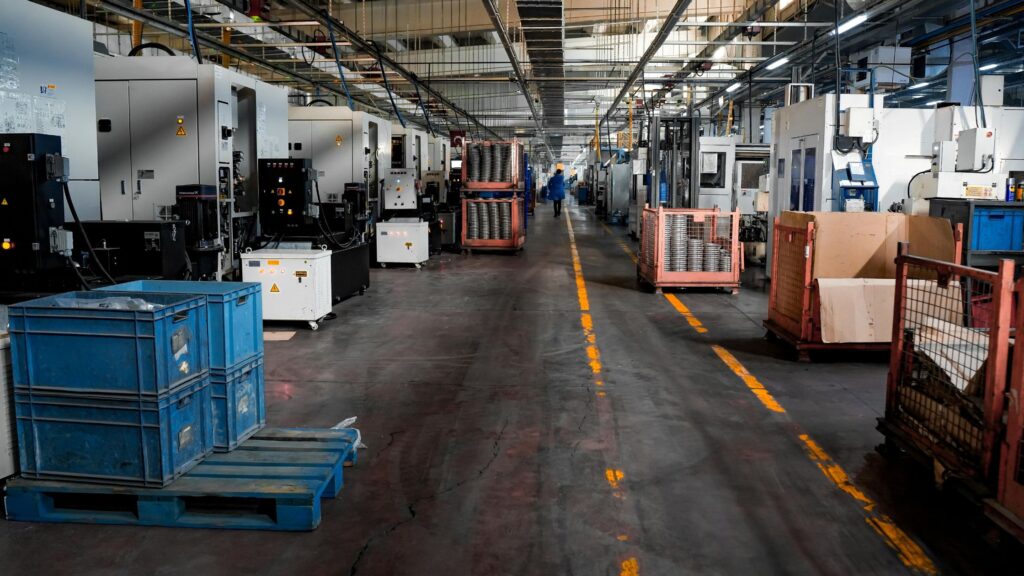
Warehouse floors take a beating that most people outside of logistics never understand. Here’s what’s actually happening to your concrete every day:
The dust problem
Forklifts are dust factories. Every time a pallet gets moved, cardboard fibers, shrink wrap particles, and fine concrete dust go airborne and settle back on the floor. A busy warehouse with 10+ forklifts running daily generates a visible dust layer within hours of sweeping. That dust gets into racking, coats inventory, and gets inhaled by your team.
SOURCE: Forklift traffic dust generation — ISSA Cleaning Industry Research
The grease and fluid problem
Forklifts leak. It’s not a question of if, it’s a question of how often. Hydraulic fluid, engine oil, battery acid (from older lead-acid forklifts), and coolant all end up on your floor. These don’t evaporate. They soak into unsealed concrete and create permanent dark patches that get slippery when wet.
The compliance problem
OSHA’s general housekeeping standard (29 CFR 1910.22) requires that “all places of employment, passageways, storerooms, and service rooms shall be kept clean and orderly and in a sanitary condition.” That’s not a suggestion, it’s a regulation. Slip-and-fall accidents remain one of the most common causes of workplace injuries in warehousing, and dirty, wet, or debris-covered floors are the primary trigger.
SOURCE: OSHA 29 CFR 1910.22 + slip/fall injury data — OSHA / National Safety Council
For food distribution warehouses, it gets even stricter. FDA and GMP requirements mandate documented cleaning procedures, and auditors want to see that you’re using proper equipment — not a push broom and a mop bucket.
The hidden productivity drain
Dirty floors slow everything down. Forklift operators drive more slowly on dusty or oily surfaces. Pickers in narrow aisles trip on debris. Visitors and auditors form instant impressions about your operation based on what the floor looks like. A grimy warehouse floor signals a poorly managed operation, whether that’s fair or not.
Also read – Battery powered vs corded floor scrubbers
The Zone Approach: Not Every Part of Your Warehouse Needs the Same Cleaning
This is the concept that most cleaning plans miss. A 100,000 sq ft warehouse does not need the same cleaning treatment across every square foot. Different zones get different types of dirt and need different machines and schedules.
| Zone | Primary Mess | Machine Needed | Frequency | Why |
| Main aisles | Dust, tire marks, debris | Ride-on sweeper + ride-on scrubber | Daily sweeping, scrub 2–3x/week | Highest traffic, most visible |
| Narrow racking aisles | Dust, small debris, occasional spills | Compact walk-behind scrubber | Scrub 1–2x/week | Ride-on can’t fit; dust accumulates |
| Loading docks | Heavy debris, mud, rainwater, and oil drips | Industrial sweeper + scrubber for oil spots | Sweep daily, scrub weekly | Transition zone — outdoor dirt enters here |
| Receiving / staging | Cardboard, shrink wrap, pallet chips | Sweeper | Daily | Heavy unpacking debris |
| Charging stations | Battery acid residue, water spills | Scrubber with acid-resistant squeegee | Weekly | Corrosive residue damages floor |
| Heavy debris, mud, rainwater, and oil drips | Food spills, general grime | Compact walk-behind or handheld scrubber | Daily | Employee health and morale |
| Break rooms/restrooms | Gravel, dirt, litter, leaves | Outdoor ride-on sweeper | Weekly | First impression for visitors and drivers |
Print this table. Tape it to the wall in your maintenance closet. This is your zone map.
Most warehouses try to clean everything the same way, one machine, one pass, same schedule across the whole building. That either leaves high-traffic areas under-cleaned or wastes time over-cleaning low-traffic zones. The zone approach puts effort where it matters.
Which Machines You Actually Need for Warehouse Floor Cleaning
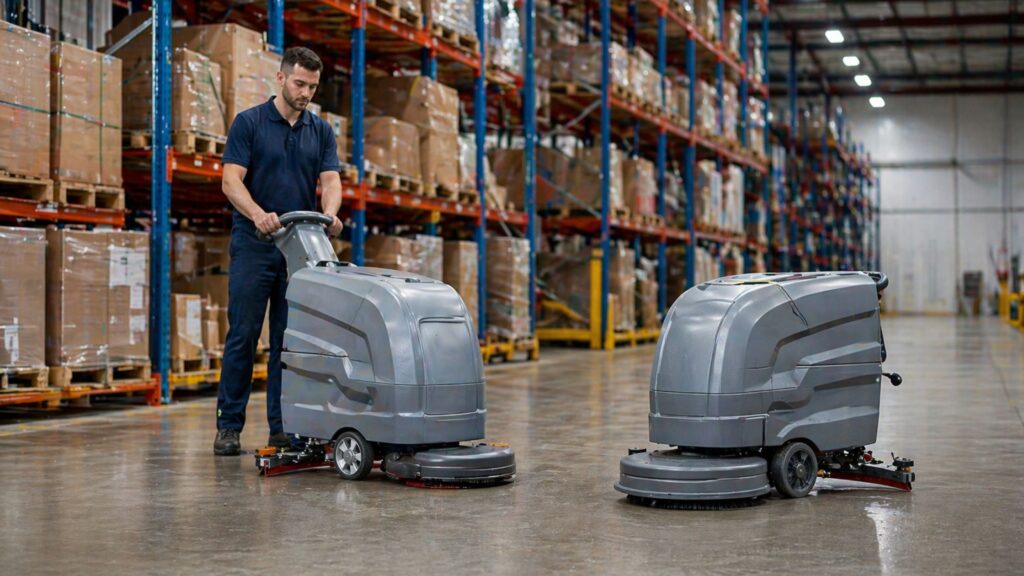
Here’s the practical equipment list based on total warehouse floor area:
Under 20,000 sq ft (small warehouse)
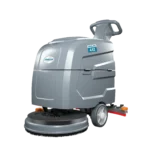
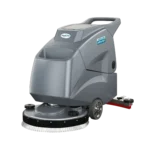
You need: One standard walk-behind scrubber.
That’s it. At this size, a single operator with a walk-behind cleans the entire floor in 1–2 hours. A sweeper is nice-to-have but not essential; the scrubber handles light debris if you use a cylindrical brush model.
Recommended: Aokelang D3 or D4 (walk-behind scrubber with cylindrical brush option for pre-sweeping).
20,000–75,000 sq ft (mid-size warehouse)
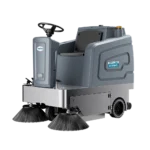
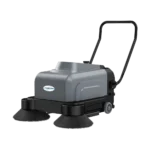
You need: One industrial sweeper + one walk-behind or compact ride-on scrubber.
At this size, dry debris (dust, cardboard, pallet scraps) accumulates fast enough that you need a dedicated sweeper for daily dry cleaning. The scrubber handles the wet-cleaning pass 2–3 times per week. For narrow aisles, a walk-behind scrubber is mandatory. For open areas, a compact ride-on is more productive.
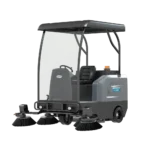
Recommended: Aokelang D1900 sweeper + Aokelang D4Z walk-behind scrubber (for aisles) or D6 ride-on (for open areas).
Not sure about sweeper vs scrubber? Read our comparison → Sweeper and Scrubber
75,000–200,000 sq ft (large warehouse)
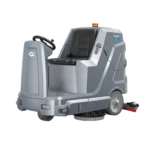
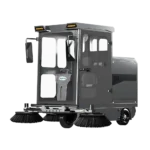
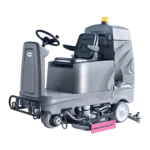
You need: One industrial ride-on sweeper + one ride-on scrubber + one compact walk-behind scrubber for tight areas.
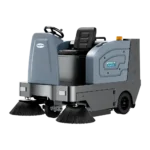
This is where the two-machine approach becomes essential. The ride-on sweeper runs daily across main aisles and open areas. The ride-on scrubber follows 2–3 times per week for wet-cleaning. The walk-behind handles narrow aisles, dock areas, and around equipment where the ride-on can’t reach.
Recommended: Aokelang D2000 or D2400 sweeper + Aokelang D7 or D8 ride-on scrubber + Aokelang D4Z walk-behind for aisles.
Compare walk-behind vs ride-on for your layout → Walk-Behind vs Ride-On Floor Scrubber
200,000+ sq ft (mega warehouse/distribution center)
You need: Fleet approach — multiple sweepers and scrubbers assigned to zones.
At this scale, you’re not buying individual machines; you’re building a cleaning fleet. Assign specific machines to specific zones with dedicated operators. A 300,000 sq ft DC might run two ride-on sweepers, two ride-on scrubbers, and two walk-behinds on alternating zone schedules.
Recommended: Contact us for fleet planning. We manufacture 20+ models and can spec the exact combination for your layout.
Each model name above → its product page
A Weekly Cleaning Schedule That Actually Works
You can hand this to your maintenance supervisor tomorrow:
| Day | Task | Zone | Machine | Time (75K sqft) |
| Monday | Full sweep + scrub main aisles | Main aisles, dock areas | Sweeper first, then scrubber | 2.5–3 hrs total |
| Tuesday | Sweep all areas + scrub narrow aisles | Racking aisles, staging | Sweeper (all), walk-behind scrubber (aisles) | 2–2.5 hrs |
| Wednesday | Sweep only (full building) | All zones | Ride-on sweeper | 1–1.5 hrs |
| Thursday | Full sweep + scrub main aisles + docks | Main aisles, loading docks | Sweeper + scrubber | 2.5–3 hrs |
| Friday | Full sweep + scrub all areas | All zones | Sweeper + ride-on scrubber + walk-behind | 3–4 hrs |
| Saturday | Spot clean spills, deep scrub problem areas | Charging stations, oil spots, dock | Scrubber with degreaser | 1–2 hrs |
| Sunday | Off (or sweep-only if 7-day operation) | — | Sweeper if running | 1 hr |
This schedule assumes a single-shift operation. If you run two or three shifts, adjust frequency upward; main aisles in a 24/7 DC should be swept every shift and scrubbed daily.
The one rule that prevents 80% of floor problems:
Clean up spills immediately. Every single one. A hydraulic fluid leak that sits for 8 hours soaks into the concrete and becomes a permanent stain that takes aggressive chemical treatment to remove. The same leak wiped up in 10 minutes leaves no trace. Post spill stations with absorbent pads at every charging area and loading dock.
Also read – How to use a floor scrubber
The ROI Case: Getting Your Budget Approved

You already know the floors need proper equipment. The problem is convincing whoever controls the budget. Here’s the math you need:
Scenario: 80,000 sq ft distribution center
Current approach: 3 warehouse associates spend 30 minutes each sweeping with push brooms at the end of every shift. That’s 1.5 labor hours/day × $20/hr = $30/day just for dry sweeping. The floor never actually gets scrubbed; tire marks, oil spots, and grime just accumulate.
After audit: OSHA flags three slip hazards. One near-miss incident. Management panics and allocates budget for “Warehouse Floor Cleaning.”
Proposed solution:
- Aokelang D1900 industrial sweeper: ~$8,000
- Aokelang D7 ride-on scrubber: ~$14,000
- Aokelang D4Z walk-behind (for aisles): ~$5,000
Total investment: ~$27,000
New cost structure:
- 1 operator runs the sweeper (1 hr/day) + ride-on scrubber (1.5 hrs/day) = 2.5 hrs × $20/hr = $50/day
- 1 operator runs walk-behind in aisles twice/week = ~$20/day average
Daily machine cleaning cost: $70/day = $1,540/month
vs. proper manual cleaning cost (if you actually scrubbed properly):
- 3 workers × $20/hr × 3 hrs/day (sweep + mop) = $180/day = $3,960/month
- Plus mop supplies, cleaning chemicals in bulk, mop replacements: ~$200/month
Total manual: $4,160/month
Monthly savings: $2,620
Payback on $27,000 investment: 10.3 months
SOURCE: ROI methodology — FCE, Aiolith. $20/hr loaded cost based on BLS avg
But here’s the kicker: the 3-worker manual approach never actually produces a clean floor. Mops don’t remove tire marks. Push brooms don’t capture fine dust. The machine approach costs less AND delivers a measurably cleaner, safer floor. That’s the argument that gets budgets approved.
Concrete Floor Care: Protecting Your Warehouse’s Biggest Asset
Your warehouse floor is a multi-million-dollar asset that most operations teams treat like dirt, literally. Concrete floors degrade over time, especially under forklift traffic. Proper cleaning doesn’t just make them look better; it extends their functional life by 5–10 years.
SOURCE: Floor lifespan extension — Portland Cement Association, concrete maintenance guides
If your floor is sealed or epoxy-coated:
- Use disc pad scrubbers with medium pads. Avoid aggressive pads that strip the coating.
- Use pH-neutral detergent. Acidic or alkaline chemicals degrade epoxy over time.
- Scrub at least weekly to prevent grime from embedding into the coating surface.
If your floor is polished concrete:
- Dust-mop or sweep daily — abrasive particles scratch the polish.
- Scrub with soft-to-medium pads and pH-neutral solution.
- Avoid leaving standing water. Polished concrete can stain if liquids sit for hours.
If your floor is bare/unsealed concrete:
- This is the hardest to maintain. Bare concrete is porous — it absorbs oil, chemicals, and moisture.
- Use cylindrical brushes (they reach into the rough surface texture).
- Consider getting the floor sealed or epoxy-coated. The upfront cost pays for itself in dramatically easier cleaning and longer floor life.
Universal rule: never let forklift fluids sit
Hydraulic oil, engine coolant, and battery acid all attack concrete. The longer they sit, the deeper they penetrate. Place absorbent mats under every charging station and have spill kits at every dock door. Clean any fluid leak within 30 minutes.
Also read – warehouse sweeper machine
Frequently Asked Questions
How often should a warehouse floor be cleaned?
Main traffic aisles and loading docks: sweep daily, scrub 2–3 times per week. Narrow racking aisles: scrub 1–2 times per week. Staging and receiving areas: sweep daily. Charging stations: scrub weekly with degreaser. In 24/7 operations, sweep every shift and scrub main areas daily.
What is the best floor scrubber for a warehouse?
For the main open floor: a ride-on scrubber with 26–40 inch cleaning width and 30+ gallon tanks. For narrow racking aisles: a compact walk-behind scrubber (18–24 inches wide) that fits between racks. Most warehouses over 30,000 sq ft need both. Aokelang’s D7 ride-on and D4Z walk-behind are built specifically for this combination.
Do I need both a sweeper and a scrubber for my warehouse?
For warehouses over 20,000 sq ft: yes, almost always. The sweeper handles daily dry debris (dust, cardboard, pallet chips) quickly and cheaply. The scrubber handles the wet-cleaning pass for tire marks, oil spots, and embedded grime. Running a scrubber over heavy dry debris clogs the squeegee and recovery system — sweep first, then scrub.
How do I clean oil stains on a warehouse concrete floor?
Fresh oil: absorb immediately with spill pads or cat litter, then scrub with a degreasing detergent and a floor scrubber with a medium-to-aggressive brush or pad. Set-in oil: apply a concrete degreaser and let it dwell for 10–15 minutes, then scrub with a cylindrical-brush scrubber. Severely stained areas may need chemical treatment and possibly floor resealing.
How much does a warehouse floor cleaning setup cost?
A small warehouse (under 20K sqft) needs one walk-behind scrubber: $3,000–$6,000. A mid-size warehouse (20K–75K sqft) needs a sweeper + scrubber: $10,000–$18,000 total. A large warehouse (75K–200K sqft) needs a sweeper + ride-on scrubber + walk-behind: $20,000–$30,000 total. Payback is typically 3–10 months, depending on size.
Is warehouse floor cleaning required by OSHA?
Yes. OSHA’s general housekeeping standard (29 CFR 1910.22) requires all workplaces to be kept clean, orderly, and sanitary. Specifically, floors must be kept clean, dry, and free of hazards. OSHA can cite violations with penalties starting at $13,000+ per instance. Food distribution warehouses face additional FDA and GMP cleaning requirements.
Can I use a ride-on scrubber in narrow warehouse aisles?
Most ride-on scrubbers are 48–65+ inches wide. Standard pallet racking aisles vary from 8–12 feet (96–144 inches) — ride-ons fit in most standard aisles. But narrow-aisle or very-narrow-aisle (VNA) warehouses with aisles under 6 feet need a walk-behind scrubber. Always measure your narrowest aisle before buying.
How do I justify the cost of cleaning equipment to management?
Present three numbers: (1) current labor cost of manual cleaning per month, (2) projected labor + machine cost per month after purchase, and (3) the payback period in months. For most warehouses, the machine pays for itself in 3–10 months. Add the OSHA compliance risk and slip-and-fall liability reduction as a non-financial justification. Use the ROI example in Section 5 of this guide as a template.