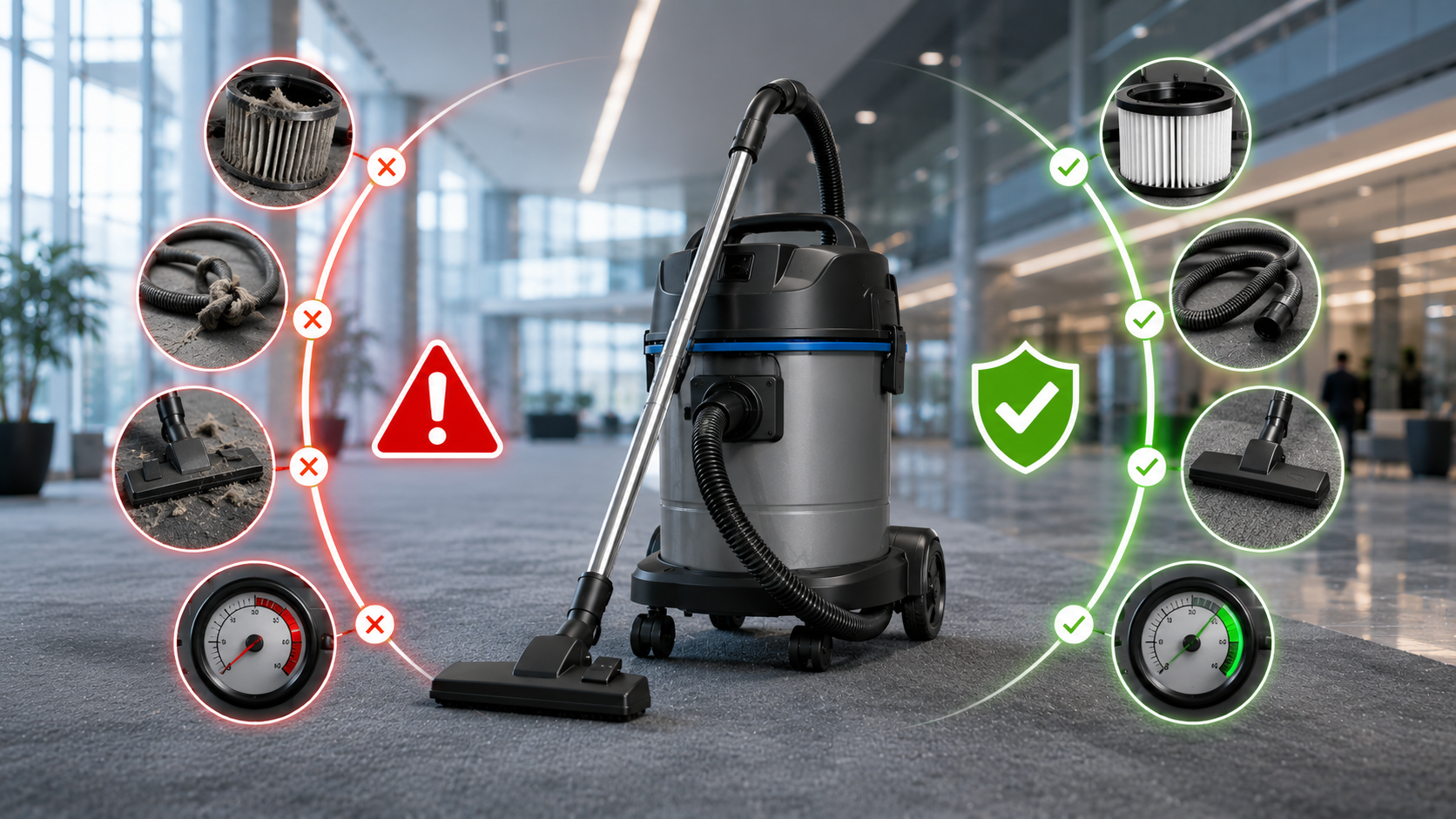
Regular performance checks for vacuum cleaners are essential because they directly preserve suction power, prevent motor damage, extend machine lifespan, maintain air quality, and avoid the unexpected downtime and costly repairs that follow from neglected maintenance. A clogged filter alone reduces suction efficiency by up to 30% and, if left unaddressed, causes motor overheating that can permanently damage the unit. For commercial and industrial operations where vacuum cleaners run daily across demanding environments, a structured performance check schedule isn’t optional — it’s the operational discipline that separates equipment that lasts years from equipment that fails months.
Every facility manager, cleaning contractor, and operations team has experienced it at some point: a vacuum cleaner that’s visibly working but isn’t actually cleaning. The motor runs. The machine moves. But suction is weak, fine dust is being redistributed rather than collected, and the floor after vacuuming doesn’t look meaningfully different from before.
The cause is almost always maintenance neglect — a clogged filter, a blocked hose, a worn brush roll, or a collection bin that’s been running over capacity. None of these problems happens suddenly. They develop gradually, performance declines incrementally, and — because no single day looks dramatically different from the last — the deterioration goes unnoticed until the machine is failing rather than underperforming.
Regular performance checks break this pattern. They catch deterioration early, maintain the machine at the level it was designed to operate, and avoid the much higher costs of emergency repairs, premature replacement, and cleaning operations that aren’t actually meeting hygiene standards.
This guide covers The Importance of Regular Performance Checks for Vacuum Cleaners, how often, why each check matters, and how to build a maintenance schedule that keeps your vacuum cleaners performing at the level your facility requires.
Table of Contents
Why Vacuum Cleaner Performance Degrades — and Why It Matters
Understanding the mechanics of performance degradation makes the case for regular checks far more compelling than a general recommendation to “maintain your equipment.”
Vacuum cleaners work by creating airflow. The motor drives a fan that creates a pressure differential, which pulls air — and with it, dust and debris — through the machine. That airflow passes through a series of filters before the clean air is exhausted. Every component in that chain — filters, hoses, collection chambers, brush rolls, motor cooling vents — can restrict airflow if not maintained, and restricted airflow means reduced suction at the cleaning head.
The cascade effect of neglected maintenance is well-documented:
- Filters clog → airflow is restricted → suction power drops → the motor works harder to compensate
- The motor works harder → it runs hotter → heat accelerates motor wear and increases the risk of overheating failure
- The collection bin fills → debris backs up into the filtration system → suction drops further and filter damage risk increases
- Brush rolls accumulate hair and fibres → the roller drags rather than sweeps → motor load increases further
- Hose blockages develop → suction at the cleaning head drops to near zero → the operator works harder for worse results
Research from indoor air quality studies shows that clogged filters reduce suction efficiency by up to 30%. In industrial and commercial settings where vacuum cleaners run daily — sometimes multiple shifts — that degradation happens faster than in domestic settings, and its consequences are more significant.
The motor is the most expensive component in any vacuum cleaner. Once damaged, motor replacement can cost nearly half the price of a new unit. Regular performance checks that catch filter and airflow problems before they cause motor overheating are, in straightforward financial terms, the cheapest insurance available for your equipment.
The 6 Critical Performance Checks
Check 1: Filter Condition and Cleanliness
Filters are the most frequent maintenance point and the one with the most direct impact on daily cleaning performance.
Commercial and industrial vacuum cleaners typically use a multi-stage filtration system: a pre-motor filter that captures larger particles before they reach the motor assembly, a main filter that handles the bulk of particulate capture during operation, and often a HEPA or ULPA post-motor filter that captures fine particles including allergens, bacteria, and respirable dust before air is exhausted.
What to check:
- Visual inspection of filter condition — discolouration, visible debris load, structural damage
- For washable pre-filters: clean when visibly dirty or at least monthly in commercial use
- For paper or cartridge filters: tap gently to dislodge accumulated surface dust; do not wash
- For HEPA filters: never wash with water (this damages the filter fibre structure and reduces filtration effectiveness irreversibly — a washed HEPA filter may appear clean but performs significantly worse); inspect regularly and replace per manufacturer schedule
How often: In commercial settings with daily use, pre-filters should be inspected weekly and cleaned as needed. Main filters should be inspected monthly. HEPA filters in commercial environments should be reviewed twice weekly for visible condition and replaced every six months to a year depending on use intensity.
With proper preventative maintenance, the main filter in an industrial vacuum cleaner generally needs replacement every 12–18 months, or sooner if suction drops to unacceptable levels. In high-dust or continuous-use industrial environments, more frequent inspection is required.
What happens if you skip it: Restricted airflow, progressive suction loss, motor overheating, and — in environments where air quality matters — filters that are no longer capturing fine particulates effectively but still creating the appearance of cleaning.
Check 2: Collection Bin or Bag Capacity
The collection bin (or bag, on bagged models) is where captured debris accumulates. A bin that’s too full doesn’t just reduce storage capacity for new debris — it directly compromises suction by reducing the volume of airspace available for airflow within the machine.
What to check:
- Empty the dustbin after every one to two uses in commercial environments, or when it reaches 70–80% capacity
- For bagged models, replace bags when two-thirds full — waiting until completely full causes suction loss and risks debris compacting into filtration components
- After emptying, check the interior of the bin for residual fine dust that coats the walls — wipe out with a dry cloth before reinstalling
How often: After every use in high-debris environments. At a minimum, before every cleaning shift in commercial operations.
What happens if you skip it: Suction drops progressively as the bin fills. Debris backs up into filtration components. In worst cases, fine dust bypasses filters and reaches the motor assembly, causing abrasive wear on motor components.
Check 3: Hose and Attachment Condition
Hoses and attachments are the most mechanically vulnerable components of any vacuum cleaner. They flex repeatedly during use, they’re dragged across surfaces and around corners, and they accumulate internal blockages from the debris being transported through them.
What to check:
- Run a full visual inspection of the hose for cracks, holes, or kinks — any break in the hose creates an air leak that bypasses the suction system, causing suction loss at the cleaning head even when the filter and motor are in good condition
- Check all connection points between the hose, wand, cleaning head, and machine body — loose connections are air leak points
- Clear blockages by disconnecting the hose and checking with a torch for visible obstructions; for stubborn blockages, reverse-feed with compressed air
- Inspect cleaning head attachments for damage, worn bristles, or debris accumulation that affects cleaning contact
How often: Weekly in commercial environments. Any time suction seems reduced and filter and bin checks don’t explain the loss.
What happens if you skip it: Hose cracks and loose connections cause suction loss that’s easily misdiagnosed as a filter or motor problem, leading to unnecessary filter replacements or premature machine replacement when the actual fault is a worn hose costing a fraction of the machine’s value to fix.
Check 4: Brush Roll and Cleaning Head
The brush roll (on upright and combination vacuum models) is the rotating component that agitates carpet fibres and floor surfaces to dislodge embedded debris before suction captures it. In commercial environments, brush rolls accumulate hair, string, fibres, and fine debris that wrap around the roller and reduce its rotation speed — or stop it entirely.
What to check:
- Remove the brush roll cover and visually inspect the roller — hair and fibres wrapped around the roller ends are the most common issue
- If the roller is difficult to turn by hand, or if it’s not rotating during operation, debris accumulation is the most likely cause
- Use scissors to carefully cut and remove wrapped material without cutting the brush bristles
- Inspect brush bristle length — worn or compressed bristles reduce the roller’s ability to agitate surfaces effectively; if bristles are uniformly worn down, the roller needs replacement
How often: Monthly inspection in commercial environments. More frequently in environments where the vacuum regularly picks up fibrous debris — carpet fibres, textiles, packaging materials.
What happens if you skip it: A brush roll tangled with hair and debris increases motor load (the motor is fighting the drag of a restricted roller), reduces cleaning effectiveness on carpeted surfaces, and in extreme cases stops the roller entirely while the motor continues to run — creating a fast route to motor overheating.
Check 5: Motor and Electrical Components
The motor is the heart of the vacuum cleaner, and the most expensive component to repair or replace. While motor internals require professional service when issues arise, surface-level checks can catch warning signs early.
What to check:
- Listen for changes in motor sound during operation — unusual humming, rattling, grinding, or high-pitched whining can indicate motor wear, bearing issues, or debris reaching internal components
- Check motor cooling vents (typically on the machine body) for blockage — dust and debris accumulation on cooling vents prevents heat dissipation and accelerates motor overheating
- Inspect the power cord and plug for damage, kinking, fraying, or discolouration near the plug — damaged power cords are both a performance and safety issue
- If the machine smells of burning during or after operation, stop immediately — this is the smell of motor insulation overheating and is a serious warning sign
How often: Listen actively during every use. Visual inspection of cooling vents and power cord weekly.
What happens if you skip it: Motor burnout is the most common cause of commercial vacuum cleaner total failure. Heat-related failure is the leading cause of vacuum motor burnout — and heat-related failure is almost always the downstream consequence of restricted airflow from neglected filters, blockages, or brush roll issues that were not caught early.
Check 6: Suction Power Testing
The most direct way to assess overall vacuum cleaner performance is a suction power check — verifying that the machine is delivering the airflow it’s rated for, rather than assuming it’s performing because it sounds like it’s running.
How to check:
- Hold your hand over the cleaning head with the machine running — suction should feel strong and consistent; weak or inconsistent suction indicates a problem somewhere in the chain
- Use a simple airflow measurement tool if your operation warrants more precise testing (appropriate for industrial environments where dust capture compliance is measurable)
- Compare against the machine’s rated suction performance in the operator manual — if performance has degraded significantly from rated levels, a systematic check through filters, hose, brush roll, and bin will identify the cause
How often: A quick hand-check should be part of every pre-shift check. Formal performance comparison against rated levels: monthly.
Building a Commercial Vacuum Maintenance Schedule
The most effective maintenance approach is a tiered schedule — daily, weekly, and monthly checks covering different aspects of the machine’s performance.
Daily (before each shift)
- Empty collection bin or check bag fill level
- Quick suction check — hand test at cleaning head
- Visual inspection of hose for obvious damage
- Check brush roll is rotating freely
Weekly
- Full filter inspection — clean washable pre-filters; visually inspect main filter
- Thorough hose inspection including all connection points
- Check motor cooling vents for dust accumulation
- Inspect power cord and plug
- Clean the machine exterior and any accessible internal surfaces of residual dust
Monthly
- Full brush roll removal and cleaning — remove all wrapped debris, inspect bristle condition
- Main filter detailed inspection — replace if performance symptoms present or per schedule
- Full suction performance check against rated levels
- Check all attachments for damage or wear
- Log any performance changes and compare against previous month
6-Monthly / Annual
- HEPA or post-motor filter replacement (or per manufacturer schedule for your use intensity)
- Professional service inspection in industrial environments — motor condition, internal components, electrical systems
- Replace worn attachments, brushes, and any components showing visible wear
The Air Quality Dimension: Why Maintenance Matters Beyond Performance
Performance checks for vacuum cleaners aren’t just about keeping the machine running — they directly affect the air quality of the spaces being cleaned.
A vacuum cleaner with a degraded HEPA filter doesn’t just clean less effectively. It actively re-releases fine particulates — including allergens, bacteria, and respirable dust — into the air. In healthcare settings, this is a patient safety concern. In food production and pharmaceutical environments, it’s a compliance issue. In any high-occupancy space, it means the cleaning operation is worsening air quality rather than improving it.
In industrial environments, OSHA Permissible Exposure Limits (PELs) for airborne dust mean that vacuum cleaner maintenance isn’t just good practice — it’s a component of regulatory compliance. A vacuum cleaner operating with degraded filtration in a facility with respirable dust hazards (silica, wood dust, metal particulates) may be contributing to dust exposure levels that exceed legal limits.
Regular performance checks, particularly of filtration components, are the mechanism that keeps vacuum cleaners performing their air quality function — not just their debris collection function.
How Vacuum Maintenance Fits Into Your Broader Facility Cleaning Programme
Vacuum cleaners rarely operate in isolation in commercial and industrial facilities. They’re typically part of a broader cleaning equipment fleet that includes floor sweepers for dry debris removal across large floor areas and floor scrubbers for wet cleaning and deep hygiene.
In most commercial cleaning cycles, vacuuming handles carpeted areas, detail cleaning, and targeted debris removal, while floor sweepers and scrubbers handle the primary floor maintenance of hard surfaces. Maintaining the full performance of each equipment type — including regular checks on your vacuum cleaners — ensures the complete cleaning programme delivers consistent results across every surface type.
Just as floor scrubbers require regular squeegee blade checks, filter cleaning, and tank maintenance to perform at their rated level — covered in detail in the floor scrubber maintenance guide — vacuum cleaners require the same systematic attention to sustain the performance they were purchased to deliver.
For facilities managing hard floor areas alongside carpeted zones, understanding which equipment does what — and ensuring each is properly maintained — is the foundation of an effective facility cleaning programme. The floor scrubber vs floor sweeper guide covers how these tools work together across different surface types, and the commercial floor cleaning machines range covers the full equipment picture for hard floor maintenance alongside your vacuum cleaning operation.
Signs Your Vacuum Cleaner Needs Immediate Attention
Beyond scheduled checks, certain performance symptoms indicate a problem that needs addressing before the next scheduled maintenance window:
- Noticeably weaker suction than previous uses — check bin fill level, then filter, then hose for blockage
- Dust visibly escaping from the machine during operation — filter damage or improper seating; check filter installation and condition immediately
- Burning smell during operation — stop the machine immediately; this indicates motor overheating, likely caused by restricted airflow from a blocked filter or hose
- Unusual noise — rattling, grinding, or high-pitched sounds indicate internal component issues; continue with caution and investigate before the next use
- Machine shutting off during operation — most modern vacuum cleaners have thermal overload protection that shuts the motor off when it overheats; allow the machine to cool, then check filters and airflow before restarting
- Visible debris remaining after vacuuming an area previously cleaned effectively — brush roll or suction problem; check both
Any of these symptoms, if they appear between scheduled checks, should trigger an immediate investigation rather than waiting for the next maintenance window.
The Cost of Not Maintaining: A Real Calculation
The business case for regular vacuum cleaner maintenance is straightforward once the numbers are considered.
A commercial or industrial vacuum cleaner represents a meaningful capital investment. Routine maintenance — filter replacements, cleaning, periodic professional servicing — costs a small fraction of the machine’s purchase price per year. Motor repair or replacement, when preventable failure occurs, can cost nearly half the machine’s original value. Full machine replacement — the outcome of extended neglect — costs the full purchase price.
Beyond the direct equipment costs, there’s the operational impact of an underperforming vacuum: longer cleaning times to achieve the same result, inconsistent hygiene outcomes, air quality that falls below the standard the operation is designed to deliver, and — in regulated environments — potential compliance exposure.
Regular performance checks are, in every measurable sense, the cheapest cleaning equipment maintenance you’ll ever do. The cost of the check is negligible. The cost of what it prevents is not.