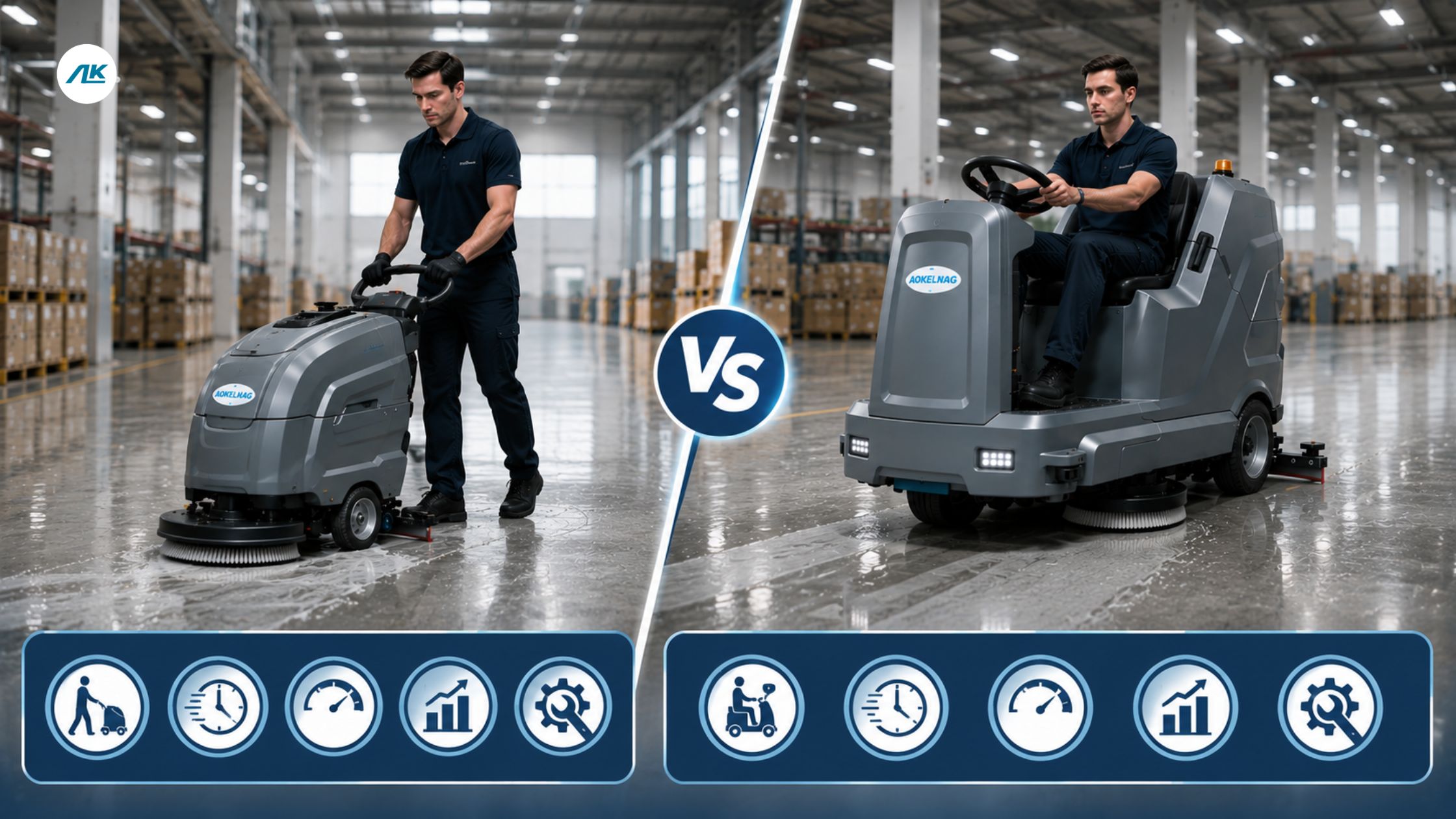
A floor scrubber isn’t a purchase you make twice. A decent machine lasts 7–10 years with proper maintenance. That means the walk-behind vs ride-on decision you make today is one your cleaning crew will either thank you for or curse you over — every single shift, for the better part of a decade.
And yet, most buyers spend more time choosing a coffee machine for the break room.
Here’s the reality: walk-behind scrubbers own about 45% of the global market. Ride-ons own about 36% and are growing faster. Neither is “better” in the abstract. One is better for your specific floor, your layout, your shift length, and your budget.
SOURCE: 45% walk-behind, 36% ride-on — Global Growth Insights 2026
This article is the framework we use internally when customers call us and say, “I don’t know which type I need.” By the end, you will. So let us start with, Walk-Behind vs Ride-On Floor Scrubber.
Table of Contents
For everything about floor scrubbers, see our complete guide – Floor Scrubbers: What They Are, How to Choose One?
1. Walk-Behind Scrubbers: What They Are and When They Win
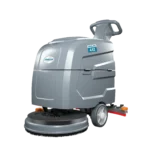
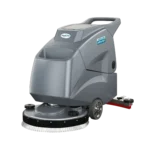
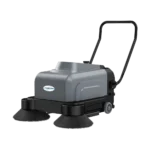
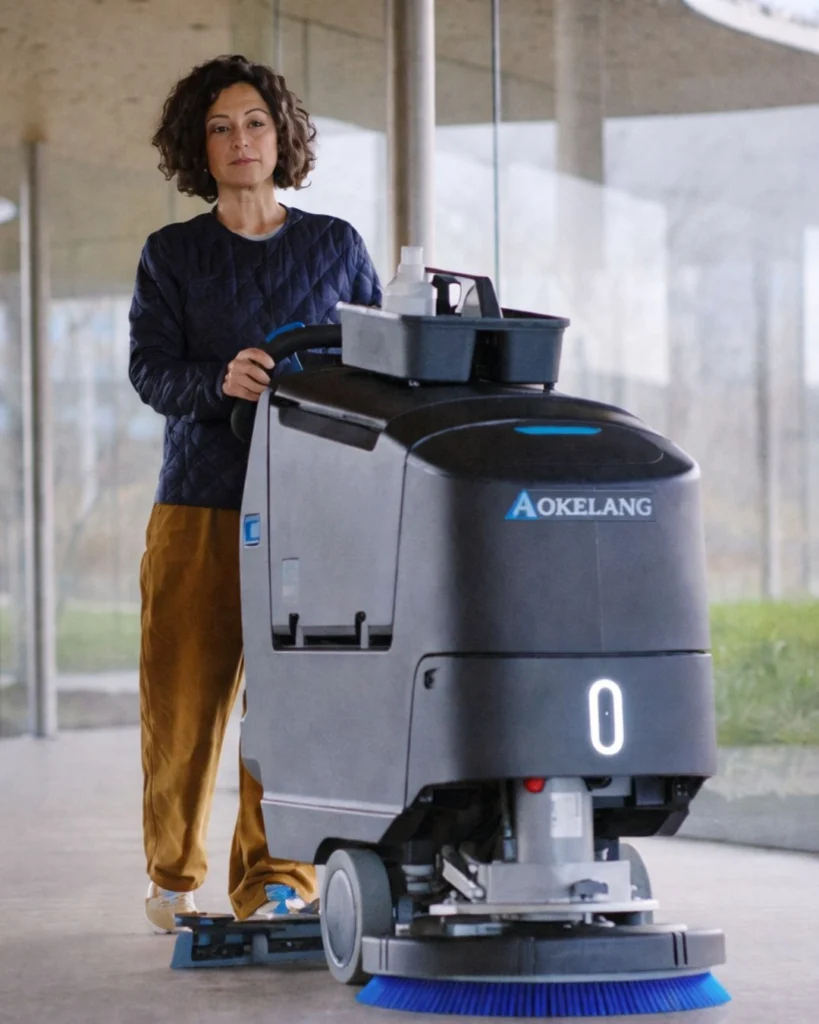
Choosing between a Walk-Behind vs Ride-On Floor Scrubber, A walk-behind scrubber is exactly what it sounds like: you stand behind it and walk as it cleans. Some models are pad-assist (the spinning brush drags the machine forward, you just steer), and some are traction-drive (a motor drives the wheels, so you expend zero pushing effort).
Quick specs:
- Cleaning width: 14–24 inches
- Tank capacity: 4–15 gallons
- Productivity: roughly 10,000–30,000 sq ft per hour, depending on model and layout
- Price: $1,500–$8,000
- Weight: 80–350 lbs
SOURCE: Productivity range manufacturer specs (Tennant, Nilfisk), FCE Buyer Guide
Browse all walk-behind floor scrubbers.” → Walk behind scrubber
Walk-behinds win when:
- Your facility is under 25,000 sq ft. At this size, a ride-on is overkill. You’re paying for a seat, bigger tanks, and a wider cleaning path you don’t need.
- Your layout is tight. Aisles between warehouse racking, corridors in hospitals, spaces between tables in restaurants, areas around fixed equipment in factories. Walk-behinds turn tighter and fit where ride-ons physically can’t.
- You need to clean under things. Desks, workbenches, low shelving. A walk-behind’s low profile lets operators push the machine into spaces a ride-on can’t reach.
- Budget is your primary constraint. A solid walk-behind costs 40–70% less than a comparable ride-on. For a small business cleaning 8,000 sq ft of retail floor daily, a $3,000 walk-behind gets the job done.
- You clean multiple floors in a building. Walk-behinds are lighter and can fit in freight elevators. Try putting a 900-lb ride-on in an elevator.
Walk-behinds lose when:
- Your floor area is over 30,000–40,000 sq ft. At that scale, the time difference is brutal. A walk-behind takes 2–3x longer than a ride-on to cover the same area.
- Your operators work long shifts. Four hours of walking behind a machine, even a self-propelled one, is physically exhausting. Cleaning quality drops in the final hour.
Also read – How Much Does a Floor Scrubber Actually Cost?
SOURCE: Fatigue reduces cleaning quality 20–30% — ISSA cleaning industry research
2. Ride-On Scrubbers: What They Are and When They Win
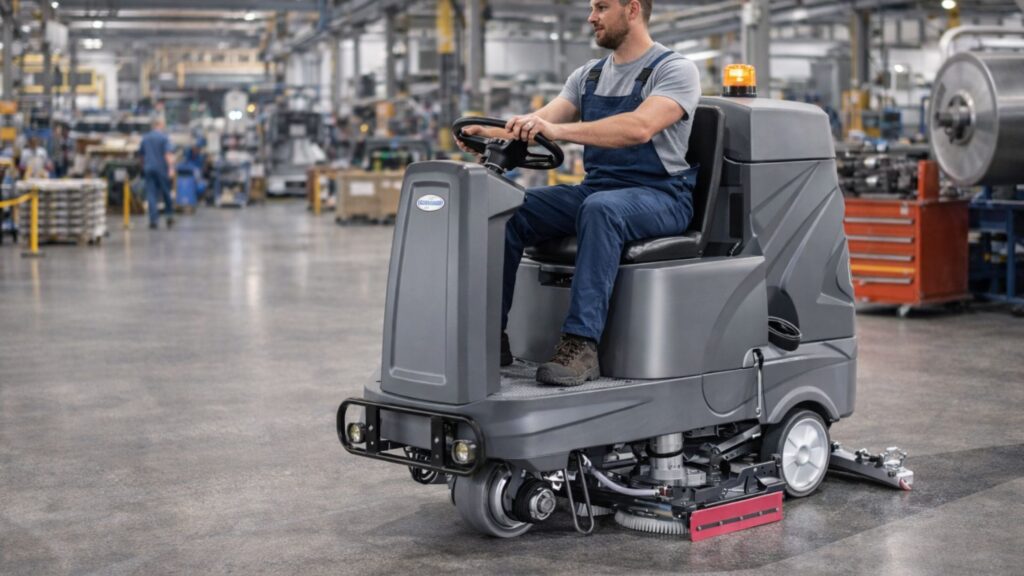
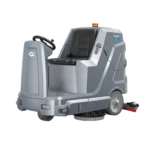
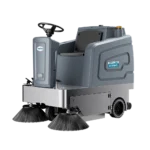
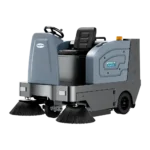
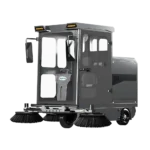
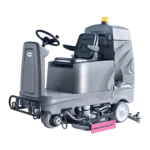
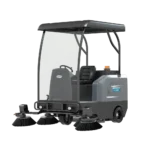
While choosing Walk-Behind vs Ride-On Floor Scrubber, Ride-on scrubbers have a seat. You drive them like a small vehicle. Everything else, solution dispensing, scrubbing, squeegee, vacuum, works the same as a walk-behind, just bigger and faster.
Quick specs:
- Cleaning width: 26–40+ inches (some industrial models go wider)
- Tank capacity: 20–70+ gallons
- Productivity: roughly 30,000–80,000+ sq ft per hour
- Price: $5,000–$30,000+ (premium brands at top; factory-direct significantly lower)
- Weight: 500–1,500+ lbs
SOURCE: Productivity range, manufacturer specs, FCE data
Browse all ride-on floor scrubbers → Ride on srubers
Ride-ons win when:
- Your facility is over 25,000–30,000 sq ft. The math is simple: a ride-on covers 3–4x more area per hour than a walk-behind. In a 100,000 sq ft warehouse, a walk-behind takes 4+ hours. A ride-on does it in 1.5–2.
- Your operators work long or multiple shifts. No walking fatigue. The operator sits, steers, and maintains the same speed and cleaning pressure for the entire shift. Consistency stays high from hour one to hour four.
- You have wide, open layouts. Warehouse main aisles, mall concourses, airport terminals, factory production floors. Ride-ons eat up open space.
- Labor cost matters more than machine cost. One ride-on operator covers the work of 3–5 manual cleaners on large areas. At ~$17/hour per worker, the labor math justifies a ride-on fast.
Ride-ons lose when:
- Your space has tight spots. Ride-ons are 60–80 inches wide. If your narrowest aisle or doorway is under 60 inches, the machine literally won’t fit.
- You need to clean multiple floors. Most ride-ons weigh 500+ lbs. They don’t fit in standard elevators and can’t go up stairs.
- The budget is very tight. Even at factory-direct pricing, a ride-on starts around $5,000. If your entire cleaning budget is $3,000, a walk-behind is the answer.
3. Side-by-Side Comparison
| Factor | Walk-Behind | Ride-On |
| Best for (sqft) | Under 25,000 sq ft | Over 25,000 sq ft |
| Cleaning width | 14–24 inches | 26–40+ inches |
| Productivity | 10K–30K sqft/hr | 30K–80K+ sqft/hr |
| Tank capacity | 4–15 gallons | 20–70+ gallons |
| Operator fatigue | Moderate to high (walking 2–4 hrs) | Low (seated the entire shift) |
| Maneuverability | Excellent — tight turns, narrow aisles, under furniture | Limited — needs 60–80″ clearance |
| Price range | $1,500–$8,000 | $5,000–$30,000+ |
| Weight | 80–350 lbs | 500–1,500+ lbs |
| Transport | Fits in freight elevators, vans | Needs loading dock or trailer |
| Learning curve | Minutes — push and steer | 30–60 minutes — driving + controls |
| Maintenance | Simpler, fewer parts | More complex, larger tanks and systems |
| Best industries | Clinics, schools, restaurants, offices, small warehouses | Clinics, schools, restaurants, offices, and small warehouses |
SOURCE: Price ranges — Scrubbershop, US Cleaning Tools. Productivity — manufacturer specs
4. The Square Footage Cheat Sheet – Walk-Behind vs Ride-On Floor Scrubber
Stop overthinking. Match your floor area to a machine type:
| Floor Area | Machine Type | Why | Aokelang Model |
| Under 5,000 sqft | Compact walk-behind | Anything bigger is wasted money | X2, T3Z |
| 5K–15K sqft | Standard walk-behind (pad-assist) | Right balance of coverage and cost | D2, D3 |
| 15K–30K sqft | Large walk-behind (traction-drive) | Traction-drive eliminates pushing effort for longer shifts | D4, D4Z, T3 |
| 30K–50K sqft | Walk-behind OR compact ride-on | This is the crossover zone. Depends on layout. | D4Z or D6 |
| 50K–200K sqft | Mid-size ride-on | Traction drive eliminates pushing effort for longer shifts | D6, DX6 |
| 200K+ sqft | Industrial ride-on | Maximum tank, maximum width, maximum productivity | D7, D8, X5 |
Each model name → our product pages
Pay attention to the 30K–50K zone. That’s where the decision isn’t obvious. If your 40,000 sq ft facility is mostly open floor, a compact ride-on wins. If it’s broken up by aisles, racks, and equipment, a traction-drive walk-behind is more practical even though it’s slower overall.
5. The Aisle Width Test Nobody Does (But Should)
This is the step that separates informed buyers from regretful ones.
Before you pick any model, grab a tape measure and find the narrowest point in your facility where the scrubber needs to go. That means:
- The narrowest aisle between racking or shelving
- The narrowest doorway between cleaning zones
- Any pinch points around columns, machinery, or loading dock areas
Now compare that measurement to the machine width:
| Machine | Typical Width | Minimum Aisle Width Needed |
| Compact walk-behind | 18–24 inches | ~30 inches (machine + operator clearance) |
| Standard walk-behind | 20–28 inches | ~36 inches |
| Large walk-behind | 24–32 inches | ~42 inches |
| Compact ride-on | 38–48 inches | ~55 inches |
| Mid/large ride-on | 48–65+ inches | ~72–80 inches |
If your narrowest aisle is 50 inches and you buy a ride-on that’s 52 inches wide, that machine is going back on the truck. We see this happen at least once a month. Don’t be that buyer.
The smart play for facilities with mixed layouts: buy a ride-on for the open areas and a compact walk-behind for the tight zones. Two machines, zero dead spots. This is what most large warehouses and manufacturing plants end up doing.
Must read – Floor Scrubber Maintenance Guide
6. The Real Cost Comparison of Walk-Behind vs Ride-On Floor Scrubber (Not Just Sticker Price)

Sticker price is misleading. A $3,000 walk-behind is not “cheaper” than a $12,000 ride-on if the ride-on saves you $2,000/month in labor.
Example: 80,000 sq ft warehouse
Option A — Walk-behind: Two operators, 4 hours/day to cover 80K sqft. Labor: 2 × $20/hr × 4 hrs = $160/day. Machine cost (amortized 5 years): ~$3/day. Total: $163/day.
Option B — Ride-on: One operator, 2 hours/day. Labor: 1 × $20/hr × 2 hrs = $40/day. Machine cost (amortized 5 years): ~$10/day. Total: $50/day.
Daily savings: $113. Monthly: ~$2,500. Annual: ~$30,000.
SOURCE: $20/hr loaded labor cost based on ~$16.84/hr avg janitor wage (BLS) + benefits
The ride-on “costs more” but saves $30,000/year. It pays for itself in under 5 months.
But flip the scenario: a 6,000 sq ft clinic. One operator with a walk-behind finishes in 45 minutes. A ride-on can’t even turn around in the corridors. The walk-behind is the only sensible option.
Total cost of ownership depends on YOUR floor, not a spec sheet.
7. The Hybrid Approach (What Most Large Facilities Actually Do)
Here’s something the internet rarely mentions: most facilities over 50,000 sq ft don’t choose between walk-behind and ride-on. They buy both.
- Ride-on for the main open floor areas — warehouse aisles, mall concourses, factory production floors, hospital lobbies.
- Walk-behind for the tight and tricky areas — between racks, around machinery, restrooms, corridors, and under workbenches.
A 150,000 sq ft warehouse might run an Aokelang D7 ride-on for the main floor and an Aokelang D4Z walk-behind for narrow racking aisles. Total investment: roughly $12,000–$18,000. Cleaning time: under 3 hours with one operator on the ride-on and one on the walk-behind. Cost of manual mopping the same space: $200+/day, $4,400/month.
The hybrid setup is the one nobody regrets.
What Industries We Serve –
Hospitals, etc
The Fastest Way to Decide – Walk-Behind vs Ride-On Floor Scrubber
Measure two things while deciding between Walk-Behind vs Ride-On Floor Scrubber: your total floor area and your narrowest aisle. Send us those two numbers along with your industry, and we’ll tell you exactly which model fits walk-behind, ride-on, or both. Takes us about 10 minutes. Takes you about 30 seconds to measure.
Frequently Asked Questions
Can one operator use both a walk-behind and a ride-on in the same facility?
Yes, and this is common. The operator rides the ride-on for open areas, then switches to a walk-behind for tight zones. Some facilities dedicate one operator per machine for speed. The key is matching each machine to the areas it handles best rather than forcing one machine to do everything.
At what square footage should I switch from walk-behind to ride-on?
The crossover zone is 25,000–50,000 sq ft. Under 25K, walk-behind almost always makes more sense. Over 50K, ride-on is clearly better. In between, it depends on your layout — open floor plans favor ride-on; tight, cluttered spaces favor walk-behind.
Are ride-on scrubbers harder to operate?
Slightly. A walk-behind requires almost no training — push and steer. A ride-on needs 30–60 minutes of orientation for steering, speed control, and dashboard functions. But any operator comfortable driving a golf cart or forklift picks it up immediately. Most Aokelang ride-on models have intuitive controls designed for non-technical operators.
Can a ride-on scrubber fit through a standard doorway?
Most standard commercial doorways are 36 inches wide. Compact ride-ons (38–48 inches) will NOT fit. You need double doors (60–72 inches) or dock-width openings for ride-on scrubbers. Always measure every doorway between cleaning zones before buying.
Is a traction-drive walk-behind as good as a ride-on for medium spaces?
For spaces in the 15K–40K sq ft range, a traction-drive walk-behind is a strong alternative. It eliminates pushing effort (the motor drives the wheels), costs 40–60% less than a ride-on, and fits in tighter areas. The trade-off is speed — a ride-on still covers the same area 2–3x faster.
What’s a stand-on scrubber?
A stand-on scrubber is a middle ground: you stand on a platform behind the machine rather than sitting (ride-on) or walking (walk-behind). They’re more compact than ride-ons, reduce fatigue compared to walk-behinds, and offer better visibility than ride-ons for navigating obstacles. They’re popular in retail, schools, and mid-size commercial spaces.
Which type is quieter?
Walk-behinds are generally quieter because they have smaller motors and vacuum systems. Many compact walk-behinds operate at 65–70 dB — quiet enough for daytime cleaning in hospitals and offices. Ride-ons typically run at 70–80 dB, which is comparable to a loud conversation.
Which Aokelang models are walk-behind and which are ride-on?
Walk-behind models: X2 (compact), T3Z (small), D2 (standard), D3 (commercial), D4 and D4Z (battery-powered mid-size), T3 (industrial). Ride-on models: D6 (compact ride-on), DX6 (versatile), D7 (industrial), D8 (commercial large), X5 (automatic). That’s 7 walk-behind and 5 ride-on options covering every facility size.