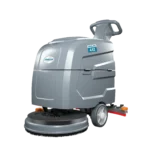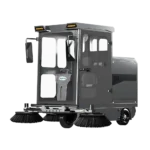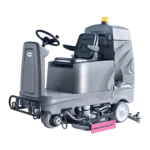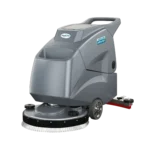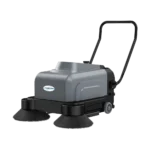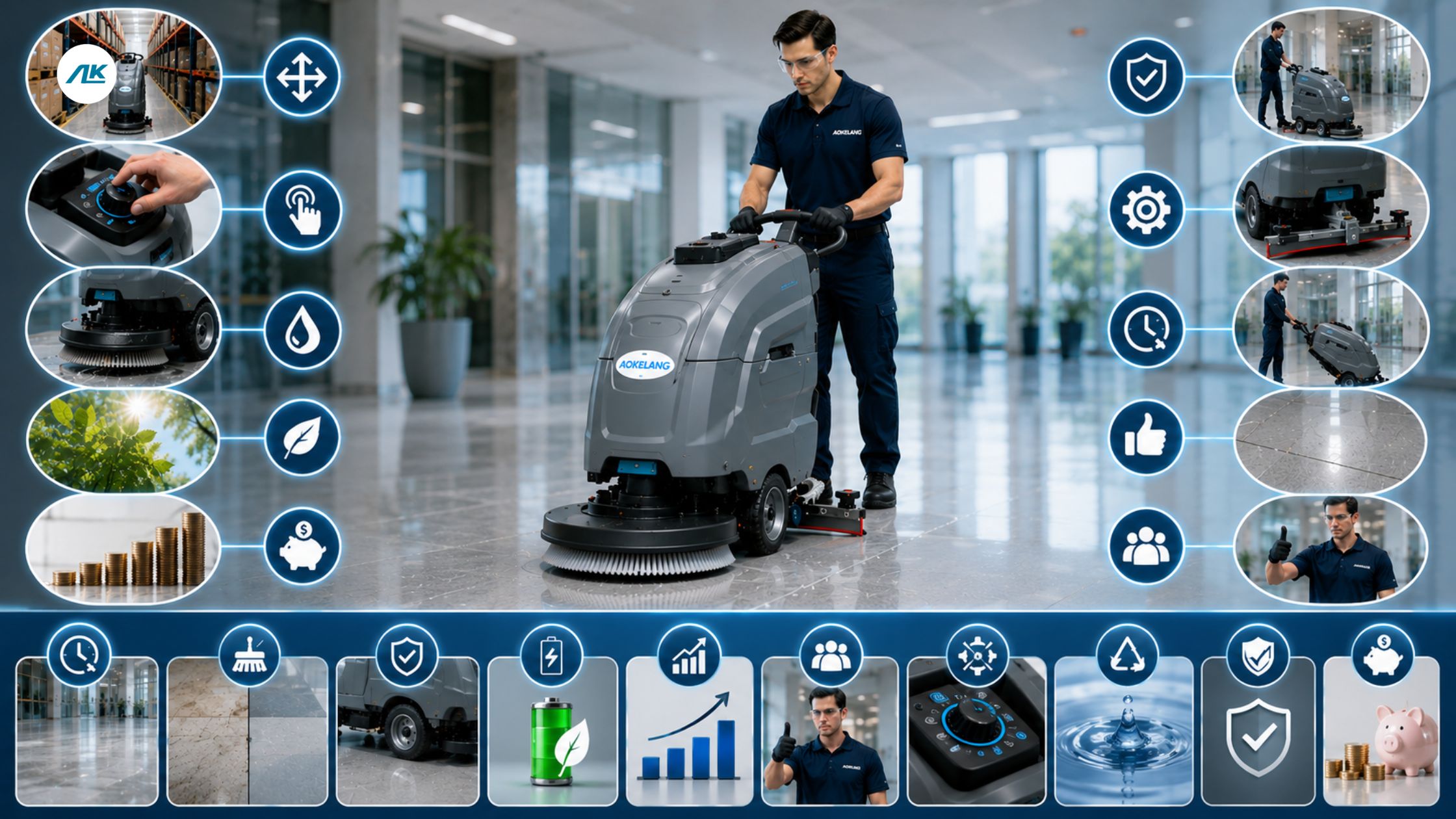
The 10 key benefits of walk-behind floor scrubber are: (1) deep cleaning in a single pass that mopping cannot replicate, (2) floors are dry and safe within seconds, (3) 50% or greater reduction in labour costs, (4) superior manoeuvrability in tight and congested spaces, (5) consistent and repeatable cleaning results every cycle, (6) significantly reduced water and chemical consumption, (7) improved hygiene standards to a level relevant for compliance, (8) extended floor surface lifespan, (9) low training burden with easy operation, and (10) a lower capital cost than ride-on machines while overlapping in capability for small-to-medium facilities.
Walk-behind floor scrubbers are compact, battery-powered or corded cleaning machines that scrub, wash, and dry hard floor surfaces in a single forward pass. They are the most practical floor cleaning upgrade for facilities between 1,000 and 50,000 square feet — delivering results that mopping physically cannot achieve, at a cost that pays back within months.
The rest of this guide explains each benefit in depth, fills the gaps that most articles on this topic skip entirely, and gives facility managers, procurement teams, and operations directors everything they need to make a properly informed decision.
Table of Contents
What Is a Walk-Behind Floor Scrubber?
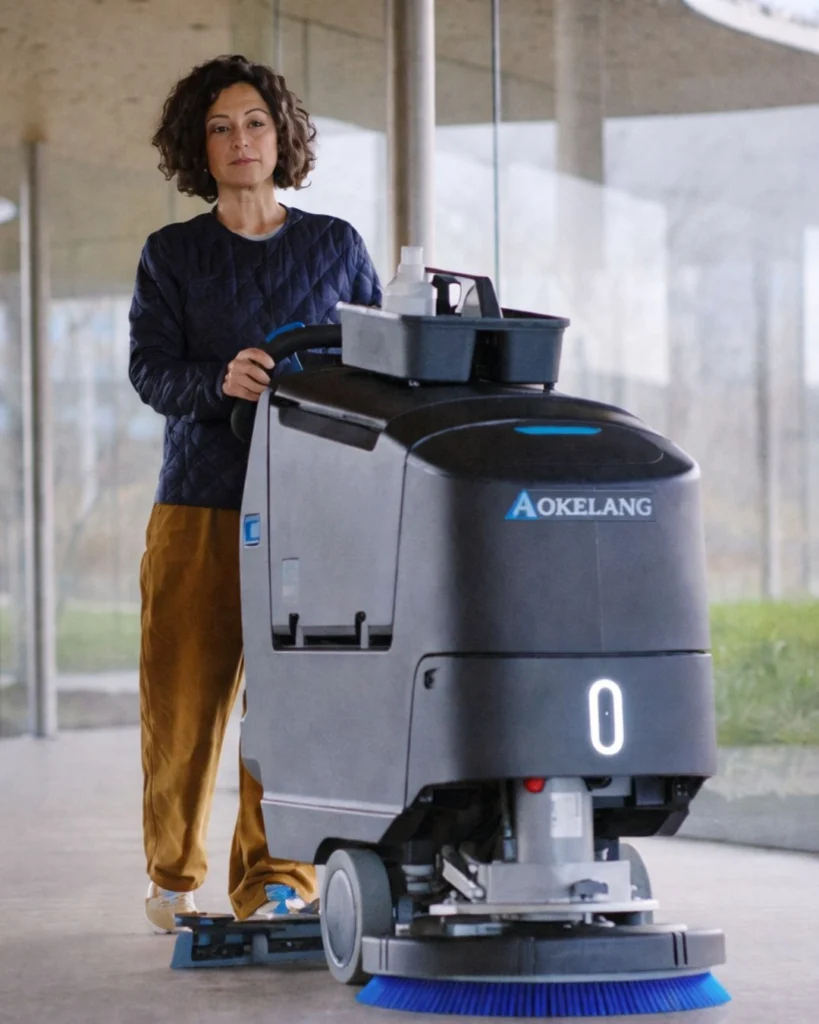
A walk-behind floor scrubber is a powered floor cleaning machine in which the operator walks behind the unit and guides it across the floor. As it moves, it simultaneously:
- Dispenses a controlled amount of clean water and cleaning solution from the solution tank to the floor surface
- Scrubs the floor with rotating disc or cylindrical brushes under controlled pressure, mechanically breaking up contamination
- Recovers the dirty water via a rear squeegee blade and suction system into a separate recovery tank
- Leaves the floor clean and nearly dry — walkable within seconds
This is fundamentally different from mopping. A mop applies dirty water across the floor and relies on evaporation. A walk-behind scrubber applies clean solution, mechanically removes contamination, and immediately recovers the dirty water. The floor is cleaner, safer, and usable faster.
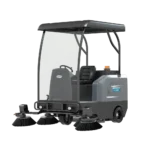
Walk-behind scrubbers differ from ride-on scrubbers in that the operator guides the machine on foot. This makes them more manoeuvrable in tight spaces, more accessible in cost, and more appropriate for small-to-medium facilities or constrained zones within larger ones.
Aokelang manufactures a full range of walk-behind floor scrubbers — from compact models like the X2 for tight corridors and restrooms, to mid-range commercial models like the D3 and D4 for retail and office environments, to industrial walk-behind models like the T3 and T3Z walk behind floor scrubber for demanding factory and logistics applications.
Every one of these questions is answered in this guide.
Benefit 1: Deep Cleaning in a Single Pass — Something Mopping Cannot Do
The headline benefit of any walk-behind floor scrubber is the quality of clean it delivers — and this is worth explaining mechanically, because the difference between “cleans well” and what actually happens is significant.
The mopping problem: A mop head absorbs contamination from the floor on its first contact. From that point forward, every stroke redistributes a mixture of cleaning solution and whatever the mop picked up on the previous stroke. In a busy commercial or industrial environment, this means the floor is being spread with a progressively dirtier solution throughout the cleaning cycle. Mopping also provides no mechanical scrubbing action — it relies entirely on chemical action and light physical friction, which is insufficient for ingrained grease, bonded residues, or heavy contamination.
How a walk-behind scrubber fixes both problems: Clean solution is continuously fed from the clean water tank to the brush head. The brushes — rotating at controlled speed and pressure — mechanically agitate and break up ingrained contamination. The squeegee and suction system immediately recover the dirty water into a sealed recovery tank. At no point is contaminated water redistributed across the floor.
The result: a walk-behind floor scrubber removes contamination that mopping leaves behind — grease films in food production, tyre marks in warehouses, chemical residues in manufacturing, ingrained dirt in high-traffic corridors. A visually clean mopped floor and a machine-scrubbed floor are not equivalent from a hygiene or contamination standpoint.
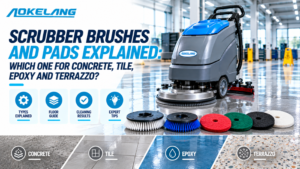
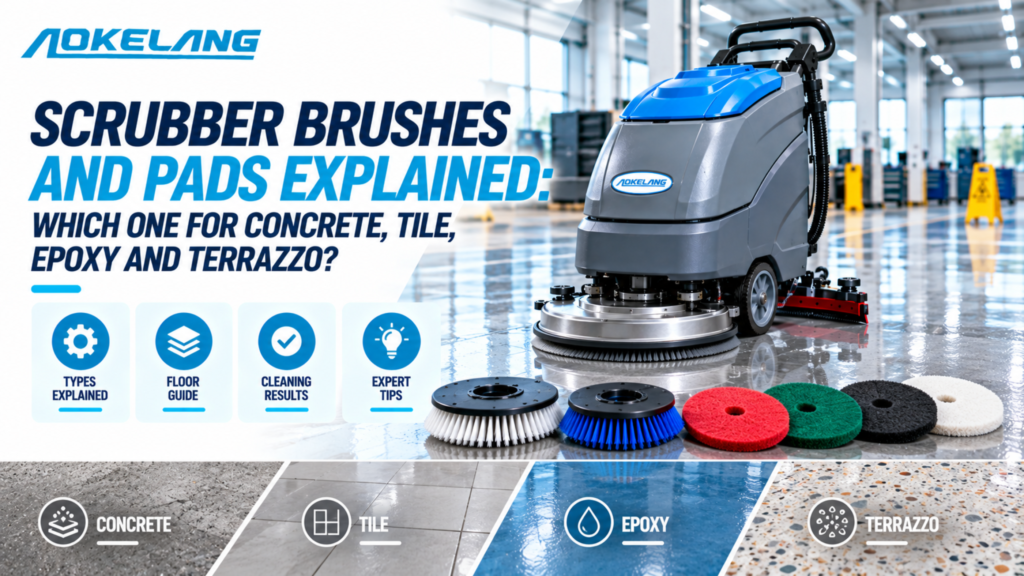
Brush type matters: Cylindrical brushes reach into grout lines and textured surfaces for deep cleaning on rough floors. Disc brushes are more effective on smooth, sealed surfaces. Selecting the right brush type for your floor surface is part of getting the full benefit from the machine. Aokelang’s scrubber range spans both configurations — the right choice depends on your specific floor surface.
Also read – Floor scrubbers for schools
Benefit 2: Floors Are Dry and Safe Within Seconds
This is the benefit with the most direct safety implication, and the one that most clearly distinguishes walk-behind scrubbers from every other method.
After mopping, a floor is wet. Drying time ranges from 15 minutes to over an hour depending on ventilation, ambient temperature, and how much water was applied. During that window, the floor is a slip hazard. In busy commercial environments — supermarkets, hospitals, warehouses, schools — this creates a real and ongoing liability exposure.
A walk-behind floor scrubber vacuums up the bulk of the moisture via the squeegee system as it moves. The floor behind the machine is damp, not wet, and reaches a safe, walkable condition in seconds to a couple of minutes.
The operational impact: Facilities can clean during business hours without taking areas out of service for drying. A hospital corridor can be scrubbed without closing it. A retail floor can be cleaned in sections while customers are present. A warehouse aisle can be scrubbed and returned to forklift traffic within minutes. This flexibility directly affects when and how often cleaning can happen — which directly affects the floor standard maintained throughout the day.
The gap most articles miss: Drying performance depends on squeegee condition. A worn or poorly fitted squeegee leaves more water behind, extending dry time and reintroducing the slip hazard. Squeegee inspection and replacement is the most commonly neglected maintenance task on walk-behind scrubbers — and it directly determines whether the machine delivers the safety outcome it is supposed to.
Also read – Benefits of floor sweeper
Benefit 3: Up to 50% Reduction in Labour Costs
Labour cost is the most financially significant benefit of walk-behind floor scrubbers, and it is the one that most directly determines whether the investment makes financial sense. Here is how the numbers actually work.
The baseline: Labour costs represent approximately 90% of the total cost of maintaining commercial floors. That figure, cited consistently across facility management industry research, means the machine’s cleaning quality is almost secondary to the labour equation when building the financial case.
The speed difference: A two-person team mopping 5,000 m² takes approximately 8 hours. A single operator with a walk-behind floor scrubber completes the same area in approximately 4 hours — a 50% labour reduction verified across operational case studies in retail, healthcare, logistics, and manufacturing environments. A medium-sized walk-behind scrubber covers approximately 2,200 m² per hour under real-world conditions. Manual mopping covers 200–400 m² per hour.
Real-world ROI data:
- A 12,000 sq ft distribution centre reduced its cleaning from 3 operatives rotating mop duty (3 hours daily) to 1 walk-behind scrubber operator (45 minutes daily). Investment payback: 13 months.
- A 9,500 sq ft manufacturing floor that mopped twice daily cut operative cleaning hours by 75% after deploying a walk-behind scrubber. Payback period: 5 months.
- For a 10,000 sq ft warehouse, walk-behind scrubbers typically pay back their investment through labour savings alone within 11 to 18 months.
The calculation for your facility: Take the number of operative hours currently spent on floor cleaning per week. Multiply by hourly labour cost. The machine reduces this by 40–75% depending on facility layout and current cleaning method. The annual saving against the machine’s purchase price gives the payback period. For most commercial facilities, this period is under two years — often well under.
Benefit 4: Manoeuvres Confidently in Tight and Congested Spaces
This is the defining operational advantage of the walk-behind format over ride-on scrubbers, and it is why walk-behind machines remain essential even in large facilities that also operate ride-on equipment.
Ride-on scrubbers are faster across open floor areas. But they require adequate aisle width for safe operation and turning, cannot navigate around frequent obstacles without multiple-point manoeuvres, and are impractical in zones with columns, racking, machinery, or irregular layouts.
A walk-behind scrubber is guided by an operator on foot. The operator provides the spatial awareness, the reaction speed, and the fine directional control. The result: tight aisles, narrow corridors, doorways, restrooms, around machinery bases, and right up to walls and racking legs — all areas a ride-on scrubber would skip or approximate — are cleaned precisely and completely.
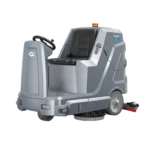
The two-machine strategy: Many large facilities — warehouses, manufacturing plants, large retail environments — run a ride-on scrubber for open floor areas and a walk-behind for the constrained zones. The walk-behind is not a substitute for the ride-on in these environments — it is the specialist for the areas the ride-on cannot serve. Aokelang produces both walk-behind scrubbers and ride-on scrubbers at matched scales, allowing facilities to equip both functions from a single manufacturer.
Compact models for genuinely tight spaces: Aokelang’s X2 walk-behind scrubber is built specifically for facilities where space constraints are severe — narrow hallways, restrooms, break rooms, tight service corridors. When a standard scrubber is still too wide for the space, a purpose-built compact model is the answer.
Also read – Floor Scrubber Price
Benefit 5: Consistent, Repeatable Results Every Single Cleaning Cycle
Manual mopping produces variable results. The quality of the clean depends on the operative’s technique, effort, and physical state at the time. Fatigue degrades performance across a long shift. Sections get missed in large areas. Multiple operatives covering different zones produce inconsistent results across the facility.
A walk-behind floor scrubber delivers the same result every time, because the cleaning parameters — solution flow rate, brush pressure, brush speed, squeegee recovery — are fixed machine specifications. The output does not vary based on who is operating it, how experienced they are, or what time in the shift it is.
Why this matters: For facility managers responsible for maintaining defined hygiene, safety, or presentation standards, the consistency of machine cleaning is what makes those standards reliably achievable. A cleaning schedule built around a walk-behind scrubber can be planned and relied upon. A schedule built around manual mopping is subject to the variability of the people executing it.
The compliance implication: In regulated industries — food production, healthcare, pharmaceuticals, logistics — the consistency of cleaning outcomes is part of the compliance requirement, not just the outcome itself. Auditors and inspectors look for evidence of systematic, consistent cleaning — which machine records can demonstrate in a way that manual cleaning cannot.
Benefit 6: Uses 60–80% Less Water and Chemical Than Mopping
This surprises most people encountering it for the first time, because the intuitive assumption is that a machine using water must use more than a bucket-and-mop setup. The opposite is true.
Walk-behind scrubbers dispense cleaning solution at a precisely controlled rate directly to the brush head. There is no overfilling a bucket, no pouring excess detergent, and no applying more water to the floor than is needed. The solution is applied only where it is needed, in the quantity required for effective cleaning — then immediately recovered.
In practice, walk-behind scrubbers use 60 to 80 percent less water per square metre than mopping. Chemical consumption is similarly reduced by controlled dispensing that prevents the over-dosing that is common with manual cleaning.
The financial impact: For a 5,000 m² facility cleaned once daily, the water and chemical savings across a year are material — particularly for facilities paying for commercial water supply and professional-grade cleaning chemicals. These ongoing operating cost savings compound the labour savings already described.
The sustainability impact: Zero water wastage from over-application. No chemical residue left standing on the floor. For facilities with environmental management systems (ISO 14001), ESG reporting commitments, or corporate sustainability targets, this is a quantifiable contribution to resource efficiency metrics at no additional operational cost.
Benefit 7: Hygiene Performance That Supports Regulatory Compliance
The hygiene benefit of walk-behind floor scrubbers is often stated vaguely — “cleaner floors,” “better hygiene.” The reality is more specific and more significant for regulated industries.
Mopping redistributes contaminated water. The mop head absorbs pathogens on first contact and distributes them across every subsequent stroke. Even with regular bucket water changes, the contamination window between changes means mopping is spreading, not removing, microbial contamination in environments where it matters.
A walk-behind scrubber continuously applies fresh solution and continuously recovers contaminated water into a sealed recovery tank. Contamination is removed from the floor and contained — not redistributed.
Also read – Floor Scrubber Maintenance
Industries where this is a compliance requirement, not just a preference:
- Food production — HACCP, BRC Global Standard, SQF certification all require documented, validated cleaning procedures. Machine scrubbing is consistent with these requirements. Mopping typically is not, particularly in production zones.
- Healthcare — CQC inspection criteria, national infection control standards, and NHS cleaning specifications define cleaning method and frequency requirements where machine cleaning provides a defensible, auditable approach.
- Pharmaceuticals — GMP cleaning guidelines require that cleaning procedures be validated and consistently applied. Walk-behind scrubbers provide the consistency of outcome that validation requires.
- Warehousing and logistics — Health and Safety at Work Act (UK), OSHA (US), and Work Health and Safety Act (Australia) create employer obligations around floor safety and hygiene that machine cleaning supports more robustly than manual methods.
The audit trail: A cleaning programme built around machine use — with defined schedules, documented usage, and maintenance records — provides the systematic evidence that compliance audits require. Manual mopping applied inconsistently cannot produce this evidence even if the visible floor condition is similar.
Check out the following:
ride on floor scrubber
walk behind floor scrubber
ride on floor sweeper
walk behind floor sweeper machine
industrial ride-on floor sweeper machine
warehouse sweeper machine
warehouse floor scrubber
battery floor scrubber
Benefit 8: Extends the Usable Life of Your Floor Surface
Hard floor surfaces degrade through two mechanisms: abrasive wear from particles that are walked or driven across the surface, and chemical degradation from spills, residues, and cleaning product accumulation over time.
Mopping addresses neither effectively. It redistributes fine abrasive particles across the floor rather than removing them, and it applies chemical solution that is rarely fully rinsed, leaving residue that accumulates in surface pores and degrades coatings.
A walk-behind floor scrubber removes abrasive particles mechanically, applies and recovers chemical solution in a controlled way that prevents residue accumulation, and leaves surfaces cleaner at a deeper level than mopping.
The financial impact: Floor resurfacing, recoating, and replacement are expensive — significantly more expensive than the cleaning programme that prevents them. For facilities with quality floor finishes — epoxy resin, polished concrete, vinyl composition tile, safety flooring — regular machine scrubbing is a floor asset protection measure with a financial return that compounds across years.
An often-missed consideration: Over-wetting with a mop damages certain floor types — adhesive-bonded tiles, wood-effect vinyl, and moisture-sensitive coatings are all at risk from the sustained moisture of manual mopping. Walk-behind scrubbers, which apply and recover water in a controlled process, are actually safer for moisture-sensitive floor types than the mopping they replace.
Benefit 9: Easy to Operate — Any Operative, Consistent Results from Day One
Modern walk-behind floor scrubbers are designed for accessibility. The operational interface is straightforward: solution tank filled, brushes lowered, machine guided forward, squeegee down. The machine handles the scrubbing, solution dispensing, and water recovery automatically.
An operative with no prior experience can be trained to operate a walk-behind floor scrubber competently in a single session — covering machine startup, operating technique, tank management, and shutdown procedure. From that point, they produce consistent results because the machine’s performance is fixed, not dependent on their technique.
Why this matters operationally: Facilities with high staff turnover — common in cleaning, logistics, retail, and hospitality — can maintain cleaning quality without extended training periods. New operatives are productive from their first shift. The machine does not create a training dependency.
What training should cover: While the operation itself is simple, proper training on a few specific tasks significantly affects machine performance and service life: solution dilution and tank preparation, battery charging discipline (for battery-powered models like Aokelang’s D4 and D4Z), squeegee and brush inspection before use, recovery tank emptying and rinsing after use, and basic fault identification. For a complete operational guide, see how to use a floor scrubber.
Benefit 10: Lower Capital Cost Than Ride-On Scrubbers — With Overlapping Capability for the Right Facility
Walk-behind floor scrubbers are less expensive to purchase than ride-on scrubbers of equivalent build quality. For facilities where the floor area and layout make a walk-behind the appropriate choice, this difference is genuine savings rather than compromise.
A medium-sized walk-behind scrubber covering 2,000–4,000 m² per cleaning cycle is sufficient for the majority of commercial facilities: retail stores, office buildings, schools, hospitals, food production areas, and smaller warehouses. In these environments, the additional speed of a ride-on scrubber would not produce a proportional operational benefit — the time saving would be modest and the capital cost premium substantial.
Beyond purchase price, walk-behind scrubbers have:
- Lower maintenance costs — simpler mechanical configuration, lower parts cost, more accessible servicing
- Lower consumable costs — brushes and squeegees at walk-behind scale are less expensive than ride-on equivalents
- Longer component life — typically, because walk-behind machines are used more gently and in more controlled environments than ride-ons
- Simpler battery management — smaller battery packs, faster charge cycles, lower replacement cost
Over a five-to-seven-year service life, the total cost of ownership advantage of a correctly specified walk-behind over a ride-on in a sub-5,000 m² facility is typically larger than the purchase price difference suggests.
Walk-Behind vs Ride-On Floor Scrubber: Which Is Right for Your Facility?
This is the most searched comparison question in the floor scrubber category, and it deserves a direct, structured answer.
Choose a walk-behind floor scrubber when:
- Your facility floor area is below approximately 4,000–5,000 m²
- Your layout includes narrow aisles, tight corridors, frequent obstacles, or restricted turning space
- Your capital budget warrants the lower-cost option for equivalent cleaning outcomes at your scale
- You need to clean right up to walls, racking, machinery, or furniture with precision
- You are supplementing a ride-on with a machine for constrained zones
Choose a ride-on floor scrubber when:
- Your floor area is large — typically above 5,000 m² — and predominantly open
- Cleaning speed is the primary operational requirement
- Operator fatigue on extended shifts is a concern
- Your layout allows the machine to operate at speed without frequent stops and turns
Consider both when:
- Your facility has large open areas AND constrained zones — the ride-on covers the open floor, the walk-behind serves the aisles, edges, and tight spaces
For a detailed comparison, the walk-behind vs ride-on scrubber guide covers this decision framework with facility-specific guidance.
Walk-Behind Floor Scrubbers and Floor Sweepers: The Complete Picture
Walk-behind floor scrubbers and floor sweepers address different cleaning problems and are frequently used together in the same facility.
A floor scrubber is the right tool for: wet contamination, grease, stains, residues, and ingrained surface dirt. Wet process. Floors dry and walkable within seconds of the machine passing.
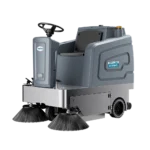
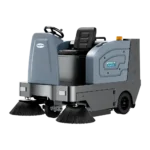
A floor sweeper is the right tool for: dry debris — dust, grit, loose particles, litter. Dry process. No water. Floors immediately available after sweeping.
Best practice in professional cleaning is sweep-first, then scrub. The sweeper removes loose debris that would otherwise contaminate the scrubber’s clean water tank and degrade scrubbing performance. The scrubber then deep-cleans a surface that is already clear of loose material — producing better results from both machines and extending the service life of brushes and squeegees.
Aokelang manufactures both categories: a full floor scrubber machine range and a full floor sweeper machine range, allowing facilities to source both functions from a single manufacturer with matched operational scales.
Summary: 10 Benefits of Walk-Behind Floor Scrubbers
| Benefit | What It Delivers |
| 1. Deep cleaning in one pass | Removes contamination mopping redistributes — grease, residues, ingrained dirt |
| 2. Floors dry within seconds | No wet-floor slip hazard; areas back in use immediately after cleaning |
| 3. Up to 50% labour saving | Single operator replaces multi-person mopping team; payback typically under 18 months |
| 4. Superior manoeuvrability | Navigates tight aisles, corners, and obstacles with precision |
| 5. Consistent, repeatable results | Fixed machine parameters; performance does not vary with operator fatigue |
| 6. 60–80% less water and chemical | Controlled dispensing and recovery eliminates waste and over-application |
| 7. Compliance-grade hygiene | Continuous fresh solution; contaminated water contained, not redistributed |
| 8. Extends floor surface life | Removes abrasive particles; prevents chemical residue accumulation |
| 9. Minimal training required | Operative competent from first session; consistent results regardless of experience |
| 10. Lower capital cost than ride-on | Right-sized investment for facilities up to ~5,000 m² |
About Aokelang Walk-Behind Floor Scrubbers
Aokelang is a specialist manufacturer of commercial and industrial floor cleaning equipment, operating from a 20,000 m² production facility in Hefei, China. The company produces a full range of walk-behind and ride-on floor scrubbers — from compact models for tight commercial spaces to industrial-grade machines for warehouse and manufacturing environments — alongside a complete floor sweeper range.
All machines are available factory-direct, with no distributor markup, and with technical support, parts access, and consultative pre-purchase guidance as standard.
Frequently Asked Questions About Walk-Behind Floor Scrubbers
What is a walk-behind floor scrubber?
A walk-behind floor scrubber is a powered cleaning machine that the operator guides from behind. It simultaneously applies cleaning solution, scrubs the floor with rotating brushes, and vacuums up dirty water — cleaning and drying the floor in a single pass. It is used on hard floor surfaces in commercial and industrial environments as a more effective, faster, and safer alternative to mopping.
How much does a walk-behind floor scrubber save on labour costs?
Operational data from across retail, healthcare, logistics, and manufacturing consistently shows labour reductions of 40 to 75 percent compared to manual mopping. A two-person 8-hour mopping operation is typically reduced to a single-operator 4-hour machine cleaning cycle for the same floor area. Labour costs represent approximately 90% of total floor maintenance costs, so this saving directly drives the ROI calculation.
How fast does a walk-behind floor scrubber clean?
Under real-world conditions — accounting for obstacles, doorways, and periodic tank management — a walk-behind floor scrubber covers approximately 1,500 to 3,500 m² per hour depending on model and cleaning width. This is 5 to 10 times faster than manual mopping of equivalent floor area.
What floor types can a walk-behind scrubber clean?
Walk-behind floor scrubbers work on most hard floor surfaces: concrete, epoxy resin, ceramic tile, vinyl, terrazzo, marble, and sealed stone. They are not suitable for carpet. Brush type should be matched to floor surface — cylindrical brushes for grouted, textured, or rough surfaces; disc brushes for smooth, sealed surfaces.
How long does it take to train an operator to use a walk-behind floor scrubber?
Most operatives can be trained to competent independent operation within a single training session of one to two hours. The operational interface is intuitive and consistent across brands and models. Key training areas are solution preparation, battery management, squeegee inspection, and post-use tank rinsing.
What is the ROI on a walk-behind floor scrubber?
For a typical commercial facility, payback periods through labour savings alone range from 5 months (in high-frequency, large-area applications) to 18 months (in smaller or lower-frequency applications). Secondary savings from reduced water and chemical consumption, lower floor maintenance costs, and reduced slip-and-fall incident costs shorten the effective payback period further.
Do walk-behind floor scrubbers replace mopping entirely?
In most commercial and industrial applications, yes. Walk-behind scrubbers deliver a deeper clean, more consistent results, faster floor turnaround, and significantly lower labour cost than mopping. Manual mopping may still be appropriate for small spot cleaning between machine cycles or in areas too small or irregularly shaped for machine access.
What maintenance does a walk-behind floor scrubber need?
Core daily maintenance tasks: empty and rinse the recovery tank after each use, clean the squeegee blade and check its seating, check and lower/raise brush pressure as needed. Scheduled maintenance: inspect and replace brushes when worn, clean or replace dust filters, manage battery health and charge cycles on battery-powered models, and periodic mechanical inspection. For a complete guide, see floor scrubber maintenance best practices.