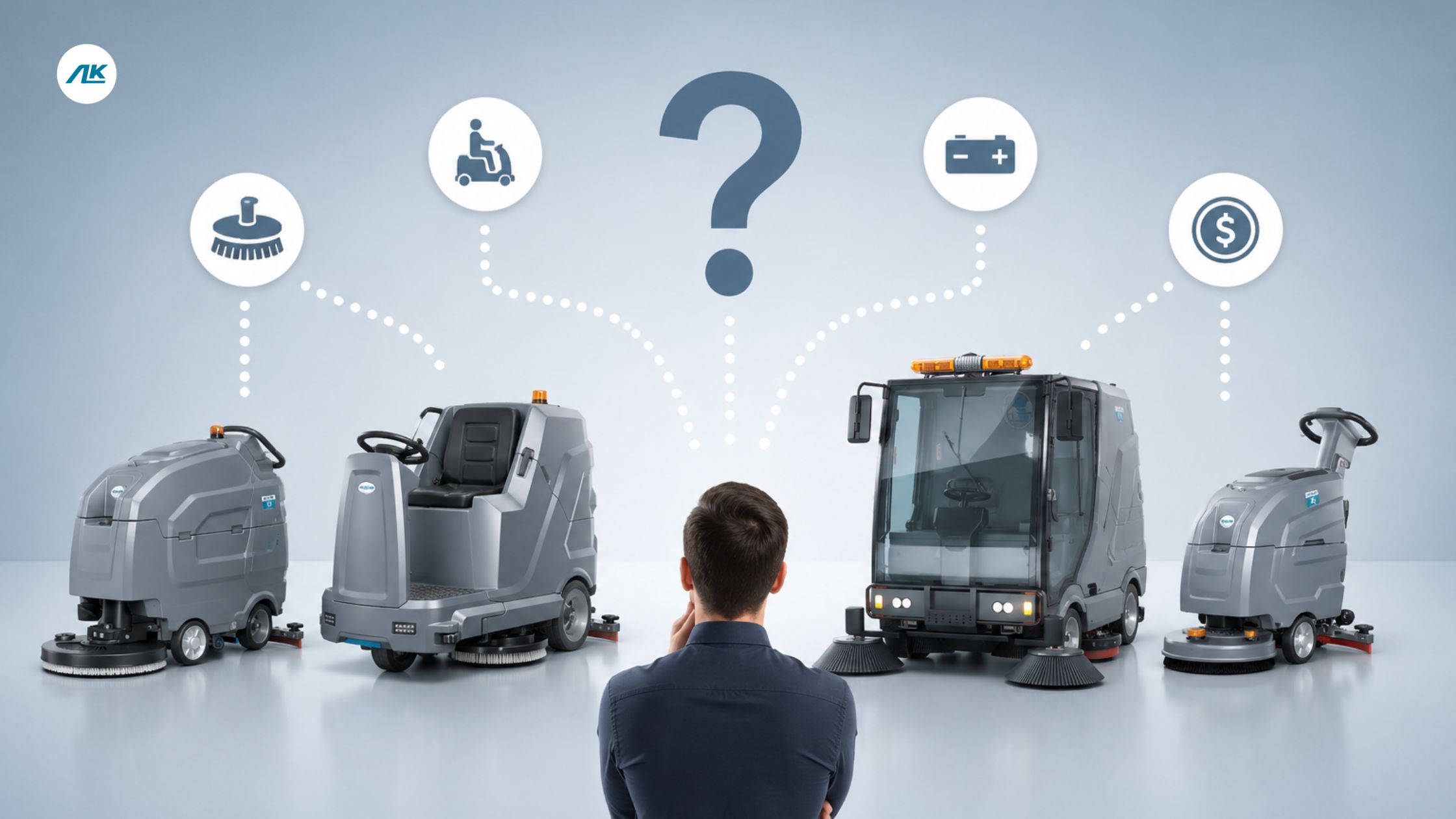
How to Choose a Floor Scrubber? Choose a floor scrubber based on four things: the size of the area you need to clean, your floor type, your power source preference, and your budget. For spaces under 20,000 sq ft with obstacles or narrow aisles, a walk-behind scrubber is right. For large open facilities over 20,000 sq ft, a ride-on scrubber delivers better productivity and lower long-term labour costs.
Table of Contents
What Is a Floor Scrubber and How Does It Work?
A floor scrubber machine is a professional cleaning machine that applies a mixture of water and detergent to a floor surface, agitates the dirt using rotating brushes or pads, and then recovers the dirty water using a squeegee and vacuum system — all in a single pass. This makes it significantly more efficient than traditional mopping, which spreads dirty water rather than removing it. Floor scrubbers are used across warehouses, factories, hospitals, shopping malls, schools, and airports.
Understanding how one works is the first step to choosing the right model for your facility.
Step 1: Determine Your Floor Area and Layout
Your facility’s square footage and layout are the single most important factors in choosing a floor scrubber.
Facilities under 20,000 sq ft, or those with narrow aisles, frequent obstacles, or mixed small zones, are best served by walk-behind models. These are more maneuverable, easier to store, and cost considerably less upfront. Retail floors, school corridors, restaurant kitchens, and small warehouses all fall into this category.
Facilities over 20,000 sq ft with open, unobstructed floor space benefit far more from ride-on scrubbers. A single operator on a ride-on machine can cover tens of thousands of square metres per shift — a task that would require multiple operators and significantly more time using a walk-behind. Before buying, measure your narrowest doorways and aisles to ensure your chosen machine can physically fit through them.
Step 2: Understand the Types of Floor Scrubbers
Walk-Behind Floor Scrubbers
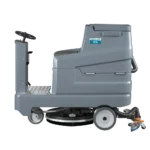
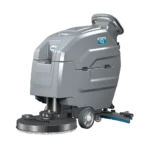
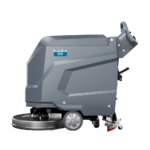
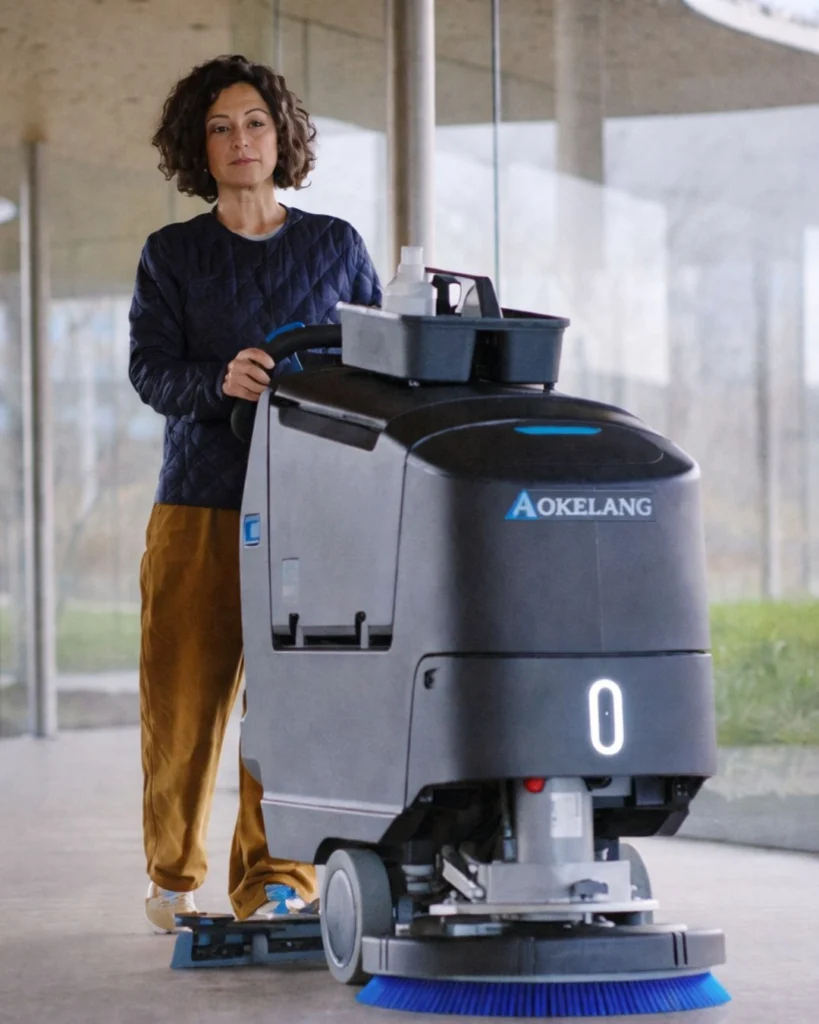
The operator walks behind the machine and guides it through the cleaning path. These range from compact upright models suitable for tight spaces like restrooms and offices, to larger self-propelled units capable of handling medium-sized commercial facilities. Walk-behinds are the entry point into the market and offer the best combination of flexibility, maneuverability, and value for smaller operations.
Ride-On Floor Scrubbers
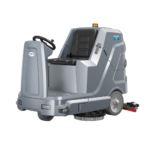
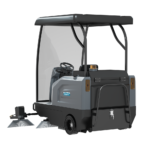
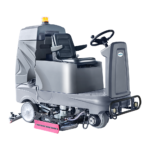
The operator sits inside the machine and drives it, similar to a small vehicle. These are designed for sustained productivity over long cleaning cycles in large, open spaces, distribution centres, manufacturing plants, airports, and convention centres. Ride-on floor machines feature wider cleaning paths, larger solution and recovery tanks, and significantly reduce operator fatigue on long shifts. They cost more upfront, but the labour savings typically offset this within months.
Compact / Micro Scrubbers
These are small-footprint machines designed specifically for congested areas — around equipment, in restroom facilities, or in spaces where a standard walk-behind cannot manoeuvre. They are often used as a supplementary machine alongside a larger primary unit.
Also read – walk behind floor scrubber vs ride on
Step 3: Match the Machine to Your Floor Type
Before choosing a floor scrubber you need to know that not every scrubber works equally well on every surface. Using the wrong machine or the wrong settings can damage your floors.
Smooth sealed concrete, VCT, and tile work well with disc brushes, which deliver effective scrubbing action on flat surfaces.
Uneven surfaces, textured floors, and grouted tile perform better with cylindrical brushes, which can reach into grout lines and lift debris from textured areas more effectively than flat disc pads.
Hardwood and sensitive floor finishes require machines with careful moisture control — the scrubber must dispense water gradually and recover it efficiently to prevent moisture from seeping into seams or dulling the finish.
Mixed-floor facilities benefit from machines with adjustable brush pressure and variable water flow, so the same unit can handle different zones without causing damage.
Always check your flooring manufacturer’s specifications before running a scrubber over a surface for the first time. Using incorrect pad pressure is one of the most common and avoidable sources of floor damage.
Step 4: Choose the Right Power Source
Battery-powered (cordless): The most common and practical choice for most commercial and industrial applications. No extension cord creates trip hazards, and the machine can move freely across large areas. Lithium-ion batteries are increasingly the preferred option — they last longer, require less maintenance, and charge faster than older lead-acid or gel battery units. Always verify you have sufficient charge to complete your full cleaning cycle before starting a job.
- Corded electric: Suited to smaller, fixed areas where a power outlet is nearby and runtime is not a concern. The cord limits reach and mobility but removes the need to manage battery charge.
- LPG or engine-powered: Uncommon and mainly used in large outdoor areas or facilities with adequate ventilation. Not suitable for enclosed indoor environments due to fumes.
For most commercial operations, a battery-powered machine offers the best combination of safety, flexibility, and practicality.
Step 5: Evaluate Tank Size and Cleaning Path Width
- Tank capacity determines how long your machine can operate before it needs to stop for a refill or to empty the recovery tank. Larger tanks mean fewer interruptions — critical in large facilities where stopping mid-job wastes significant time. Walk-behind units typically carry around 50 litres, while ride-on machines can carry up to 130 litres or more.
- Cleaning path width determines how quickly you cover a given area. A wider path means fewer passes, which translates directly to less cleaning time. However, a machine that is too wide for your narrowest aisle or doorway will slow you down rather than speed you up. Always measure your tightest access points and match the cleaning path accordingly.
Also read – Sweeper and Scrubber
Step 6: Factor in Brush Type, Maintenance, and Support
The type of scrubbing pad or brush affects both cleaning results and floor safety. Disc brushes suit smooth, even surfaces. Cylindrical brushes handle textured and uneven surfaces. Using the wrong type reduces cleaning efficiency and may scratch or damage flooring.
Pad and brush life depends on how much area you clean and how often. Calculate your weekly cleaning area and factor in regular pad replacement as part of your ongoing operating cost.
Perhaps the most overlooked factor in buying a floor scrubber is after-sales support. A machine with no local service network or hard-to-source replacement parts can quickly become a liability. Before committing to a purchase, confirm the warranty terms, availability of spare parts, and access to qualified service technicians. A slightly more expensive machine from a well-supported brand almost always costs less over its full working life than a cheap machine with no support infrastructure.
Step 7: Calculate Total Cost of Ownership, Not Just Purchase Price
The purchase price is only one part of the true cost of a floor scrubber. Labour represents approximately 90% of the total cost of maintaining commercial floors, which means a machine that cleans more efficiently can pay for itself quickly by reducing the hours required.
A ride-on scrubber, for example, can improve cleaning productivity by up to 400% compared to manual equipment, and the higher upfront cost is often recovered through labour savings within three to six months. When evaluating options, always calculate the cost per square metre cleaned across the machine’s expected working life, not just the sticker price.
Common Mistakes to Avoid When Buying a Floor Scrubber
Buying based on price alone, without considering after-sales support, frequently results in higher long-term costs through downtime and expensive repairs and Floor Scrubber Maintenance. Choosing a floor scrubber machine that is too large for your space is as problematic as choosing one that is too small — a machine that cannot turn in your aisles will slow your team down rather than speed them up. And neglecting operator training, even for straightforward walk-behind models, leads to inconsistent cleaning results and accelerated wear on both the machine and your floors.
Must read – How to use a floor scrubber
Aokelang Floor Scrubbers: Purpose-Built for Commercial and Industrial Use
Once you understand what type of floor scrubber your facility needs, the next step is choosing a manufacturer whose machines are built to match those requirements.
Aokelang is a specialist manufacturer of commercial and industrial floor cleaning machines, operating from a 20,000 m² manufacturing facility in Hefei, China. Their range covers manual, self-propelled, and intelligent floor scrubbers and sweepers, designed for factories, warehouses, shopping malls, hospitals, airports, and commercial buildings. Every machine in the Aokelang lineup is engineered for durability, cleaning efficiency, and practical usability across demanding environments.
Walk-Behind Floor Scrubbers from Aokelang
If your facility falls into the small-to-medium category — or has the kind of congested, obstacle-heavy layout where operator control and maneuverability matter — Aokelang’s walk-behind range gives you a strong set of options.
Aokelang X2 is a compact walk-behind scrubber designed specifically for tight spaces, congested areas, and facilities where a larger unit cannot easily navigate. It is well-suited to retail aisles, office corridors, and commercial kitchens.
Aokelang D3 is a high-performance commercial walk-behind scrubber built for medium to large commercial environments. It delivers strong cleaning results with the maneuverability that walk-behind operation provides.
Aokelang D4 / D4Z are battery-powered walk-behind scrubbers designed for extended runtime and practical battery-powered operation across a range of commercial floor types.
Aokelang T3 / T3Z are industrial-grade walk-behind scrubbers built for demanding environments where durability and cleaning power are the priority — suitable for manufacturing floors, warehouses, and light industrial settings.
View Aokelang Walk-Behind Floor Scrubbers
Ride-On Floor Scrubbers from Aokelang
For large open facilities where throughput per shift is the priority, Aokelang’s ride-on range is built to handle sustained, high-volume cleaning cycles.
Aokelang D6 is a ride-on floor scrubber designed for efficient cleaning of large commercial and industrial spaces. Battery powered and built to industrial standards, it is suited to warehouses, logistics centres, and large-format retail.
Aokelang D7 is an industrial-grade ride-on scrubber for the most demanding environments — heavy soil, large footprints, and facilities that require consistent deep cleaning across long shifts.
Aokelang D8 is a commercial ride-on scrubber with a focus on balanced performance across a wide range of large commercial settings, from shopping centres to institutional buildings.
Aokelang X5 is an automatic ride-on floor scrubber, representing Aokelang’s step toward intelligent cleaning — designed for facilities that want to reduce operator dependency and increase consistency.
Aokelang DX6 is a ride-on floor cleaning machine that combines strong cleaning performance with practical operability for facilities requiring high-efficiency floor care on a regular schedule.
Aokelang also provides a direct consultation process — you can describe your floor size, working environment, and cleaning requirements, and their team will recommend the most suitable machine for your specific facility needs. This is particularly valuable for buyers who are configuring a first-time purchase or replacing legacy equipment with a more efficient solution.
Quick Reference: Which Floor Scrubber Do You Need?
| Facility Size | Layout | Best Choice |
| Under 5,000 sq ft | Tight, congested | Compact walk-behind (e.g. Aokelang X2) |
| 5,000 – 20,000 sq ft | Mixed or moderate obstacles | Walk-behind (e.g. Aokelang D3, D4, T3) |
| 20,000 – 50,000 sq ft | Mostly open | Self-propelled walk-behind or entry ride-on |
| 50,000+ sq ft | Large open floor | Ride-on (e.g. Aokelang D6, D7, D8, X5) |
Frequently Asked Questions
What is the difference between a floor scrubber and a floor sweeper?
A floor scrubber cleans and dries hard floors using water, detergent, and brushes. A sweeper collects dry dust and debris but does not wash the floor. For deep cleaning and fast drying, use a scrubber. For dry debris removal before wet cleaning, a sweeper is often used as a first step.
How often should a floor scrubber be maintained?
At minimum, empty and rinse the recovery tank after every use, clean the squeegee blade, and inspect brush wear weekly. Recovery tanks left with dirty water develop odours and bacterial growth quickly. Regular maintenance extends machine life significantly.
Is a battery-powered floor scrubber better than a corded one?
For most facilities, yes. Battery power removes cord trip hazards, allows free movement across the entire floor, and is compatible with large areas. Lithium-ion battery models are increasingly preferred for their longer lifespan and lower maintenance requirements compared to older lead-acid units.
What cleaning solution should I use in a floor scrubber?
Always use a low-foam, neutral-pH detergent specifically formulated for floor scrubbers. Household cleaners and high-pH or acidic solutions can generate excess foam that damages the vacuum motor, corrodes internal components, or strips protective coatings from your floor surface.